


Booklet 03: The Book of Haggai
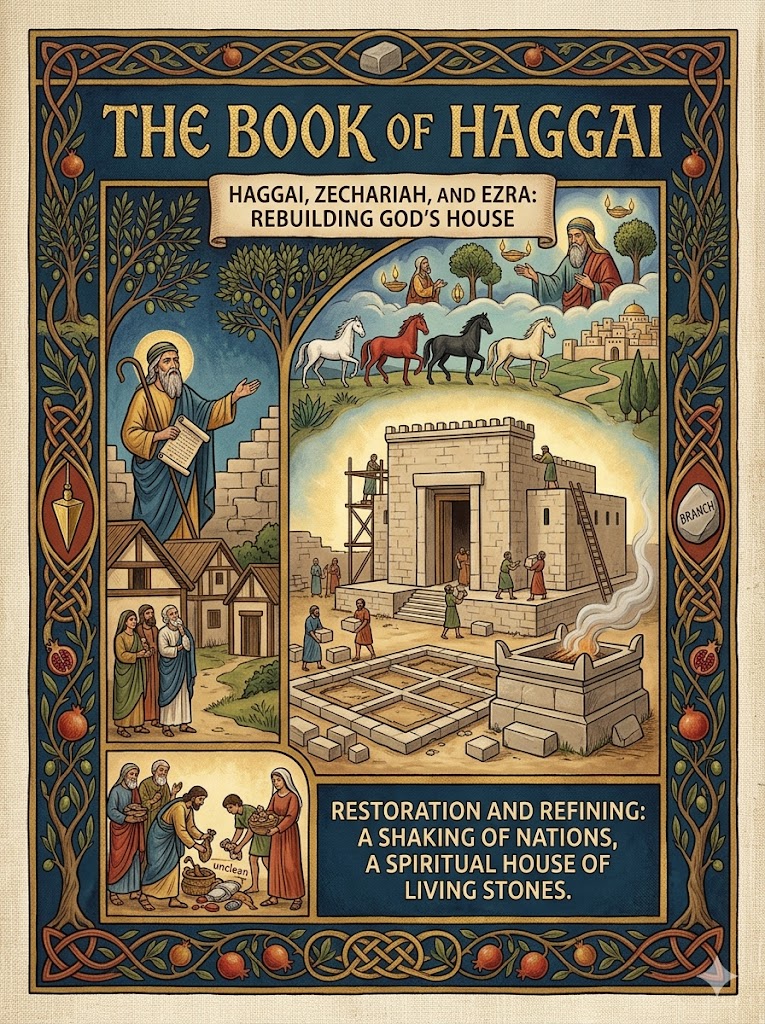
The Book of Haggai
Working Statement — Haggai and Zechariah
What the prophets Haggai and Zechariah together reveal is the rebuilding of God’s house after the exile. Haggai speaks in a very direct manner with little symbolic language, while Zechariah uses visions and symbols. When the two prophets are read together, they provide a fuller understanding of the restoration that took place.
Haggai shows that the people had begun the work but left it unfinished. According to the historical record, the people rebuilt the altar and laid the foundation of the temple, but the construction of the house itself stopped due to opposition from surrounding nations.
The order recorded in Scripture is important. The altar was restored first so that sacrifices could resume and the people could maintain their covenant relationship with God. After this, the foundation of the temple was laid, marking the beginning of the rebuilding of God’s house.
In the New Covenant, the sacrificial system reaches its fulfillment in Christ. Scripture states that believers now have an altar connected to Christ’s sacrifice (Hebrews 13:10). Through His sacrifice, the covenant relationship with God is maintained.
The New Testament also explains that God’s house is no longer merely a physical building. Believers themselves become the spiritual house of God, described as living stones built together (1 Peter 2:5).
Therefore, the restoration under Zeru4bbabel reveals a pattern:
- The altar restored the means by which the covenant relationship could continue.
- The foundation of the temple was laid.
- The house of God was to be built.
In the New Covenant, this pattern finds its fulfillment as Christ becomes the sacrifice and cornerstone, and the people of God become the spiritual house built upon Him
Haggai and the Meaning of the House
In the time of the prophet Haggai, the people who had returned from captivity had begun the work of restoring the worship of God. The altar had been rebuilt and the foundation of the temple had been laid. However, the building of the house of God was left unfinished.
Instead of completing the temple, the people turned their attention to their own homes.
Haggai rebukes them for this directly.
Haggai 1:4
“Is it time for you, O ye, to dwell in your ceiled houses, and this house lie waste?”
At the time Haggai spoke these words, the situation was physical and historical. The temple in Jerusalem remained unfinished while the people invested their effort into their own houses.
However, the concept of the house of God later takes on a much greater meaning in the New Testament.
The New Testament explains that the house of God is not limited to a physical structure made of stone.
1 Peter 2:5
“Ye also, as lively stones, are built up a spiritual house, an holy priesthood…”
In this sense, the house of God becomes a spiritual house composed of the people of God themselves.
The New Testament also describes believers collectively as the temple in which God dwells.
1 Corinthians 3:16
“Know ye not that ye are the temple of God, and that the Spirit of God dwelleth in you?”
When these passages are considered together, the warning given through Haggai gains an additional level of meaning. While the immediate message addressed the rebuilding of the physical temple, the broader biblical pattern shows that God’s true house ultimately refers to the people among whom He dwells.
The historical rebuilding under Zerubbabel therefore becomes a picture of a greater reality revealed later in Scripture: God’s desire to dwell among His people and build them together into His house.
Refined Draft (Close to Your Original)
In the books of Haggai and Zechariah we see two sides of the same moment in Israel’s history. Haggai speaks in a direct and historical manner, while Zechariah presents visions and symbolic language that reveal a deeper spiritual dimension of the same restoration.
Haggai rebukes the people because they had turned their attention to their own lives while leaving the house of God unfinished. The people had rebuilt the altar and the foundation of the temple had been laid, yet the work of building the house itself had stopped. Instead of completing the temple, the people focused on building and maintaining their own homes.
Haggai confronts this condition directly:
“Is it time for you, O ye, to dwell in your ceiled houses, and this house lie waste?” (Haggai 1:4)
The problem was not that the altar had not been restored or that the foundation had not been laid. The problem was that the house of God, the place where God would dwell among His people, remained unfinished.
When the New Testament explains the meaning of God’s house, it reveals a much greater reality. God’s house is no longer only a physical building made of stone.
1 Peter 2:5 describes believers as “living stones” being built into a spiritual house, and 1 Corinthians 3:16 teaches that the people of God themselves become the temple in which His Spirit dwells.
Zechariah’s visions add another layer to the same restoration. In Zechariah’s prophecy, a stone is set before the high priest Joshua, and that stone is connected with God’s watchful presence and His work among His people (Zechariah 3:9). Later in the same book, Zerubbabel is shown laying the foundation and completing the temple (Zechariah 4:9).
Together, Haggai and Zechariah show the same situation from two perspectives. Historically, the people had begun the restoration but had not completed the house of God. Spiritually, the prophets reveal the deeper meaning of God’s house and the need for His presence to dwell among His people.
The central issue in both books is therefore the same: the people had begun the work of restoration but had allowed their own priorities to take precedence over completing the house where God would dwell among them.
Zechariah records the statement that the people would look upon the one whom they pierced. The Gospel of John later cites this passage when describing the piercing of Jesus during the crucifixion. The New Testament also teaches that people can share responsibility for Christ’s death not only through the physical act but through spiritual rejection of Him. In this way the piercing described in Zechariah and the event recorded in John both testify to the rejection of the Messiah.
Zechariah records that the people would look upon the one whom they pierced and mourn. When Christ was pierced during the crucifixion, the Gospel of John cites this passage as a witness to that event. In this way Zechariah’s statement and John’s testimony stand together as two witnesses concerning the piercing of the Messiah.
Zechariah’s prophecy later speaks of events that the New Testament directly connects to the Messiah. The prophet describes a shepherd whose price is set at thirty pieces of silver (Zechariah 11:12–13), a prophecy that the Gospel of Matthew applies to the betrayal of Christ. These people in Zechariah and Haggai have both betrayed Christ and have spiritually killed Christ. The thirty silver piece ties these people directly to Julius betrayal of Christ show they are guilty of the same, and the piercing connect these people directly to the killing of Christ. These people have spiritually betrayed and killed Christ. Once that see what they have done they mourn heavily for it.
Zechariah speaks of the one whom the people pierced. John later cites this passage at the crucifixion, showing that the piercing in Zechariah reaches its visible manifestation in the death of Christ. In this way, the piercing is not merely a detail of the crucifixion account, but a witness to the people’s guilt in the killing of the Messiah.
The Gospel account records that after Jesus had died on the cross, a Roman soldier pierced His side with a spear. This act confirmed His death and fulfilled the Scripture concerning the piercing of the Messiah.
John 19:34
“But one of the soldiers with a spear pierced his side, and forthwith came there out blood and water.”
John then immediately connects this event with the words spoken by the prophet Zechariah.
John 19:37
“And again another scripture saith, They shall look on him whom they pierced.”
In this way the Gospel records the physical piercing of Christ, while also identifying it as the event that corresponds with the statement given in Zechariah concerning the one who was pierced.
Draft — Zechariah Reveals the Deeper Conflict
The book of Haggai shows the outward result of the work done under Zerubbabel. The altar was restored, the foundation of the temple was laid, and the people were called to finish building the house of God.
However, this is not the entire picture. When the book of Zechariah is examined, the spiritual dimension behind this restoration begins to appear.
In Zechariah’s visions we see movements of forces symbolized by horses sent out from before the Lord.
Zechariah 6:2–6 describes these horses going to different directions of the earth. The black horses go toward the north country, followed by the white horses. After this movement the text states that the Lord’s Spirit is quieted in the north.
This imagery shows that events affecting the covenant people are not merely political or historical but part of a larger spiritual conflict unfolding under God’s authority.
Later in the book the conflict becomes clearer.
Zechariah 9:13
“When I have bent Judah for me, filled the bow with Ephraim, and raised up thy sons, O Zion, against thy sons, O Greece…”
This language reveals tension and struggle surrounding God’s people.
The book eventually describes a division among the people themselves. Not all are refined.
Zechariah 13:8–9
“Two parts therein shall be cut off and die; but the third shall be left therein.
And I will bring the third part through the fire, and will refine them…”
This shows that the restoration associated with Zerubbabel does not represent the refining of all the covenant people. Instead, only a portion are purified, while others are removed.
Through these visions Zechariah reveals a deeper reality behind the historical rebuilding of the temple recorded in Haggai. The prophets together show that the rebuilding of God’s house is connected with a process of division, testing, and refinement among the people themselves.
Haggai records the physical rebuilding of the temple under Zerubbabel. Zechariah, speaking at the same time, reveals the larger spiritual reality behind that work. While Zerubbabel lays the foundation and leads the rebuilding of the house, Zechariah points to the Branch who will ultimately build the temple of the LORD and rule as both king and priest.
The two prophets therefore complement one another. The book of Zechariah provides the broader spiritual picture. Through visions and symbolic language, Zechariah reveals the deeper reality behind the restoration and points to the work God is accomplishing among His people. The prophet shows that the rebuilding of the temple is part of a larger work connected to the Branch and the establishment of God’s house.
The book of Haggai, however, focuses on the practical details of the work itself. Rather than presenting visions, Haggai addresses the people directly and calls them to complete the rebuilding of the temple under the leadership of Zerubbabel. In this way Haggai records the specific actions taken to restore the house of God.
Taken together, the two prophets present both sides of the same event. Zechariah reveals the spiritual meaning of the restoration, while Haggai records the practical work through which that restoration was carried out.
Chapter 2
Draft — Beginning Chapter 2 of Haggai
At the end of chapter one in Haggai, the people respond to the prophet’s rebuke. The remnant of the people begin to obey the voice of the Lord and resume the work of rebuilding the house of God. The temple project that had been neglected is taken up again under the leadership of Zerubbabel and Joshua.
The text records that the Lord stirred the spirit of the leaders and of the people so that the work could begin again.
Haggai 1:14
“And the LORD stirred up the spirit of Zerubbabel… and the spirit of Joshua… and the spirit of all the remnant of the people; and they came and did work in the house of the LORD of hosts.”
This moment marks a turning point. The people who had previously neglected the house of God begin to obey, and the rebuilding of the temple resumes.
When chapter two begins, however, another problem appears. Many of the older people remembered the former temple built by Solomon. When they looked at the new temple being constructed by this small remnant, it seemed insignificant in comparison.
Haggai 2:3
“Who is left among you that saw this house in her first glory? and how do ye see it now? is it not in your eyes in comparison of it as nothing?”
The remnant now rebuilding the temple is small, and the structure they are able to build appears far less impressive than the former house.
Yet God’s response is not focused on the size of the building. Instead, He reveals that His purpose extends far beyond the immediate situation. Through Haggai the Lord declares that He will shake the nations and fill His house with glory.
Draft — The Shaking of the Nations
Although the temple being built by the remnant appeared small compared to the former temple of Solomon, God directs the people to look beyond what they see in the present moment. The work being done under Zerubbabel is part of a much larger purpose that God is carrying out among the nations.
Through the prophet Haggai the Lord declares that He will shake the heavens and the earth.
Haggai 2:6–7
“For thus saith the LORD of hosts; Yet once, it is a little while, and I will shake the heavens, and the earth, and the sea, and the dry land;
And I will shake all nations, and the desire of all nations shall come: and I will fill this house with glory, saith the LORD of hosts.”
This statement shows that the rebuilding of the temple in Haggai’s day is connected to events far greater than the small structure being built in Jerusalem. God speaks of a future shaking that will affect the heavens, the earth, and the nations themselves.
The message is meant to encourage the remnant. The temple they are building may appear small, but God’s plan is not limited to the size of the building. The work they are doing is connected to a greater purpose in which the Lord will act among the nations and fill His house with glory.
This promise also shifts the focus away from the physical appearance of the temple and toward the work that God Himself will accomplish. The glory of the house will not depend on the strength or numbers of the people rebuilding it, but on what the Lord will do in His appointed time.
Draft — The Glory of the Latter House
After declaring that He will shake the heavens and the earth and all nations, the Lord reminds the people that the wealth and resources of the world are under His authority.
Haggai 2:8
“The silver is mine, and the gold is mine, saith the LORD of hosts.”
The people rebuilding the temple were few in number and limited in resources. Compared with the temple built by Solomon, the structure they were raising seemed small and unimpressive. Yet God reminds them that the glory of His house does not depend on the wealth or power of the people doing the work. All wealth ultimately belongs to Him.
Because of this, the Lord declares that the future glory of the house will surpass the former.
Haggai 2:9
“The glory of this latter house shall be greater than of the former, saith the LORD of hosts: and in this place will I give peace.”
This promise goes beyond the immediate rebuilding project. The temple being restored under Zerubbabel did not match the physical splendor of Solomon’s temple. Yet God declares that the latter house will ultimately possess a greater glory.
The promise therefore points to a future fulfillment in which God’s presence and peace will be established in His house in a way that surpasses what had existed before.
Draft — The Lesson of Holiness and Uncleanness
After speaking about the future glory of the house, the prophet turns to explain the spiritual condition of the people and why they had previously lacked blessing.
Haggai 2:12–13
“If one bear holy flesh in the skirt of his garment, and with his skirt do touch bread, or pottage, or wine, or oil, or any meat, shall it be holy?
And the priests answered and said, No.
Then said Haggai, If one that is unclean by a dead body touch any of these, shall it be unclean?
And the priests answered and said, It shall be unclean.”
Haggai asks the priests these questions because they were responsible for understanding and teaching the Law. The first question concerns whether holiness spreads indirectly from one object to another. The priests answer that it does not. A holy object touching something else does not automatically make the second object holy.
The second question concerns uncleanness. When something unclean touches another object, the priests answer that the uncleanness does spread.
Haggai then applies this principle to the people themselves.
Haggai 2:14
“So is this people… and so is every work of their hands; and that which they offer there is unclean.”
The people believed that because they had restored the altar and begun the temple work, their offerings would be acceptable to God. But the prophet shows that their spiritual condition was still corrupt. Just as uncleanness spreads easily while holiness does not, the impurity of the people had affected the work they were doing.
This explains the hardship they had experienced in their harvests.
Haggai 2:16
“When one came to an heap of twenty measures, there were but ten… when one came to draw fifty vessels from the press, there were but twenty.”
Their labor produced far less than expected. The problem was not their farming or their effort; it was that God had withheld blessing because the people had neglected His house.
The Lord confirms this in the next verse.
Haggai 2:17
“I smote you with blasting and with mildew and with hail…”
God reminds them that the hardships they experienced were part of His correction, meant to turn their attention back to Him and to the rebuilding of His house.
Draft — The Turning Point: From Lack to Blessing
After reminding the people of the hardship they had experienced, the Lord calls them to consider the moment when the rebuilding of the temple resumed.
Haggai 2:18
“Consider now from this day and upward, from the four and twentieth day of the ninth month, even from the day that the foundation of the LORD’S temple was laid, consider it.”
The people are asked to remember a specific moment in time — the day when the work on the temple was taken up again. Haggai directs their attention to this point because it marks the beginning of a change in their condition.
Up to that time, their labor had produced little. Their harvests were reduced and their work brought little reward. But once the people turned their attention back to the house of God and resumed the rebuilding of the temple, the situation began to change.
The Lord then gives the promise that from that day forward He will bless them.
Haggai 2:19
“Is the seed yet in the barn? yea, as yet the vine, and the fig tree, and the pomegranate, and the olive tree, hath not brought forth: from this day will I bless you.”
The crops had not yet produced fruit, and the outward evidence of blessing had not yet appeared. Nevertheless, God declares that the change has already begun. From the moment the people obeyed and resumed the work of rebuilding His house, the direction of their circumstances would turn from lack to blessing.
This statement closes the central message of Haggai’s prophecy to the people. When the house of God was neglected, their labor produced little. When the people obeyed and restored the work of the temple, the Lord declared that blessing would begin again.
Draft — The Final Message to Zerubbabel
After declaring that blessing would return to the people, the word of the Lord comes again to Haggai on the same day with a message directed specifically to Zerubbabel, the governor of Judah.
Haggai 2:21
“Speak to Zerubbabel, governor of Judah, saying, I will shake the heavens and the earth.”
The Lord repeats the promise that the heavens and the earth will be shaken. This language points beyond the immediate situation of rebuilding the temple and suggests a future upheaval among the nations.
The prophecy continues with a description of the overthrow of earthly powers.
Haggai 2:22
“And I will overthrow the throne of kingdoms, and I will destroy the strength of the kingdoms of the heathen…”
This statement shows that the work taking place in Jerusalem was not isolated from the wider world. While the remnant rebuilt the temple, God declared that He would ultimately shake the nations and overturn the power of earthly kingdoms.
The prophecy then turns back to Zerubbabel personally.
Haggai 2:23
“In that day, saith the LORD of hosts, will I take thee, O Zerubbabel… and will make thee as a signet: for I have chosen thee.”
The image of the signet ring represents authority and ownership. A signet ring was used by a king to seal official documents and to signify his authority. By describing Zerubbabel as a signet, the Lord declares that he has been chosen and set apart for the work that is being carried out.
Closing Summary of the Book
The message of Haggai therefore unfolds in a clear progression.
First, the people are rebuked for neglecting the house of God while focusing on their own houses. Because of this neglect, their labor produced little and their harvests were reduced.
Second, the remnant of the people respond to the prophet’s message. Their spirits are stirred, and they resume the work of rebuilding the temple under the leadership of Zerubbabel and Joshua.
Third, God promises that although the temple they are building appears small compared with the former house, its future glory will surpass the former, and the Lord will shake the nations and fill His house with glory.
Finally, the book closes with a message to Zerubbabel, affirming that he has been chosen for the work being done and connecting the rebuilding of the temple with God’s larger purpose among the nations.
Taken together, the book of Haggai records both the rebuke and encouragement given to the remnant as they resumed the rebuilding of the house of God. It shows how obedience restored the work of the temple and marked the beginning of renewed blessing among the people.
Draft — Haggai and Zechariah Together
The two prophets speak to the same generation but reveal different aspects of the same work. The book of Haggai focuses on the practical rebuilding of the temple and the obedience required from the people. The book of Zechariah, speaking at the same time, provides visions that reveal the deeper spiritual realities surrounding the restoration.
Zechariah shows that the covenant people are not all in the same condition. The prophet speaks of division and refinement among the people themselves. In one place he describes the people being tested so that only a portion are refined.
Zechariah 13:8–9
“Two parts therein shall be cut off and die; but the third shall be left therein.
And I will bring the third part through the fire, and will refine them…”
This passage shows that the restoration of God’s house does not involve the entire covenant people equally. A refining process takes place in which only a portion emerge purified.
Haggai explains an important reason for this refining. When the prophet questioned the priests concerning holiness and uncleanness, he showed that holiness does not spread automatically.
Haggai 2:12–14
The people believed that because they were involved in the rebuilding of the temple and touching holy things, they would become holy themselves. Yet the prophet shows that touching what is holy does not make a person holy if their heart has not turned to God.
Because of this condition, the people were corrected and refined through hardship. Their harvests were reduced and their labor produced little until they turned back to the work of the Lord.
When these passages are read together, Haggai and Zechariah show both the outward rebuilding of the temple and the inner testing of the people. Some among the covenant people remain faithful and are refined through trial, while others follow a different path.
The Scriptures later describe a similar pattern among the people of God, where a remnant remains faithful while conflict arises around them.
Revelation 12:17
“And the dragon was wroth with the woman, and went to make war with the remnant of her seed, which keep the commandments of God, and have the testimony of Jesus Christ.”
In this way the rebuilding described in Haggai and the visions given to Zechariah together reveal both the restoration of God’s house and the refining of His people.
Structural Parallel: Haggai, Zechariah, and Revelation
The prophets Haggai and Zechariah describe the restoration of the house of God after the exile. The altar is restored, the foundation of the temple is laid, and the people are called to complete the rebuilding of the house of the Lord.
At the same time, Zechariah reveals that the covenant people are not all in the same condition. The prophet speaks of division and refinement among them.
Zechariah 13:8–9
“Two parts therein shall be cut off and die; but the third shall be left therein.
And I will bring the third part through the fire, and will refine them…”
This shows that only a portion of the covenant people remain after a period of testing and refinement.
Haggai explains part of the reason for this refining. When the prophet asks the priests about holiness and uncleanness, he shows that touching something holy does not automatically make a person holy.
Haggai 2:14
“So is this people… and so is every work of their hands; and that which they offer there is unclean.”
The people believed that participation in holy activity would make them holy, but the prophet shows that their hearts must turn to God. Because of this condition, correction and testing come upon the people.
A similar pattern appears later in the book of Revelation. In Revelation the dragon makes war with a remnant who remain faithful.
Revelation 12:17
“And the dragon was wroth with the woman, and went to make war with the remnant of her seed, which keep the commandments of God, and have the testimony of Jesus Christ.”
In both cases the Scriptures describe a situation in which the people of God are not uniform. Some remain faithful, while others follow a different path. The faithful remnant endures testing and conflict but remains committed to God. This other group of people are covenant people that keep the sabbath, Passover and the holy days but that does no made them holy.
Closing Paragraph — Transition to Ezra
The prophets together lead the reader toward the full understanding of the events surrounding the rebuilding of the house of God. The book of Haggai records the practical work of rebuilding the temple and the obedience required from the people. The book of Zechariah reveals the deeper spiritual dimension behind that work, showing the refining and division that occurs among the covenant people.
When these two prophets are read together, the broader picture of the restoration begins to emerge. Yet the story does not end with these prophets alone. One more witness speaks about the same events.
The book of Ezra records the historical account of the rebuilding and provides the final perspective on the work carried out under Zerubbabel and Joshua.
By placing these witnesses together—Haggai, Zechariah, and Ezra—the full account begins to come into view. Following the method given in Isaiah 28, the understanding of these events comes through assembling the testimony line upon line and precept upon precept.
For this reason we now turn to the book of Ezra to continue the account and seek the final understanding of the events surrounding the rebuilding of the house of God.