


Book 06 : Foundations
Book 06 : Foundations
- Chapter 1 The Lost Ten Tribes
- 🔧 Chapter 2 — Refined
- Chapter 3 — Jeremiah’s Mission: Planting the Seed (Refined)
- Chapter 4 — The Bloodline Hidden in Cornwall (Refined)
- Chapter 5 — The Fall of Assyria and the Path North (Refined)
- Chapter 6 — The Early Struggle in Britain (Refined)
- 📖 Chapter 7 — The Gathering of the Tribes
- 📖 Chapter 8 — Storyline Flow
- Chapter 9 — Cedric: The Bridge and the Separation (Corrected)
- 📖 Chapter 10 — Alfred the Great
- Chapter 11 Britain find the law
- Chapter 12 The Covenant Written in Stone
- Chapter 13- The Bloodline of David in Britain
- Chapter 14 — The Prophecy Fulfilled
- Chapter 15 — Messiah
- Chapter 16 Opening to the Next Chapter
- Chapter 17 — Messiah and the Birthright Fulfilled
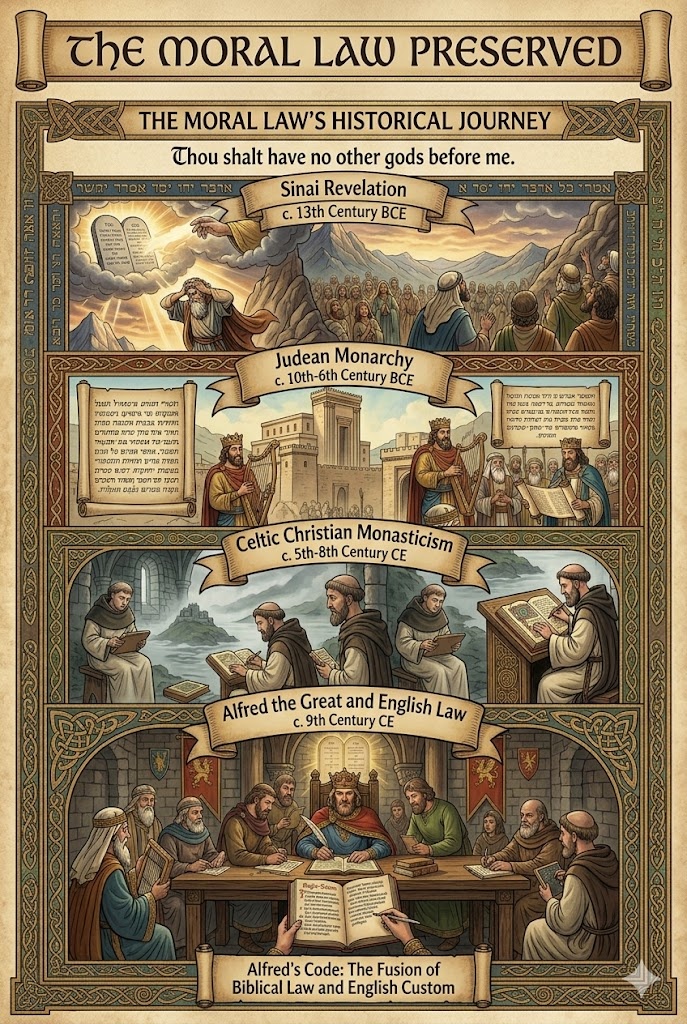
Chapter 1 The Lost Ten Tribes
The Moral Law Preserved
The story begins at Sinai. When God gave Israel the Ten Commandments, He established more than just rules—He revealed His own character. These ten words, spoken by God and written on stone, formed the foundation for all the laws that would govern His people:
“And God spake all these words, saying… Thou shalt have no other gods before me…” (Exodus 20:1–3)
These commandments defined Israel’s relationship with God and with one another. They were not arbitrary; they expressed enduring principles of justice, righteousness, and covenant order.
From these Ten Commandments flowed the broader structure of Israel’s law. The moral law established the core principles of worship and conduct. The civil laws applied those principles within society—addressing justice, restitution, and governance. The ceremonial system pointed toward holiness through sacrifice, anticipating a future fulfillment. Each aspect was rooted in the same foundation established at Sinai. The Ten Commandments formed the basis of covenant life and were preserved as the central standard within Israel.
Judah, as the tribe associated with kingship, carried this law forward within its national structure. The framework of Judah’s governance reflected the same principles given at Sinai: reverence toward God, rejection of idolatry, protection of life, and the pursuit of justice. This continuity demonstrates that the covenant law was not isolated to a moment in history, but functioned as an ongoing standard within the people of Israel.
Centuries later, elements of this same moral framework appear in regions far removed from Jerusalem. In the early Christian communities of the British Isles—often associated with what is now called Celtic Christianity—there is evidence of strong emphasis on Scripture, moral instruction, and disciplined religious life. These communities placed importance on biblical teaching, literacy, and moral conduct derived from Scripture. While historical records are limited and varied, the presence of these elements shows a continuity of biblical influence distinct from later institutional developments.
This influence becomes significant when examining the formation of early English law. Alfred the Great, ruling in the 9th century, produced a legal code that begins with biblical material, including portions of the Ten Commandments and Mosaic law. His prologue explicitly references these sources, showing that his legal framework was shaped in part by Scripture rather than solely by existing pagan or Roman systems.
This does not establish a direct transfer of covenant authority as described in the Bible, but it does demonstrate a historical alignment: the same moral structure introduced at Sinai appears again as a guiding framework in the development of law in Britain. The principles themselves remain consistent—justice, accountability, and moral responsibility rooted in divine law.
The result was a significant transformation in legal and moral structure. Systems once governed by tribal custom increasingly reflected codified standards influenced by biblical teaching. The concept of a ruler operating under law—rather than above it—emerges clearly in this period. This reflects a pattern consistent with the biblical model, where kings were subject to the law of God rather than independent from it.

🔧 Chapter 2 — Refined
The House of Israel and the Fall of Judah
After Solomon’s reign, the kingdom of Israel divided into two houses: the ten tribes of the north, known as the House of Israel, and the southern kingdom, known as the House of Judah, consisting of Judah, Benjamin, and Levi. The northern tribes turned to idolatry, rejecting the covenant established by God. Prophets were sent to warn them, but they did not turn back.
In time, Assyria rose to power. Samaria was besieged, its defenses broken, and its people carried away into captivity (2 Kings 17). The ten tribes were removed from their land and scattered throughout the Assyrian empire. From this point forward, the biblical record no longer follows them as a distinct national body within the land, and their historical path becomes less directly traced within Scripture.
Judah, however, remained. For another century, the southern kingdom continued under the line of David. Though often marked by corruption, it still preserved something central to God’s promise: the throne of David. God had declared:
“Thine house and thy kingdom shall be established for ever before thee: thy throne shall be established for ever.” (2 Samuel 7:16)
This promise becomes central to understanding what follows.
In 586 BC, Babylon rose against Judah. Jerusalem was besieged, the city fell, and the temple was burned (2 Kings 25). King Zedekiah, the last king of Judah, was captured. His sons were slain before him, and then his eyes were put out, and he was taken to Babylon in chains. From an outward perspective, the visible line of Davidic rule in Judah appeared to come to an end.
Yet the biblical record shows that the line itself was not extinguished. Zedekiah had daughters (Jeremiah 43:6), preserving the royal bloodline. At the same time, the prophet Jeremiah had been given a unique commission:
“See, I have this day set thee over the nations and over the kingdoms, to root out, and to pull down, and to destroy, and to throw down, to build, and to plant.” (Jeremiah 1:10)
This commission includes both destruction and restoration. While Jeremiah’s role in warning Judah is clear, the latter portion of his commission—“to build and to plant”—indicates a forward action that extends beyond the fall of Jerusalem.
The text does not explicitly detail how this aspect of Jeremiah’s commission was fulfilled. However, the presence of the royal line through Zedekiah’s daughters, combined with Jeremiah’s assigned role involving both removal and planting, establishes a structural connection that must be accounted for in any complete understanding of the continuation of David’s throne.
Thus, the House of Israel had been removed from the land and scattered, and the House of Judah had fallen to Babylon. The throne in Jerusalem had ceased. Yet the covenant promise to David remained unchanged.
The biblical narrative leaves the account at this point without directly tracing the continuation of the throne within the land of Judah. This creates a necessary question within the structure of the text:
👉 Where did the throne of David go?

Chapter 3 — Jeremiah’s Mission: Planting the Seed (Refined)
When the House of Israel had fallen, and later Judah fell to Babylon, it appeared that God’s covenant nation had come to an end. The throne of David was no longer in Jerusalem, the temple was destroyed, and the people were scattered. Yet God had made a promise to David—that his throne would never cease. That promise could not fail.
At this point, the role of the prophet Jeremiah becomes central. His commission was unlike that of any prophet before him. God declared that Jeremiah was appointed “to root out, and to pull down, and to destroy, and to throw down, to build, and to plant” (Jeremiah 1:10). This was not a mission of judgment alone, but one that included restoration.
Jeremiah lived through the fall of Judah. He witnessed the destruction of Jerusalem and the rise of Babylon over God’s people. But his commission did not end with the tearing down. It extended to planting—carrying something forward that would preserve what God had promised.
History records that Jeremiah was taken with the king’s daughters out of Judah. Though the king’s sons had been killed, the daughters survived, and through them the line of David remained. God’s promise was not broken. The royal line continued, even though the throne in Jerusalem had fallen.
But Jeremiah carried more than a bloodline. He carried the covenant—the law and truth that Israel had abandoned. What had been rejected in the land of Judah was now being carried into a different setting, one where it could take root over time.
In this, Jeremiah’s commission begins to unfold more fully. He had witnessed the tearing down of a nation in rebellion, but he was also involved in planting something that would continue beyond that destruction. The throne of David was not ended—it was preserved. The truth of God was not extinguished—it was carried forward.
Jeremiah’s immediate responsibility was to preserve that line. With Jerusalem destroyed and the royal sons killed, it appeared that the throne had been cut off. Yet the promise remained, and the survival of the king’s daughters meant the line could continue. That preservation became part of Jeremiah’s task.
At first, Jeremiah was taken into Egypt with a remnant of Judah. This was not a final destination, but a temporary stage. Even there, Jeremiah prophesied that Egypt itself would fall to Babylon, showing that it could not serve as a place of long-term safety.
Egypt, however, provided something critical—a point of access. For centuries, Israel had been connected to wider trade networks through the Phoenicians. These routes extended across the Mediterranean and beyond, reaching into the western regions.
The Phoenicians had long-standing ties with Israel, going back to the time of Solomon. Through these connections, trade routes had already been established between the East and the distant lands of the West. Among those regions were the Celtic territories, known for valuable resources such as tin, particularly in areas like Cornwall.
These routes were not new or uncertain. They had been in use for generations, linking the Mediterranean world with the far western lands. Through them, goods, culture, and contact had already passed back and forth.
In this context, Egypt functioned as an entry point into that established network. From there, movement beyond the immediate reach of Babylon became possible. What had been destroyed in Judah was not simply lost—it was being carried along a path that had already been prepared.
In this way, Jeremiah’s commission to “plant” begins to take clearer shape. What was preserved was not only a lineage, but the foundation of something that would continue to develop beyond the fall of Judah.
“…the Celts, where the seed of God’s government would begin to take root—carried forward through the preserved throne of David.”

Chapter 4 — The Bloodline Hidden in Cornwall (Refined)
Jeremiah’s role was not only to prophesy, but to act. His mission had become immediate: the bloodline of David had to be preserved. Judah had fallen. Babylon had broken the city, scattered the people, and ended the visible throne in Jerusalem. Yet the promise to David remained.
Jeremiah, carrying both the Word of God and the king’s daughters, could not remain where Babylon’s reach would soon extend. Egypt offered only temporary shelter. Jeremiah himself declared that Egypt would also fall under Babylon’s power. It was not a place of safety, but a transition point.
There was only one viable path forward—one that had been established long before the crisis.
That path was through trade.
For centuries, Israel had been connected to merchants who traveled across the Mediterranean and beyond. These were not temporary arrangements, but established networks built on ongoing exchange. Resources moved between regions—metals from the western territories and goods from the East—linking distant lands through consistent routes.
Among these western regions were the Celtic territories, including areas such as Cornwall. These lands were already part of the trade network, known and accessible through routes that had been used for generations.
What set these regions apart was not only their distance from Babylon, but their environment. Unlike the dominant empires of conquest, these societies operated with different customs. There was a recognized respect for women and for those who came from outside their lands. This created a setting that was more stable for those seeking refuge than the surrounding powers driven by expansion and control.
Jeremiah’s movement was not random or reactionary. He was not acting out of panic, nor simply escaping danger. His mission required direction. The same networks that had connected Israel to the outer regions now provided a means of movement beyond Babylon’s immediate reach.
Through these established routes, passage into the far western territories became possible. What had been destroyed in Judah was not abandoned—it was being carried forward into a place where it could be preserved.
The mission remained twofold: to preserve the royal line and to carry forward what had been entrusted to that line. In these distant regions, removed from the centers of Babylonian control, the conditions existed for that preservation to continue.
Jeremiah’s Hidden Path (Refined)
At this stage, both history and prophecy must be considered together. Judah had fallen, and Jeremiah was no longer operating within a functioning nation. Yet he was not acting independently—he was operating within the scope of a divine commission.
A prophet does not move without purpose. The preservation of the Davidic line required more than escape; it required a path that would remain outside the reach of those seeking to eliminate it.
That path already existed.
The trade routes linking the Mediterranean to the western territories were established, reliable, and capable of moving people as well as goods. The regions connected to these routes, including the Celtic lands, were known for receiving travelers through these exchanges.
This is where interpretations begin to divide.
Some acknowledge the existence of these routes and recognize that Egypt could not serve as a final destination. They accept that movement beyond Egypt would have been necessary. Yet they stop short of following that path to its logical conclusion.
Others move in the opposite direction, abandoning established history and turning to unverified traditions and legends. In doing so, they move away from a traceable path and into speculation.
Neither approach follows a consistent method.
What must be recognized is that the path itself was set in such a way that it would not be obvious through surface-level observation alone. It requires following the sequence that has been laid out—step by step—without stopping short or moving beyond what can be established.
When that path is followed, the direction remains consistent. The routes are known, the access points are established, and the movement away from Babylon’s reach is accounted for.
At this stage, the pattern is not yet fully concluded—but the direction is set.
“…shows only that Jeremiah had to hide the bloodline from Babylon, which was actively seeking to destroy it.
The path, when followed step by step, leads in one consistent direction: Jeremiah carrying the surviving daughters of Judah beyond Babylon’s reach into the far western territories. There, the bloodline would be concealed—kept out of sight, preserved among the people, and held until the time God would bring it forward.”

Chapter 5 — The Fall of Assyria and the Path North (Refined)
After the preservation of the Davidic line in the far west, another major shift was unfolding across the eastern world—the fall of Assyria.
For centuries, Assyria had dominated the Near East. Its armies had conquered the northern kingdom of Israel and scattered its people across a vast empire. But no empire endures indefinitely. By the time of Jeremiah, Assyria was already weakening under pressure from multiple directions.
From the east and south, Babylon and the Medes advanced. At the same time, pressure came from the north. Groups broadly identified in history as Scythians moved down from the steppe, disrupting Assyria’s northern regions and contributing to the instability of the empire. Under this combined pressure, Assyria collapsed.
With that collapse came movement.
As imperial control broke apart, displaced populations began to shift. Among those affected were the peoples who had been carried away in earlier conquests. In the regions north of the Black Sea, groups identified in historical records as Cimmerians appear. Over time, these groups are found moving into central Europe.
These movements do not occur in isolation. As populations migrated and merged, new identities formed. Among these emerging groups were the peoples later known as the Celts, who appear across Europe during this general period of transition.
At this stage, what can be observed is movement—peoples relocating, merging, and establishing themselves in new regions across Europe.
Two developments are now running in parallel.
- A preserved royal line, carried westward and maintained beyond the reach of the eastern empires
- A broader population movement, shifting north and west as the structures that once held them dispersed
These movements remain separate at this point in the account, but both follow the same general directional pattern—away from the former centers of control and toward the outer regions of Europe.
The Celtic Rule and the March of Empires (Refined)
Long before the arrival of Rome, Britain was inhabited by Celtic tribes. These groups established settlements, constructed defensive structures such as hillforts, and organized themselves into regional societies. Their presence shaped the island for centuries prior to Roman expansion.
While these developments were taking place in the west, the eastern world continued to shift.
In 539 BC, Babylon fell to the rising Persian Empire under Cyrus. Persia then held dominance for approximately two centuries before being overtaken by Greece under Alexander the Great. By 331 BC, Greek power extended across much of the known world.
This dominance, however, was also temporary. In 146 BC, Rome defeated the Greek powers and expanded its influence across Europe, North Africa, and the Near East, becoming the next dominant empire in the sequence.
Roman Britain and the Anglo-Saxon Transition (Refined)
By the first century before Christ, Rome had expanded its power across much of the known world. Its influence continued to grow until its reach extended to the shores of Britain.
In 43 AD, under Emperor Claudius, Roman forces crossed into Britain. Over time, much of the island was brought under Roman control, though regions in the far north remained outside direct rule. To mark the boundary of its authority, Rome constructed defensive works such as Hadrian’s Wall in the early second century.
For nearly four centuries, Roman administration shaped Britain. Roads, towns, and systems of law were established, integrating the island into the broader structure of the empire.
However, the strength of Rome did not last indefinitely. By the early fifth century, the empire was under increasing pressure from multiple directions. In response to threats on the continent, Roman forces were withdrawn from Britain. In 410 AD, imperial authority formally ended, leaving the island without the support it had relied upon.
With the departure of Roman forces, a power vacuum emerged. Local populations were left to manage defense against external pressures, including groups from the north and seaborne incursions from across the surrounding waters.
In this environment, groups from northern Europe—identified historically as Angles, Saxons, and Jutes—began to arrive. Initially, their presence is associated with military assistance. Over time, however, this shifted into settlement.
By the mid-fifth century, these groups were establishing themselves across different regions of the island. The Angles settled in the eastern and northern areas, the Saxons in the south and west, and the Jutes in southeastern regions such as Kent.
This migration significantly altered the structure of Britain. Earlier populations were displaced or pushed toward the western and northern regions, while the incoming groups established new centers of control.
The result was a transition from a Celtic-dominated landscape to one shaped by Anglo-Saxon settlement. What had begun as external assistance developed into long-term occupation, forming the early foundation of what would later become the English identity.

Chapter 6 — The Early Struggle in Britain (Refined)
Following the withdrawal of Roman authority in the early fifth century, Britain entered a period of fragmentation. Without a central power to maintain order, the island became divided among competing groups.
Three primary populations shaped this period: the Celts, the Angles, and the Saxons.
The Celts, who had occupied the island for centuries, remained established across much of the western and northern regions. Their societies were organized around tribal structures, local leadership, and long-standing cultural traditions.
From across the North Sea came the Angles and the Saxons. These groups originated from regions in northern Europe and began arriving in Britain during the fifth century. Although often grouped together, they were distinct in origin and settlement patterns. The Angles established themselves primarily in the eastern and northern areas, while the Saxons spread through the southern regions.
Initial contact between these groups and the existing populations appears to have included cooperation, particularly in matters of defense. However, this relationship shifted over time. What began as assistance developed into competition for land and control.
Conflict followed.
The existing populations resisted the expansion of incoming groups, while the Angles and Saxons established settlements and extended their influence inland. The result was a landscape defined by division, with multiple regions controlled by different groups.
These divisions were not limited to conflict between native and incoming populations. Rivalries also existed within and among the groups themselves. The island was characterized by fragmentation rather than unity, with no single authority able to bring the regions together.
At this stage, Britain was not a unified nation, but a collection of competing territories shaped by migration, settlement, and conflict. The conditions for future consolidation were present, but not yet realized.
Transition to Leadership (Refined)
In time, the need for stability within this fragmented environment would become increasingly evident. The coexistence of multiple competing groups created conditions that required consolidation for long-term survival and development.
It is within this context that leadership would later emerge capable of unifying previously divided regions. That development, however, belongs to the next stage of the account.

📖 Chapter 7 — The Gathering of the Tribes
Following the withdrawal of Roman authority, Britain remained divided and unstable. The island was occupied by multiple groups, most notably the Celts, the Angles, and the Saxons, each maintaining its own territories and leadership.
The Celts, who had lived in Britain for centuries, continued to hold the western and northern regions. Their societies were structured around tribal leadership and long-standing cultural traditions. Despite their history on the island, they were not unified, and internal divisions limited their ability to respond collectively to external pressures.
From across the North Sea came the Angles and the Saxons. These groups originated from northern Europe and began arriving in Britain during the fifth century. Though often grouped together, they remained distinct in origin and settlement. The Angles established themselves primarily in the eastern and northern regions, while the Saxons expanded into the southern areas.
Initial contact between these groups and the existing populations included cooperation, particularly in matters of defense. However, this arrangement did not remain stable. Over time, competition for land and control led to conflict.
As these conflicts continued, Britain became a landscape defined by division. Territories were controlled by different groups, and rivalries existed not only between the incoming populations and the Celts, but also among the groups themselves. No single authority emerged to unify the island during this period.
The result was a prolonged state of fragmentation. Britain existed as a collection of competing regions rather than a unified structure. The conditions for consolidation were present, but the process had not yet begun.
The Role of Early Leadership: Cerdic
During this period of division, early leadership developments began to shape the future structure of Britain.
Historical records associate the year 495 AD with the arrival of a leader named Cerdic in southern Britain. He is connected with the early formation of what would become the kingdom of Wessex.
Cerdic’s origin has been the subject of ongoing discussion. His name does not align clearly with typical Germanic naming patterns, and some sources suggest possible connections to Celtic naming traditions. This has led to differing interpretations regarding his background, though no single conclusion is universally accepted.
What is more clearly established is his role in the development of Wessex. By the early sixth century, Cerdic is recorded as ruling in that region, forming a leadership line that continued through subsequent generations.
This line would later include Alfred, whose role in the consolidation of Anglo-Saxon territories would mark a significant stage in the movement toward a more unified structure in Britain.
At this stage, the importance of Cerdic lies in his place within that developing line of leadership, rather than in resolving the uncertainty surrounding his origin.

📖 Chapter 8 — Storyline Flow
The movement of nations through history is not always clear on the surface. Records remain, but understanding them has often been incomplete. Historians work with fragments, tracing trade, migration, and political change, yet many connections remain unresolved.
What can be established is that established pathways existed long before the fall of Jerusalem. Trade routes connected the eastern Mediterranean to the western isles, carrying metals such as tin and copper from regions like Cornwall into broader networks of exchange. These routes were known, used, and sustained over long periods of time.
In moments of crisis, such established pathways would naturally become avenues of movement. When Jerusalem fell and the surrounding region came under pressure, movement away from the center of conflict required routes that were already functioning and accessible. The trade networks linking the Mediterranean to the western regions provide one such pathway.
These routes are not hypothetical. Historical records acknowledge their existence and their use in commerce. Goods moved along them consistently, connecting distant regions through established exchange. In other areas of study, such evidence is accepted as reliable in tracing movement and contact between peoples.
At this stage, what can be observed is the presence of a viable path extending from the eastern regions toward the western isles. The existence of this path provides a framework through which movement during times of disruption can be understood.
The Hidden Path
The fall of Jerusalem marked a major turning point, but it did not eliminate the broader systems already in place. Trade networks continued to operate, linking regions across great distances.
Among these, the routes associated with Mediterranean trade extended toward the western coasts, including areas connected with the tin trade. These connections had been maintained for generations and were known to those engaged in long-distance exchange.
In a period marked by upheaval, such routes represent the most stable and accessible means of movement away from regions under threat. The continuity of trade provides a basis for understanding how connections between distant regions were maintained even during times of political collapse.
At this point in the account, the focus remains on the existence and reliability of these pathways, rather than on final conclusions regarding their use in specific events.
Exposing the Myths
In examining this subject, it is important to distinguish between what can be supported and what cannot.
Some approaches rely heavily on unverified traditions, extended genealogies, and accounts that cannot be confirmed through established records. While such material is often presented with confidence, it does not provide a stable foundation for historical analysis.
A structured approach requires that claims be supported by evidence that can be traced and evaluated. Where such support is lacking, conclusions cannot be established.
Any claim must be tested against what can be established. Where information cannot be verified, it cannot serve as proof.
In much of the material presented on this subject, explanations rely on extended traditions, reconstructed genealogies, or accounts that cannot be confirmed through reliable records. These approaches do not provide a stable foundation, because they cannot be consistently tested.
A structured approach requires that conclusions be drawn only from what can be traced and examined. Where the record is limited, the conclusion must remain within those limits.
In this case, both historical and biblical records establish movement toward the western regions. Beyond that point, the record does not continue in a direct or traceable way. This absence is part of the evidence itself.
At this stage, what can be stated is that the record establishes a consistent direction of movement, with no alternative pathway supported by the same level of evidence. This line will be carried forward and tested as the account progresses.
The Hidden Path
The fall of Jerusalem did not end the systems that were already in place. Trade networks continued to function, linking distant regions across the Mediterranean and into the western isles.
Among these, the routes associated with the tin trade connected areas such as Cornwall with broader networks of exchange. These pathways were established long before the events surrounding the fall of Jerusalem and remained in use during periods of disruption.
In times of crisis, movement follows what is already established. These routes provide a framework through which movement from the eastern regions to the western isles can be understood.
At this stage, the record does not present multiple viable alternatives. What it does present is a single consistent pathway that aligns with known trade networks and historical movement. This pathway remains the only one supported by the available evidence at this point in the account.
Separating Record from Reconstruction
In examining this subject, it is necessary to distinguish between what is recorded and what has been added later.
Some accounts attempt to fill gaps in the record by constructing extended narratives, including detailed genealogies and connections that cannot be independently verified. While such reconstructions are presented as explanations, they do not meet the standard of demonstrable evidence.
Where the record is silent, conclusions cannot be established by adding unverified details. Likewise, dismissing established evidence without providing an alternative supported by the record leaves the question unresolved.
A consistent method requires that both additions and omissions be avoided. The conclusion must remain anchored in what is preserved.
The Celtic Root in Cerdic
The same standard must be applied to figures associated with early British leadership.
Cerdic, identified in early records as a foundational figure in Wessex, presents an unusual case. His name does not align clearly with typical Germanic naming patterns and is recognized as Celtic in form. This is a matter of record, not interpretation.
This feature stands out within the context of early Saxon leadership and requires explanation. It represents a point where Celtic naming appears within a developing Anglo-Saxon structure.
Later references associated with Alfred include claims of broader lineage connections. Alfred stated he had Celtic bloodline. In his linage only Cedric is the link of Celtic bloodline. At this stage, what can be established is that these elements raise consistent questions regarding origin and identity within the emerging leadership line.
Within the available record, Cerdic represents a key point where Celtic influence appears in a position of authority, with no equivalent parallel example of the same nature presented in the same context.
This observation will be carried forward and examined in relation to the broader pattern as the account continues.
The Two Lines of Evidence
Throughout this account, the record has not provided a complete, uninterrupted explanation. Instead, it has preserved a path—partial, but consistent.
What can be observed is this:
One line of evidence begins with Jeremiah and the preservation of the royal line during the fall of Jerusalem. The record establishes movement away from the center of conflict and toward regions connected by long-standing trade networks extending to the western isles.
A second line of evidence appears within early British leadership. Cerdic, associated with the formation of Wessex, bears a name recognized as Celtic in form. This feature stands out within the context of early Saxon leadership and continues forward through the line that would later include Alfred.
These two lines do not yet form a complete proof. The record does not provide a continuous, fully documented account connecting every step. What it does provide is a consistent pattern—movement in one direction, and later developments that align with that same line.
At this stage, the evidence does not resolve every question, but it does establish a framework that must be accounted for. No alternative explanation supported by the same level of record has been established alongside it.
The conclusion has not yet been fully drawn. The path has been set.
Closing with Cerdic
Cerdic is identified in historical records as a foundational figure in the development of Wessex. By the early sixth century, he is recorded as ruling in southern Britain, establishing a line that would continue through subsequent generations.
From this line would later come Alfred, whose role in consolidating Anglo-Saxon territories marked a significant stage in the movement toward a more unified structure in Britain.
Cerdic’s importance can be understood in two ways.
First, he represents a point of political formation. His rule is associated with the establishment of a leadership structure in Wessex that would endure and expand over time.
Second, he presents a feature within the record that requires explanation. His name, recognized as Celtic in form, appears within a developing Saxon leadership context. This detail does not resolve the full question of origin, but it remains a consistent element within the record that carries forward into later generations.
At this stage, the record establishes a line of leadership and a pattern within that line. How these elements connect to the broader account will be examined as the structure continues to build
The final resolution of this matter does not come from history alone. It comes from the Bible itself. The questions that remain unresolved in the world today—Jeremiah’s movement, the identity of the lost tribes, the continuity of the line of David, the birthright promises, and the transfer of that authority—are not separate issues. They are connected, and they will be addressed together.
What has been shown so far is a path. History provides movement, patterns, and points of contact. But history does not complete the explanation. That completion belongs to the biblical record.
At present, much of what is taught on these subjects rests on incomplete structure. Claims are made, but they are not consistently supported. Pieces are presented, but they are not brought together into a unified framework.
The purpose of this work is not to repeat those claims, but to establish a structure where each part can be tested and shown in relation to the whole. The full proof will not come from one element alone, but from the agreement of all parts—history and Scripture—working together.

Chapter 9 — Cedric: The Bridge and the Separation (Corrected)
Cerdic stands as one of the most unusual figures in early British history. The record surrounding him is limited. His background is not clearly defined, and his origin remains uncertain within the available sources.
Yet what is recorded about him is enough to establish his importance.
Cerdic appears in southern Britain during a period of transition and becomes associated with the formation of Wessex. From him begins a line of kings that continues through successive generations and extends forward into the later monarchy of Britain.
This alone places him in a critical position within the historical record. The line of rulers that follows from Cerdic is not a minor or isolated development—it becomes central to the structure of British leadership.
But there is a second feature that makes Cerdic stand out.
His name.
Cerdic is not a Saxon name. It is recognized as Celtic in form. This has been noted within historical discussion and remains an unusual feature within the context of early Saxon leadership. Cedric also named his son Celtic names. There is little question that Cedric was of the line of the Celtic people. Some historians say he was of royal brood and other say he was not, however historian do nto argue Cedric was a Celtic name. You also have he record of Alfred who claim Celtic brood. In histrioy there is no other link to the King David’s bloodline Jeremiah was to protect then Cedric. What we have here is not facts to deal with historian do not have fact either. What we have is a path but there must be proof this path is factual that will come later in the book. What we do have is prophecy that David’s bloodline will always be over Israel this is the only path that fulfills the prophesy. That does not make the path proof at this time I am not trying to force that conclusion what I am doing is showing this is the only path the Bible and history gives us at this time.
This creates a point in the record that requires explanation:
- A foundational figure in a Saxon ruling line
- Bearing a name identified as Celtic
This combination is not typical and does not align cleanly with a simple origin.
At this stage, the record does not fully explain this detail. What it does provide is a consistent point of tension within the structure—one that carries forward through the line that develops from him.
A Line That Continues
From Cerdic, the line of Wessex develops and continues across generations. This line later includes Alfred, who plays a central role in consolidating Anglo-Saxon territories.
The continuity of this line is established in later records, showing that the leadership structure associated with Cerdic was preserved and extended until this day.
At this stage, what can be established is:
- A continuous line of rule
- Beginning with Cerdic
- Extending into later British leadership
The origin of that line remains a question to be examined as the structure continues to build.
A Separation Within the Record
The early populations of Britain include distinct groups, notably those identified as Saxons and Angles. These groups develop along separate paths within the historical record.
Cerdic is associated with the Saxon line, specifically within the development of Wessex. This establishes one line of leadership within the broader structure of Britain.
At this stage, what can be observed is the presence of separate developments within the island. These do not yet form a unified structure and must be considered individually within the broader account.
Jeremiah’s Commission (Positioned, Not Proven Yet)
The biblical record describes Jeremiah’s role in both destruction and establishment:
“I have this day set thee over the nations and over the kingdoms, to root out, and to pull down, and to destroy, and to throw down, to build, and to plant.” — Jeremiah 1:10
This establishes a pattern of removal followed by development.
At this stage, the connection between this pattern and the historical developments described earlier is not yet fully drawn. It will be examined as the structure continues to build.
In Jeremiah 1:10, God says: “See, I have this day set thee over the nations and over the kingdoms, to root out, and to pull down, and to destroy, and to throw down, to build, and to plant.”
This was not limited to Judah’s fall to Babylon. Jeremiah’s commission included both destruction and restoration—tearing down a pagan system and planting a covenant-based kingdom. That restoration prophecy finds fulfillment not in the ancient world but centuries later, when the bloodline of David was carried forward and eventually planted into Britain. the prophecy has two sides:
The tearing down of pagan rule—God stripping authority from a corrupted order.
The planting of covenant rule—God establishing His government through the line of David in a new nation. Britain, through the Davidic bloodline, becomes that planted nation.
History is use to back up the Bible however the Bible is the authority. When you look at the historical account you cannot remove the Bible from the story. This prophecy had to be fulfilled that is part of the history. The Bible is not written to back up history it is the other way around. What history is showing us is a path for this prophecy to be fulfilled. The proof of this path has to be confirmed that is what we are doing at this time in the book, showing the path and we will let the Bible confirm it as the book goes along,
The Celtic World Before Change (Refined)
At the time associated with these events (6th century BC), the peoples identified as Celtic were established across regions of western Europe and the British Isles. Archaeological and historical records describe societies structured around tribal leadership, with a significant role played by a priestly class often referred to as Druids.
These systems included religious practices centered on nature, ritual, and seasonal observance. Sacred sites, including groves and natural landmarks, were used for worship and ceremony. Various forms of sacrifice including human sacrifice and divination are also recorded in association with these societies. The Druids were a pagan people with beliefs in pagan gods
The Druids functioned not only as religious figures but also as judges, advisors, and teachers within their communities. Their influence extended into governance, law, and decision-making, giving them a central role in maintaining social order.
At this stage, what can be established is that these societies possessed structure, organization, and systems of authority, though these systems differed from those that would later develop in Britain.
The Druidic Influence
The influence of the Druids within Celtic societies was significant. Their role connected religious practice with governance, allowing them to shape both belief and law.
Historical accounts describe their presence across multiple regions, where they contributed to maintaining cohesion among tribal groups. Their authority was not limited to spiritual matters but extended into political and judicial functions.
When external powers encountered these societies, this structure was recognized as a unifying force. In particular, Roman accounts identify the Druids as a central element in maintaining resistance among Celtic populations.
Roman Response (Refined)
As Roman influence expanded into Britain, these existing structures came into direct conflict with imperial control.
Roman sources describe efforts to dismantle Druidic influence, including the targeting of known centers of activity. Locations such as the island of Mona (Anglesey) are recorded as focal points of this conflict.
These actions were part of a broader effort to establish Roman authority and reduce resistance within the region. The result was a significant disruption of existing religious and social structures among the Celtic populations.
To the modern mind, the Celts can appear romanticized—brave warriors, skilled in craft, bound to nature. But spiritually, they were in darkness. They had governmental structure and discipline, but it was ruled by superstition and the demonic.
This is the backdrop into which Jeremiah’s prophecy fits: God promised a planting of covenant government to replace pagan authority. The Celts were the soil into which the Davidic seed would eventually be mixed. Their discipline, tribal structure, and even reverence for law prepared them, in time, to host the throne of David—though not without conflict and transformation.
The Druidic Stronghold and the Pagan Nation
The Power of the Druids over the Celtic People
Before Rome ever set foot on Britain’s soil, the Celtic tribes were united under a deeply entrenched priestly class: the Druids. Their influence was not merely religious but political and judicial, shaping law, culture, and even the very identity of the Celtic people. To the tribes, the Druids represented wisdom, tradition, and the voice of their gods. They held the power to crown kings, declare wars, and maintain tribal unity. This gave them immense sway over every layer of society.
Rome Sees a Threat
When the Romans arrived, they quickly recognized the danger. The Druids were not just local priests—they were the glue binding Celtic resistance together. Their sacred groves, especially on the island of Mona (Anglesey), became fortresses of rebellion. Roman generals like Suetonius Paulinus made it their mission to uproot this influence. To the empire, the Druids were more dangerous than swords, for they inspired unity in a fractured land. Thus Rome declared their practices outlawed and their religion a threat to imperial stability.
The Roman Assault on the Druids
The Romans struck with force. Sacred oak groves were burned, altars destroyed, and Druid leaders slaughtered. The heart of their power was crushed, and officially, their practices were made illegal across the empire. By the time Rome withdrew from Britain around 410 AD, the once-mighty Druidic priesthood had been broken and scattered.
A Weak but Lingering Pagan Element
Yet Rome’s victory was not absolute. While the organized priesthood was dismantled, fragments of their influence survived. Pagan customs, superstitions, and rituals remained woven into the fabric of Celtic culture. These remnants—though weaker—were enough to continue shaping the beliefs of many. When Rome’s legions left Britain, there was no longer an empire to enforce the ban. The weakened element of Druidism resurfaced in small, fractured ways, mingling with Celtic tribal identity and fueling resistance to new forms of rule.
The Scene Alfred Inherited
By Alfred’s day, the full priestly power of the Druids was gone, but the shadow of their paganism lingered. No longer did Druids train the nobles’ children—that power now belonged to Christian monks who carried the knowledge of Scripture and the ability to shape rulers. But Alfred’s world still faced the embers of that pagan fire, a cultural undercurrent in the Celtic lands that could never fully be ignored.
Jeremiah’s Prophecy, the Druids, and the Pagan Stronghold When Jeremiah spoke of tearing down a pagan nation and raising up a covenant nation in its place, the shadow of pagan power still hung heavy over the Celtic lands.
The Romans recognized the danger. To the empire, the Druids were more than a foreign cult; they were the heartbeat of resistance. Their groves, their councils, and their influence over kings made them a threat to Rome’s control. Julius Caesar himself described the Druids’ authority over Celtic tribes, noting how their judgment settled disputes and how their schools trained noble children for decades at a time. The Druids were the backbone of Celtic identity.
Rome sought to crush this power. Campaigns were waged against their strongholds, particularly the sacred island of Anglesey, where the Druids kept their schools and altars. Roman historians recorded how soldiers cut through sacred groves and destroyed their places of sacrifice, declaring the practice of Druidism against Roman law.
By the time of Alfred, the Druids no longer openly trained the noble children, nor did they rule openly over the tribes. The mantle of teaching and shaping leaders had passed to the monks, who now held the schools that prepared young nobles for governance. Yet the old pagan customs, the rituals tied to nature
and the spirits of the land, remained like a shadow under the surface. The people were not free from its pull. Alfred’s Christian reforms, and the establishment of government under God’s law, came against this very backdrop — a land where the old pagan roots still tugged at the hearts of the Celtic people, even as a new covenant nation began to rise.
It was into this spiritual vacuum that a new authority rose: the monks. Where once the Druids trained the sons of noblemen in law and religion, the monks now filled that role. They built their schools upon sacred hills where Druids once stood, but their teaching was not the invention of paganism—it carried echoes of Judean wisdom. These monks preserved the commandments of God, fragments of Israel’s law carried across time and woven into their learning.
But it is vital to understand—these monks were not the product of a Jewish migration into Britain. There is no historical evidence of such a migration, and the strength of their teaching does not point to foreign colonists. Rather, they were Celtic, Anglo, and Saxon men who had received pieces of Judean teaching and as Bible prophecy shows the hand of Jeremiah’s mission itself. Their strength did not come from ethnicity but from the truth they preserved.
In this way, the balance of spiritual authority shifted. The Druids lost their hold; the monks carried the education of noble children. The stage was being set for a different kind of kingdom to rise in Britain—a kingdom shaped not by pagan superstition, but by remnants of the law of God
Insert — Understanding the Path
Before continuing, it is important to understand the method being used.
This account does not begin with history as its authority. The authority is the Word of God. Prophecy speaks first. What God has declared stands.
History, then, is not used to prove God—it is used to follow the path of what God has already spoken.
At this stage, the reader is not being given the final proof. What is being shown is the path: the movement, the patterns, and the points that align with the prophecy. Some statements will be made ahead of their full demonstration. This is intentional.
The purpose is to establish the direction first.
The full proof will come when all parts—prophecy and history together—are brought into agreement. Until then, the reader is asked to follow the path as it is laid out, without adding to it and without taking away from it. Paul tells us many times in the Bible do not follow myths and fables. What this book is doing is follow know history that backs up the authority which is the prophecies given from the Bible. Obeying Paul and not going the myths and fables to is not just a path but the only path given by history to back up this prophecy. What we have seen in pass work have two flaws, one goes into myths and fables the others have history as the authority. That is not the way the Bible is written scripture is the authority and history back up the Bible. Here is the authority and history backs this up.
In Jeremiah 1:10, God says: “See, I have this day set thee over the nations and over the kingdoms, to root out, and to pull down, and to destroy, and to throw down, to build, and to plant.”
What history is showing us is a pagan nation ruled by pagan priest have been removed by the Roman armies and in it’s place is a covenant leadership of the monks. They believe in the Ten Commandments and the laws of Judea. These are the teachers which Alfred the Great was taught not the Druids, but it was not just the Saxon these monk taught. It was also the Anglo’s and the a Celtic nobbles. We will see the importance of this with Alfred. Alfred will bring Britain under teachings of the monks the reason they are accepted is because they teach all the Saxon, the Anglo’s and Celtic people. In the next chapter will will see Alfred bringing in the covenant law over Britain. It will be accepted because all the nobbles are taught as young men under the teaching of these monk. Once the government is set Alfred set the monks in power over schools training all of Britain in the laws of God. History shows the fulfillment of the prophecy of Jeremiah, of tearing down and building back up. A Once a pagan nation taught in pagan teaching has been replace by a covenant teaching. Jeremiah is the authority and history back that up, history only backs up the Bible.
Insert — The Reader’s Responsibility
This work does not ask the reader to accept a conclusion without examination. It presents a path and a structure drawn from what has been preserved.
The responsibility does not rest in the writer, but in the one who reads.
If the path is followed and the structure holds, then it must be acknowledged. If it does not hold, it must be rejected. But it cannot be ignored.
What has been removed are the distractions—myths, assumptions, and additions that cannot be tested. What remains is what can be examined.
Each reader must decide whether what is presented accounts for the promises of prophecies as they were given by God.

📖 Chapter 10 — Alfred the Great
When Alfred rose to the throne, Britain was fractured. Kingdoms were divided, nobles competed for power, and Viking forces pressed hard against the land. What remained was not a unified nation, but a structure under constant strain.
Alfred did not inherit stability. He inherited conflict.
Yet what distinguishes Alfred within the record is not only his role in war, but what followed it. His rule reflects both preservation and development—defense against external threat, and the formation of internal order.
Alfred the Defender
The Viking incursions placed the existing structure of Saxon rule under severe pressure. Towns were destroyed, centers of learning disrupted, and leadership challenged repeatedly.
Alfred himself experienced displacement during this period. The record shows moments where he was forced into retreat, operating with limited support before reestablishing control.
His victory at Edington in 878 marks a turning point. From that point forward, the structure of rule associated with Alfred begins to stabilize.
At this stage, what can be established is that Alfred preserved the existing line of leadership during a period where it faced potential collapse.
Alfred and the Formation of Law
Following the stabilization of his rule, Alfred’s focus extends beyond defense.
The record shows the development of a legal structure—one that gathers existing laws and organizes them into a more unified system. This represents a movement from fragmented rule toward ordered governance.
This development is significant within the broader structure of the account.
A system of law is not simply administration—it defines how a people is governed.
At this stage, what can be observed is the emergence of a more structured form of rule under Alfred, one that brings together previously scattered elements.
The Role of Instruction and Learning
Alongside legal development, the record also shows an emphasis on education and written transmission of knowledge.
Texts were translated, and efforts were made to preserve learning that had been disrupted during earlier periods of conflict.
This marks a shift:
- from instability → toward preservation
- from fragmentation → toward continuity
These elements contribute to the formation of a more stable structure within the kingdom.
A Point of Convergence
Under Alfred, multiple elements begin to align:
- A preserved line of leadership
- Stabilized rule after conflict
- Development of law
- Restoration of learning
At this stage, these do not yet form a complete explanation—but they do represent a convergence of factors within one period and under one ruler.
This convergence becomes a critical point within the broader structure being developed in this account.
A Shift in Purpose
Alfred’s reign marks more than survival—it marks a change in direction.
Before him, leadership was largely defined by conflict. Kingdoms fought to hold ground, and victory was measured by what could be defended or taken. Under Alfred, the focus begins to move beyond immediate survival.
The record shows a transition:
- from holding territory
- to forming a structure that could endure
This shift does not remove conflict, but it changes its purpose. War becomes a means of preservation rather than an end in itself.
The Viking Pressure
The Viking incursions placed constant strain on the existing order in Britain. Raids targeted centers of wealth and learning, particularly monasteries and settlements along the coast.
These attacks were not isolated—they were sustained and widespread. Over time, large portions of the land came under Viking control, forming what is known as the Danelaw.
One by one, established kingdoms fell:
- Northumbria
- Mercia
- East Anglia
Until only Wessex remained as a center of resistance.
At this stage, the structure of rule in Britain was reduced to a single remaining line of defense.
Resistance and Stabilization
The record shows that early encounters with Viking forces resulted in repeated setbacks. However, over time, resistance began to organize more effectively.
Under Alfred, this resistance takes on a more structured form. Defense becomes coordinated, and control begins to stabilize following key victories, including the engagement at Edington.
From this point forward, Wessex remains intact.
A Divided Land Under Pressure
While Wessex resisted, other regions experienced varying outcomes.
- Some areas remained under Viking control
- Others maintained local resistance
- Celtic regions continued their own conflicts in parallel
This results in a fragmented landscape:
- multiple groups
- multiple authorities
- no unified structure
At this stage, Britain is not a single nation—it remains divided under pressure.
Positioning for What Follows
This period establishes several key conditions:
- A single surviving center of rule (Wessex)
- Ongoing external pressure (Viking presence)
- Fragmented regional control
- The beginning of stabilization under one leadership line
These conditions form the setting for the developments that follow.
The Turning Point
The pattern begins to shift under Alfred’s leadership.
The record shows the development of new defensive measures, including fortified settlements and more organized response to attack. These changes reduce the effectiveness of earlier Viking raids, which had depended on speed and surprise.
Over time, resistance becomes more consistent. The earlier pattern of rapid Viking success begins to slow.
A Changed Balance
The conflict does not end immediately, nor does one side completely remove the other.
Instead, a different pattern emerges:
- Viking presence continues in parts of the land
- Anglo-Saxon control remains in others
- Interaction between groups increases over time
This results in a gradual change within the population. Cultural elements, language, and practices begin to reflect this continued contact.
Positioning for What Follows
What began as repeated conflict develops into a more stable balance.
- The remaining structure of rule is preserved
- External pressure is contained rather than eliminated
- A more settled environment begins to form
These conditions mark the end of one phase and the beginning of another.
Under Alfred, what had long been divided began to move toward unity. Conflict gave way to structure, and survival gave way to order. What had been scattered under pressure was now being brought together under one rule.
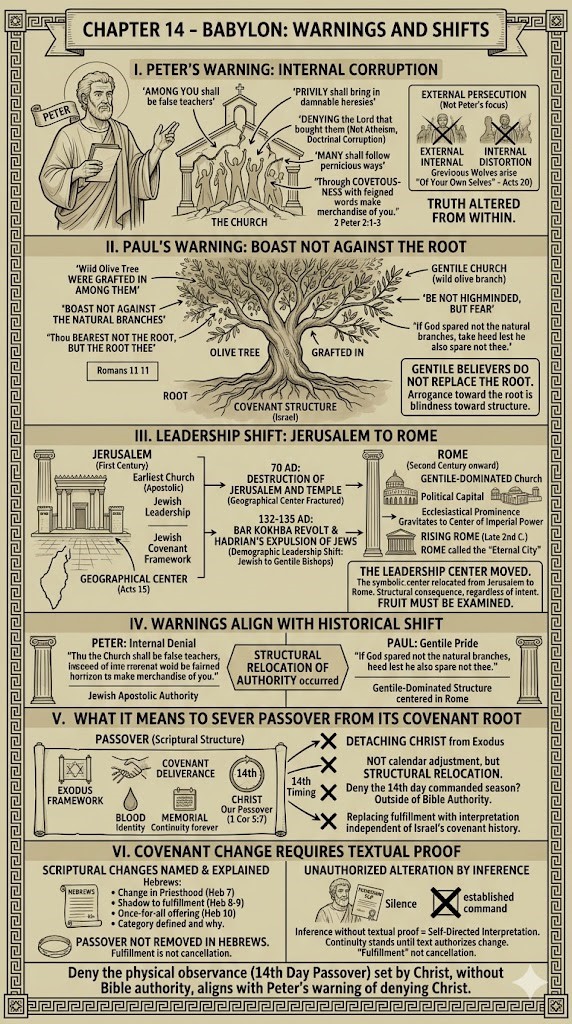
Chapter 11 Britain find the law
For more than four centuries, Britain had been a land of war. Celt against Saxon, Saxon against Angle, Angle against Dane. The island was torn by rival peoples and rival gods, until Alfred stood up and, by God’s providence, brought peace. For the first time in generations, Britain was united under one king, one sword, one shield.
But Alfred knew what every wise man of Israel once knew: a nation cannot stand on strength alone. Armies can win a field, but without law, nations fall into ruin. And the law Alfred turned to was not the law of Rome, nor the decrees of bishops. It was the law of God.
Yet here lies the snare of history. Later chroniclers, shaped by their own age, would write of Alfred as a Christian king. To them, “Christian” meant Catholic, for Rome had come to brand the word as its own. They did not know, or did not care, that this word had not been spoken in Britain in Alfred’s day.
The term “Christian” had never been born in Jerusalem or Antioch by the mouth of the apostles themselves. It was a Gentile word, applied from the outside, not a name chosen by the followers of Christ. By Alfred’s time, the historians had begun to throw this net wide. They called the Celtic druids Christian Celts, though their ways were pagan. They called the monks Christian monks, though their faith came not from Rome but from Scripture. They called those under the pope’s sway Christians, as if one word could hide a thousand different fires.
So when the records call Alfred a “Christian king,” they hide the truth. They clothe him in a Catholic robe that he never wore. Alfred was no servant of Rome. If he was to be called Christian at all, it was in the sense of the monks he loved and learned from: men who clung to God’s law, not to papal decrees. He was, in truth, a law-king, not a Catholic king.
The Challenge of Rome
When Alfred had at last united the warring tribes of Britain into one military force, his work was only half done. For a kingdom may be defended with the sword, but it cannot stand without law. And law, in Alfred’s time, was tangled in the great question of religion.
Four centuries earlier, when the Roman Empire still cast its shadow over Europe, Pope Gregory had sent a missionary named Augustine to Britain. Augustine’s mission was not simply to preach Christ, but to bring the island under Rome’s religious authority. His order was plain: convert the people, bend the church of Britain to Rome, and bring the island into the Catholic fold.
But Britain was no blank slate. Long before Augustine stepped ashore, the Celts had their druids and monks, learned men who kept law and scripture apart from Rome. They were not “Christians” in the Roman sense, though the historians now call them so. They were men of the old faith of the land, holding fast to the law of God, some to their own traditions. Rome called them “Christian monks” though they never bent knee to the pope.
The Weight of Catholic Power
By Alfred’s day, Rome’s power had swept across nearly all of Europe. Kings bowed to papal decrees. Crowns were set or removed at the whim of the pontiff. Catholic influence reached into courts, armies, and monasteries, binding men with oaths not to God, but to Rome.
Here lay Alfred’s trial: to forge a nation bound not by papal law, but by the law of God. He knew that if the Catholic Church gained dominance in Britain, the people would not only lose their freedom, but the truth of God’s word would be buried beneath Roman ceremony.
The historians, eager to write Britain into Rome’s story, would later call Alfred a “Christian King.” But in their pen, “Christian” meant Catholic. This was false. Alfred was no servant of the pope. If he was to be called a Christian, it was in the sense of a monk-king, a man schooled by the law of God, not by papal decrees.
Alfred’s Resolve
Thus Alfred stood at the crossroads. Around him lay the ruins of four hundred years of tribal wars. Ahead stood the might of Rome, pressing upon his island as it had pressed upon Gaul, Spain, and the German lands. If Britain was to be free, if it was to stand as a covenant nation under God, Alfred would have to resist not only the sword of the Viking, but the cross of Rome.
This was the battle unseen by many: not only a clash of armies, but of governments, of laws, and of faiths
The Catholic Problem for Alfred
By the time Alfred came to power, the Roman Catholic Church had entrenched itself as the most powerful force in Europe. The bishops of Rome, following the missionary orders first sent by Pope Gregory the Great and carried out by Augustine of Canterbury (596 AD), had laid claim to Britain as part of their spiritual empire. Every kingdom that submitted to Rome was drawn into a wider network of European power: papal blessing was political legitimacy, and papal disapproval was political ruin. Monarchs who resisted Rome often found themselves isolated, without allies, and vulnerable to both excommunication and foreign invasion.
Britain had already experienced this tension. The Celtic monks, keepers of older traditions, resisted Roman customs for centuries until they were forced into submission at the Synod of Whitby (664 AD). But the memory of this resistance lingered, especially in the hearts of those who held to a stricter form of biblical law. When Alfred rose to power, Catholic influence was everywhere in Europe — but Britain’s own religious heritage was not Catholic. There were still traces of monk monastic teaching and biblical law outside papal control. This meant Alfred was caught between two competing worlds: the massive Catholic bloc dominating the continent, and the independent biblical teaching still present in his own land.
The Risk of Denouncing the Pope
For Alfred, the challenge was not merely theological — it was political survival. If he openly denounced the Pope, Britain would become an island truly alone, cut off from alliances with Catholic Europe. Trade could suffer, armies could be raised against him under papal banners, and he might even face a crusade launched in the name of Rome. Worse still, his own people were divided. Many of his subjects, especially those influenced by Catholic missionaries, had adopted Roman practices. If Alfred declared against the Pope, he risked splitting his kingdom once more — undoing the fragile peace he had fought so hard to achieve after centuries of war between Saxon, Angle, and Celt.
Thus, Alfred walked a narrow path. To protect Britain’s unity, he could not submit fully to Rome. But to protect Britain’s safety, he could not openly denounce Rome either. His genius lay in how he insulated Britain: strengthening law and learning within his kingdom so that his people were bound by God’s law rather than papal decree, while diplomatically maintaining enough outward respect to avoid provoking Europe’s Catholic powers into war.
Alfred and the Catholic Question
In Alfred’s day, the law was not the only authority men bowed to. Across the Channel, in Rome, the Pope’s hand stretched like a net across the whole of Europe. From Spain to the German states, from France to Italy, kings paid homage to the See of Rome. The command of Pope Gregory, given through Augustine in the sixth century, had not been forgotten: Britain was to be converted to Catholic obedience. The teachers that came with Augustine had spread papal teaching, and though many Celtic monks resisted, the Catholic order continued to grow.
The Dilemma of Denouncing Rome
Here Alfred faced a dangerous crossroad. If he openly denounced the Pope, he would isolate Britain from the rest of Europe, cutting himself off from alliances and trade. To the Catholic believers within his own borders, such a denouncement would sound like rebellion against the very faith they thought sacred. Civil war could ignite again, undoing the fragile peace he had worked so hard to secure.
But if he bowed to Rome, Alfred would surrender the independence he had just forged. Britain would be no longer a free nation but a servant of papal decrees, its laws bent to foreign will. He had seen what papal power had done in the Frankish kingdoms — how kings became puppets while bishops and abbots carried more sway than crowns. Alfred could not allow such a fate for his kingdom.
Thus Alfred’s problem was not merely political but spiritual. To build a kingdom of law under God, he had to walk a razor’s edge: resisting Rome’s domination without tearing his people apart, holding Britain together as one nation while shielding it from the net of papal Europe.
Alfred Before the Crossroads
.Here lay the heart of Alfred’s greatest challenge. The faith that stretched across Europe was Rome’s faith. From the days of Pope Gregory’s order to Augustine, the Catholic Church had extended its arm into the isles, pressing its claim of spiritual supremacy. Across the continent, kings bowed their crowns before the Pope. Thrones rose and fell by Rome’s blessing. To denounce the Pope was to set oneself against the power that bound all Europe together — a power greater than any army Alfred had faced.
In Britain, this power was not merely abroad but within. Monks taught under the shadow of Augustine’s mission. Nobles with Catholic sympathies looked to Rome. To strike openly against the Pope would not only insult Europe — it would stir unrest within Alfred’s own land, undoing the fragile unity he had just secured.
Thus the dilemma was laid bare before the king. If Alfred bent the knee to Rome, he would preserve peace with Europe but surrender the soul of his nation to Catholic law. If he rejected Rome, he risked isolating Britain, turning the continent against him and dividing his own people. This was no small matter of words or titles. It was the fulcrum on which the future of Britain would turn.
It was here that Alfred’s greatness shone. For while many kings yielded to the Pope for the sake of safety, Alfred sought a higher path. He would honor the unity of the Church, but not by bowing to Rome. He would root Britain in God’s law — the law he had learned from the Scriptures and the monks who carried the old flame of truth. In this way, he would give his nation both peace and freedom, balancing the sword of war with the staff of shepherding.
The Suspense Around Alfred’s Decision
.The choice before Alfred was not simply political — it was civilizational. One false step, and the fragile house he had built could collapse back into war, religious division, or foreign domination.
Alfred gathered around him men of vision—those who could shepherd the nation’s soul as much as defend it with a sword. None was more crucial to this mission than John the Old Saxon, the scholar and abbot at Athelney.
So Alfred waited. He listened. He studied. He drew close advisers into his circle, men like John of Old Saxony, whose knowledge of both Rome’s power and the Saxon heritage was unmatched. Every voice in his council mattered, every option was weighed.
Yet the final decision would rest on Alfred alone. And he knew it would define Britain’s future forever.The choice before Alfred was not simply political — it was civilizational. One false step, and the fragile house he had built could collapse back into war, religious division, or foreign domination.
Yet the final decision would rest on Alfred alone. And he knew it would define Britain’s future forever.
John of Old Saxony Enters the Scene
Alfred was not content to rely only on warriors and earls to secure his kingdom. He understood that swords could defend a border, but only minds could build a nation. To this end, he sought out men of wisdom, men who could teach, translate, and bring order to a people long scattered by war. One of the most important of these men was John of Old Saxony, sometimes called John the Old Saxon.
John was renowned for his intelligence. Unlike many clerics of his time, who lived cloistered lives and France, loyal to Rome and the Pope, grew hostile toward John. His scholarship threatened the grip they held over interpretation. These were not simply jealous monks — they were the guardians of Rome’s influence in Western Europe, and they saw in John a rebel voice that had to be silenced.
They tried to kill him. Whether by plot, poison, or dagger, history hints at attempts on John’s life, for his pen and his teaching undermined the Catholic order. Alfred knew this, and yet he sheltered John in his court, valuing his wisdom above the danger it brought. The men who hated John were not random assassins. They were part of the same network that tied France, the monasteries, and the Roman church together — a network that would never forgive Alfred for protecting a man who dared to bring Hebrew truth through Latin words into the heart of England recited prayers by rote, John had a sharp, practical mind that Alfred recognized instantly. He was a translator, a scholar who could take the sacred texts and render them with precision. What made John unique was his insistence on working not from the polished glosses of Rome, but from Latin translations that preserved the raw, word-for-word accuracy of the Hebrew. This gave his work a power that Alfred valued deeply, for it cut through layers of commentary and tradition and reached back toward the roots of truth itself.
But such fidelity to the original sources was dangerous. It was a challenge to the authority of Rome and its carefully controlled narrative. Soon whispers spread across the channel.
Alfred’s Guardian of Truth — John the Old Saxon
Alfred gathered around him men of vision—those who could shepherd the nation’s soul as much as defend it with a sword. None was more crucial to this mission than John the Old Saxon, the scholar and abbot at Athelney.
A Scholar Anchored in Truth
John had walked into Alfred’s court not just as a learned man, but as a keeper of the written Word. Unlike some who relied on secondhand tradition, John worked from Latin translations that hewed closely to the Hebrew originals, striving for the clarity of God’s law, illuminated in their raw, unfiltered Alfred understood the power of what this meant: knowledge grounded not in Rome’s commentary, but in the commandment itself.
A Threat to Roman Power
In France, where the influence of the Catholic Church was strongest, John’s precise scholarship sparked hostility. These were powerful men—clerics tied to Rome—who saw in John a threat to their controlled narrative. Their influence reached beyond church walls; their allegiance lay with papal authority and territorial power.
Attempted Murder in the Chapel
Their opposition turned deadly. In his work Life of Alfred, Asser recounts how, while John was at prayer in the church of Athelney, two Gaulish (West Frankish) monks—loyal to Rome’s influence—ambushed him. They hid within the sanctuary and attacked with swords. John’s cries, however, roused his companions, and he survived the lethal assault
Alfred Guards a Flame Too Worthy to Quench
Alfred knew the danger John’s presence invited. But he also recognized that this scholar carried light strong enough to guide a nation. Where some saw a target to be silenced, Alfred saw a torch to be shielded. By protecting John, Alfred wasn’t just defending a man—he was preserving a pathway to truth, education, and sovereignty.
John of Old Saxony
Among the men Alfred gathered to strengthen his kingdom, none stood out more than John of Old Saxony. Known for his brilliant mind and sharp memory, John was not merely a scholar but a man who understood the weight of truth. Alfred recognized this at once and drew him close, giving him the charge of building the intellectual and spiritual foundation of the English court.
John’s greatest gift was his mastery of languages. Unlike many clerics of the age who worked only from Latin, John labored from a Latin text that itself was a word-for-word translation of Hebrew. This gave his teaching a rare precision—each word carried the rhythm of Scripture as it was originally spoken. For Alfred, who longed to restore both law and learning to his people, this was a treasure beyond measure.
The Threat from Abroad
But brilliance attracts danger. John’s work stirred envy and suspicion among some, especially those tied to the old powers across the Channel. Certain factions in France, bound to Rome and threatened by the independence Alfred was fostering, saw in John a dangerous figure. His teaching threatened their hold, for if the English gained direct access to truth—through Hebrew precision rather than Rome’s interpretations—then Rome’s control would weaken.
So it was that John faced a plot against him. Enemies moved quietly, hoping to silence him before his influence could spread. They tried to have him killed, a grim reminder that knowledge and faith were weapons in their own right. Yet John survived, and in his survival, Alfred’s cause only grew stronger.A Link Exposed
The attempt revealed more than hatred—it uncovered a link between the French powers, the monasteries bound to Rome, and the forces that wished to see Alfred fail. What might have seemed a single act of violence proved instead to be part of a larger struggle: a contest not only for the body of England but for its soul.
The scholars of Alfred’s court, like John the Old Saxon, had built a foundation of learning and government rooted in God’s Word. And at the center of that foundation was something every Christian across Europe already knew by heart: the Ten Commandments.
Alfred did not invent them, nor did he claim them as his own. What he did was something far more daring — he took those ancient words and made them the foundation of law and government in his realm. Unlike the Church of Rome, who kept the Commandments as lofty moral rules but did not govern nations by them, Alfred declared they would be the bedrock of justice and judgment in Britain.
This was bold — but here lies the twist. The Ten Commandments alone were not proof that Britain was Israel. Gentile nations, too, had the commandments. They had filtered into Europe long before Alfred’s day, passed along through the Church, through Rome, through countless translations. The Catholic Church taught them as moral principles, though never as the foundation of government.
So Alfred’s government was different. He raised up the commandments, not as a catechism, but as the structure of national law. Yet even then, one must be cautious: this was not proof that Britain was Israel — it was another path, another marker along the way, but not the destination.
What we see here is like nothing is world history show any other place. At Mt. Sinai God made with Israel a covenant and the foundation of the covenant God made with no other people was the Ten Commandments. The full covenant was not given at Mt Sinai only the foundation of the covenant the Ten Commandment. The full covenant was added by Moses over the next months and years but the covenant God made with Israel was the Ten. Commandments. It was the beginning foundation of the law of government that will be places over Israel. Alfred mirrored this in setting up his government. He as on Mt. Sinai began with the law of the Commandments as the foundation of the government he set and just like Israel added the full government based on these Ten Commandment under these laws. No other nation has done this is passed history or present, only Alfred in Britain.
The Last Piece of Candy
As Alfred’s reign matured, the Ten Commandments stood at the very heart of his laws. Some would look at this foundation and say, “Surely this proves Britain is Israel.” But that alone cannot be the proof.
The truth is, the Gentiles were also given the Ten Commandments, just not as their governing foundation. The Catholic Church carried them as moral guidelines, shaping conscience but not shaping government. Alfred, on the other hand, built his kingdom’s laws directly upon them, weaving God’s order into the framework of daily life.
So yes, Alfred’s use of the Commandments was unique, but the law by itself is not enough to prove Britain was Israel. It was one more path—another strand in the great tapestry—but not the crown jewel of evidence.
And so, we leave this chapter with the taste of that last piece of candy: a reminder that truth is not proven by one thread, but by the whole fabric woven together.

Chapter 12 The Covenant Written in Stone
When Alfred rose to rule, he did more than adopt a few moral laws. He and his advisors built the foundation of government directly from God’s covenant with Israel. The Ten Commandments were not just a moral code — they were the very heart of that covenant. Alfred’s kingdom reflected this structure in full, and when we set the governments of Alfred and Israel side by side, they match in every essential point.
But historians — looking only through their own narrow lens — dismiss this as “moral borrowing” or “early Christian influence.” They miss the weight of Scripture itself. This is not a cultural borrowing. This is God’s covenant. And God alone has authority over His covenant. No historian, no scholar, no Gentile nation has the power to place themselves under it.
God Forbids Gentile Nations from Taking His Covenant
The Bible speaks plainly: the covenant belongs to Israel alone.
- Psalm 147:19–20
“He declares his word to Jacob, his statutes and rules to Israel. He has not dealt thus with any other nation; they do not know his rules. Praise the LORD!”
Here is the first witness. God gave His statutes and judgments only to Jacob — not to Gentiles, not to foreign nations. No historian can override this.
- Amos 3:1–2
“Hear this word that the LORD has spoken against you, O people of Israel, against the whole family that I brought up out of Egypt: ‘You only have I known of all the families of the earth; therefore I will punish you for all your iniquities.'”
Here is the second witness. God Himself says He knows only Israel. This knowledge is covenant relationship. It means the covenant cannot belong to any Gentile nation.
Together, these two witnesses establish an unbreakable rule: the covenant is Israel’s alone
When Alfred rose to rule, he did more than adopt a few moral laws. What follows will show that the government formed under Alfred was exact in its covenant structure, not a mere borrowing of moral ideas. The Ten Commandments were not treated as general ethics, but as the heart of a governing covenant. This is the point historians miss, because they look at the outward form while ignoring the authority of the covenant itself.
At Sinai, God established His covenant beginning with the Ten Commandments, and from that foundation the structure of government was built over time.
What follows will show that the same order appears under Alfred. The commandments form the foundation, and the government develops from them. This is not a general resemblance—it follows the same pattern of foundation and structure.
The Covenant and Its Boundaries (Refined)
The covenant God made with Israel is not established by a single witness alone. The Scriptures show this point consistently, from Sinai through the New Testament.
Some passages state it directly:
- Book of Psalms 147:19–20
- Book of Amos 3:1–2
These witnesses declare plainly that God gave His statutes and judgments to Israel, and not to other nations.
But the structure of the covenant itself shows the same thing.
At Sinai, the covenant was not made with all peoples, nor with all generations universally. It was made with a specific people at a specific time:
- Book of Deuteronomy 5:2–3
“The LORD our God made a covenant with us in Horeb… not with our fathers, but with us, even us, who are all of us here alive this day.”
This removes a common misunderstanding. While Abraham was promised to be the father of many nations, the covenant established at Sinai was not extended to all nations. It followed a defined line.
The promise moves through the seed given through Sarah and continues through that line. The covenant is not described as transferring broadly across all peoples, but as moving within that defined structure.
The New Testament addresses this as well. The writings of Paul the Apostle show that those outside this structure are not described as creating a separate covenant, but as being brought into the existing one.
This establishes another requirement:
The covenant is not recreated elsewhere—it is entered into.
This creates a clear distinction.
A system may adopt commandments, but adoption alone does not establish covenant. The Catholic had the commandments but not as law but as a moral guideline that is not eh covenant. The ten Commandments was the foundation of law for the land. Authority over the covenant does not come from taking its laws, but from being within the structure to which it was given.
At this stage, the question is not whether the commandments can appear outside Israel, but whether the covenant itself can.
What follows will examine how this distinction applies within the structure already being developed.
Taking commandments is not the same as having the covenant
Alfred’s Foundation
Alfred did not treat the Ten Commandments as a general moral guide alone. The record shows that they were placed at the foundation of law, and that the structure of government developed from that foundation.
What must be examined is not whether the commandments appear, but how they are used.
Are they simply moral instruction, or do they form the basis of a governing system?
Two Governments Side by Side
| Israel’s Covenant Government | Alfred’s Government |
|---|---|
| Ten Commandments as foundation of law (Ex. 20) | Ten Commandments prefacing Alfred’s Book of Dooms |
| Mosaic judgments applied to cases (Ex. 21–23) | Alfred’s Doom Book containing judgments beyond the Decalogue |
| Law administered by judges and elders | Law administered by reeves, ealdormen, and Alfred’s witan (council) |
| Covenant community bound to obedience before God | Kingdom bound by oath and law under Alfred |
| Protection of the weak, widow, and stranger (Deut. 10:18–19) | Protection laws in Alfred’s code for the poor, widows, and strangers |
| King bound to the law (Deut. 17:18–20) | Alfred binding himself to the law and promoting its use |
What This Comparison Shows
When these structures are placed side by side, a pattern emerges.
The commandments are not isolated. They are followed by judgments. Authority is structured through appointed leaders. The king is placed under the law, not above it.
This reflects not a single borrowed element, but a system.
The Form of the System
What is being observed in this structure is not a full reproduction of the Old Covenant system.
Under the Old Covenant, the law was accompanied by:
- a priesthood
- a sacrificial system
- a centralized place of worship
These elements are not present in the same form within the system being examined.
Instead, what appears is:
- the law placed at the foundation
- instruction and teaching emphasized
- the transmission of the law through learning rather than sacrifice
This raises an important question:
If the structure is built on the law, but without the priesthood and sacrificial system, what form of covenant structure is being established?
This distinction must be accounted for as the structure continues to develop.
The Source of Atonement
The record describes Alfred as a “Christian king,” but the use of this term alone does not establish what system he followed.
What must be examined is not the title, but the structure.
The law is present. Judgment is applied. The commandments form the foundation.
Yet one element is absent:
- There is no priesthood performing sacrifice
- There is no altar system
- There is no offering for sin
This creates a necessary requirement.
Under the law, sin must be accounted for. Without sacrifice, the law condemns.
If animal sacrifice is not present, then the system must depend on another provision.
The writings included within Alfred’s law code contain teachings drawn from the Gospel record. This indicates that the system being formed does not rely on animal sacrifice, but on the teaching associated with Christ.
Insert — The Historical Witness
The question is not what Alfred was called, but what he established.
The law code attributed to Alfred begins with the commandments and includes teachings drawn from the Gospel record. This shows that the structure being formed does not rely solely on earlier law, but incorporates the teaching associated with Christ.
At the same time, no record shows the restoration of animal sacrifice, priesthood, or temple worship within this system.
This creates a clear structure:
- The law remains
- The teaching of Christ is present
- The sacrificial system of the Old Covenant is absent
This must be accounted for.
Insert — The Necessity of Christ in the System
The question is not what Alfred was called, but what he established.
The law code attributed to Alfred begins with the commandments, continues with the judgments of the law, and then includes teachings drawn from the Gospel record.
This shows that the structure does not stop at Moses, but continues into the teachings associated with Christ.
At the same time, one element of the Old Covenant system is absent:
- There is no priesthood performing sacrifice
- There is no altar system
- There is no offering for sin
This creates a necessary condition.
The law remains. Judgment remains. Sin remains.
But without sacrifice, the law condemns.
If animal sacrifice is not present, then the system must depend on another provision.
The inclusion of Christ’s teaching within the law structure is not incidental. It places the system within the framework where Christ is not only a teacher, but the provision that replaces sacrifice.
The structure does not follow the Old Covenant form, and the inclusion of Christ’s teaching alongside the absence of sacrifice places it in alignment with the fulfillment of old covenant showing Alfred restore the full New covenant under the authority of Christ.
Insert — The Source of Instruction
The law code attributed to Alfred begins with the commandments and continues with the judgments of the law. This establishes the foundation clearly within the structure given in Scripture.
At the same time, the system operates within a framework shaped by Christian teaching. Alfred supported instruction through monasteries, promoted the use of Scripture, and governed within a system that did not include the sacrificial elements of the Old Covenant.
God’s Exclusive Claim Over His Covenant
Scripture leaves no room for debate:
- Exodus 19:5–6 — “Now therefore, if ye will obey my voice indeed, and keep my covenant, then ye shall be a peculiar treasure unto me above all people… and ye shall be unto me a kingdom of priests, and an holy nation.”
- Deuteronomy 4:7–8 — “For what nation is there so great, who hath God so nigh unto them… And what nation is there so great, that hath statutes and judgments so righteous as all this law?”
Only Israel was given this covenant. No Gentile nation was ever permitted to take it for themselves. God Himself claims ownership. The historian has no authority here; the authority is God’s.
The Conclusion
Thus the story is set: Alfred built his government not on clever invention but on the covenant of God. Historians may argue influence, may claim mere cultural borrowing. Yet the Scriptures themselves rise up as witnesses. They say plainly: this covenant is not the heritage of Gentile nations — it is Israel’s alone. If it appears in Britain, it is because God Himself brought it there, no man has power over this covenant the authority God’s. God prophesied to Israel they would use their identity this prophecy was fulfilled with the house of Israel. God put a seal on outcome and only God can brake that seal. History cannot but the covenant God Himself has authority does. God seal the identity of the house of Israel by His words in te4h Bible and broke that seal by His words in the Bible. The covenant belongs to God and God only gave the covenant to Israel.
Therefore, any historian who claims Britain was “just another Gentile nation” misses the point. When the covenant moved there, it was not Gentile anymore — it carried the authority of God’s covenant with Israel. Historians no longer have the authority over history; the authority goes to the Bible and God Himself. This is directly from the Bible and the Bible shows the restrictions put on this covenant. Alfred restoring this covenant could only be done if Britain was Israel.

Chapter 13- The Bloodline of David in Britain
When Alfred established the covenant government, it wasn’t only law that confirmed Israel’s presence in Britain — it was also the throne itself. Scripture is clear:
- 2 Samuel 7:12–16 — God swore to David that his throne would be established forever.
- Jeremiah 33:17, 21 — God declared that David would never lack a man to sit on his throne, just as the Levites would never lack priests.
- Psalm 89:34–37 — God bound Himself to this covenant, saying David’s throne would endure “as the sun before Me.”
If this promise failed, the entire Word of God would collapse. But it did not fail. When Jerusalem fell and David’s throne was overthrown, Jeremiah was given a commission:
- Jeremiah 1:10 — to “root out, pull down, destroy, and throw down, to build and to plant.”
- After Judah’s fall, Jeremiah carried the king’s daughters (Jeremiah 43–44 supported by Ezekiel’s prophecy of “tender twigs” in Ezekiel 17:22–24) into exile.
From this point, the throne of Judah was replanted among another branch of Israel. History shows it moved northwest — following the trade routes into the isles — where the line of David would reemerge.
Britain and the Throne of David
By Alfred’s time, we see not only Israel’s covenant government restored but the royal prerogatives of David’s house emerging in the Anglo-Saxon kingship:
- The coronation ceremony in Britain mirrored the kings of Judah: anointing with oil, presentation of the law, crowning before God.
- The king ruled as God’s anointed, not merely as a warlord.
- Even Alfred’s writings (the “Doom Book”) declare the law of God as the foundation of his throne, just as Israel’s kings were commanded in Deuteronomy 17:18–20 to write and rule from the law of God.
This was no accident. The covenant could only be established where both law and line converged.
Prophetic Witness
- Amos 9:11 — God promised to “raise up the tabernacle of David that is fallen, and close up the breaches thereof.”
- Psalm 89 — declared the endurance of David’s seed and throne.
- These prophecies testify that God Himself preserved David’s throne and replanted it where His covenant could continue.
And that place was not Rome, nor among Gentile nations. It was among Judah— and the evidence is overwhelming that Israel was now in Britain.
-
-
📖 The Covenant and the Bloodline of David
-
1. The Covenant Was With Israel Alone
- God’s covenant was never given to the Gentile nations. Every scripture confirms it was established exclusively with Israel:
- Exodus 19:5–6 – “Now therefore, if ye will obey my voice indeed, and keep my covenant, then ye shall be a peculiar treasure unto me above all people: for all the earth is mine: and ye shall be unto me a kingdom of priests, and an holy nation.”
- Deuteronomy 7:6–8 – God set His love upon Israel alone, not because of their numbers, but because of His oath to their fathers.
- Psalm 147:19–20 – “He sheweth his word unto Jacob, his statutes and his judgments unto Israel. He hath not dealt so with any nation…”
- Amos 3:2 – “You only have I known of all the families of the earth…”
- This covenant nation was the foundation of God’s government on earth. Christ did not come to create a new covenant with Gentiles; rather, through His sacrifice He opened the way for Gentiles to be grafted into the one covenant given to Israel.
- Romans 11:17–18 – Gentiles are grafted into the olive tree (Israel).
- Ephesians 2:12–13 – Gentiles were “aliens from the commonwealth of Israel, and strangers from the covenants of promise” until Christ’s blood brought them near.
- Thus, all covenant authority — law, priesthood, throne, promise — remained rooted in Israel.
-
-
2. The Throne of David Could Not Be Broken
-
- The covenant throne of Israel was sworn with an oath to David:
- 2 Samuel 7:12–16 – God promised David an everlasting house, kingdom, and throne.
- Psalm 89:3–4 – “I have made a covenant with my chosen, I have sworn unto David my servant, Thy seed will I establish for ever, and build up thy throne to all generations.”
- Jeremiah 33:17 – “David shall never want a man to sit upon the throne of the house of Israel.”
- God swore by His holiness that the throne of David could never be destroyed (Psalm 89:34–37). Even if the nation was punished, the covenant throne must continue in David’s line — never to be transferred to another family, nor to Gentiles.
-
3. The Bloodline Preserved
- When Israel fell, God’s prophets preserved the covenant line:
- Jeremiah 1:10 – Jeremiah was set “over nations and over kingdoms, to root out, and to pull down, and to destroy, and to throw down, to build, and to plant.”
- That planting was the transfer of David’s throne to safety. Jeremiah carried the royal seed, preserving the covenant line in exile, while Israel’s monarchy fell in Judah.
- This is why Alfred’s kingship matters. For him to sit upon the throne of covenant, he had to be of David’s line. Otherwise, God’s covenant oath would be broken — which Scripture declares is impossible. Cedric was the link the first king of the Saxon. This name is all history will show us but his name is all we need. Cedric was a Celtic name not Saxon showing his Celtic roots where Jeremiah place the throne of David’s bloodline. Alfred himself claim Celtic blood. This is all history and the gives us but it is enough by the words of God Himself. Alfred was given the full covenant of Israel given to God chosen people on Mt. Sinai and no other nation was allow this covenant. Gentile was allow by Christ sacrifice to become a part of that covenant through Israel, but not apart from Israel.
-
4. Alfred as Proof
- Now, everything we traced — trade routes, migrations, Celtic strongholds, Saxon and Angle settlements, the uniting of the tribes — becomes more than history. It becomes fulfillment of covenant math.
- Alfred did not simply rule Britain as a Saxon warlord; he sat upon a throne that bore the signs of covenant government (law, judges, priesthood, oaths).
- The covenant throne could only exist if it was the line of David, carried forward as Jeremiah prophesied.
- Thus, by standing in covenant authority, Alfred proves the line of David was preserved and seated in Britain.
- No historian can explain Alfred’s government without stumbling into the covenant system of Israel. The structure itself is the signature of God, proving David’s throne was alive, ruling, and fulfilling prophecy.
The covenant was never Gentile — it was Israel’s alone.
-
- Gentiles entered only by being grafted into Israel through Christ.
- The throne of David was sworn to endure forever.
- Jeremiah transplanted it, and Alfred’s government shows its living presence in Britain.
- Therefore, Britain is not just historically tied to Israel — it is the covenant house of Israel, proven by Scripture, oath, and government.
- Gentiles entered only by being grafted into Israel through Christ.
-
The Covenant and the Throne
-
- When God made covenant with Israel at Sinai, He did not make it with Egypt, Assyria, or any Gentile nation. The covenant was singular — sealed by blood (Exodus 24:7–8). To Israel alone He said: “You only have I known of all the families of the earth” (Amos 3:2).
- The prophets confirmed this repeatedly:
- “He hath not dealt so with any nation: and as for his judgments, they have not known them” (Psalm 147:19–20).
- “What advantage then hath the Jew? … Much every way: chiefly, because that unto them were committed the oracles of God” (Romans 3:1–2).
- Gentiles had no covenant of their own. Paul explains it plainly: “That at that time ye were without Christ, being aliens from the commonwealth of Israel, and strangers from the covenants of promise” (Ephesians 2:12).
- Only through Christ’s sacrifice were Gentiles allowed to be “grafted in among them, and with them partake of the root and fatness of the olive tree” (Romans 11:17). The covenant never shifted to Gentiles — they were joined to Israel’s covenant. Christ’s blood opened the door, but the covenant itself remained Israel’s.
- The Throne of David
- But God’s covenant included more than law and promises — it included a throne. From David forward, the eternal covenant of kingship was sealed:
- “Thine house and thy kingdom shall be established for ever before thee: thy throne shall be established for ever” (2 Samuel 7:16).
- “I will not lie unto David. His seed shall endure for ever, and his throne as the sun before me” (Psalm 89:35–36).
- Jeremiah carried this forward: “David shall never want a man to sit upon the throne of the house of Israel” (Jeremiah 33:17).
- This means: if there is no throne of David on earth, then God’s word is broken. But God cannot lie. Therefore, the throne had to continue somewhere visible among men.
- Alfred and the Covenant
- Now the two halves come together.
- The covenant was only with Israel — not Gentiles.
- The throne of David was promised unbroken.
- When Alfred the Great rose in Britain to unite Anglo, Saxon, and Celt under one crown and law, he was not stepping into a Gentile throne. He was stepping into the covenant throne of Israel. He could not lawfully sit upon it unless he were of David’s line.
- Every path we have traced — Jeremiah’s journey, the survival of Judah’s royal daughters, the migrations of Israel into the isles — now becomes confirmation. Alone, each path seemed thin. Together, under the covenant requirement, they become necessity.
- For the covenant throne cannot fall into Gentile hands. Alfred could only have been seated there if the bloodline of David was preserved in him. Otherwise, he would have been an intruder, and God’s oath would have failed.
-
The Covenant Nation and the Throne of David
-
-
1. Overwhelming Proof of the Covenant
- We showed with verse upon verse that God made His covenant only with Israel.
- Gentiles were never given their own covenant; instead, through Christ, they were grafted into Israel’s covenant (Romans 11:17; Ephesians 2:12–13).
- Psalms and Amos were brought forward as witnesses to show that God forbids any Gentile nation from having His covenant apart from Israel.
- This is the unbreakable standard: no historian, no theologian, no skeptic can tear it down. Christ did not create a new covenant for Gentiles; He opened the way for them to join Israel’s. Thus, when covenant promises are seen in Britain, they must be understood as the fulfillment of Israel’s promises.
- 2. Britain as the House of Israel
- We demonstrated beyond doubt that Britain carried the identifying marks of Israel.
- Every prophetic promise—land, government, blessings, covenant law—was transferred.
- The grafting principle explains why Gentile families could partake, but the root remained Israel.
- This removes all ambiguity: Britain was not merely “another nation rising,” but the covenant nation itself.
-
- 3.The Throne of David
- Yet the covenant was not just about the people; it was about the throne.
- God swore that David’s line would never fail (2 Samuel 7:12–16; Psalm 89:3–4, 34–36; Jeremiah 33:17).
- Therefore, Alfred could not have sat upon that throne unless he descended from David’s bloodline.
- Here is where all our previous work—the paths, migrations, Celtic connections, monasteries, and preserved royal prerogatives—now turns from speculation into mathematical proof. If Alfred ruled as covenant king, then by necessity, he sat upon David’s throne.
- 4. The Final Proof
- The covenant throne must remain with David’s seed.
- Britain bore the covenant signs.
- Alfred ruled as covenant king.
The only conclusion: David’s bloodline was preserved and carried into Britain
- The path
First let’s take Jeremiah and the bloodline.
- The record does not provide a direct account of the movement.
- However, the conditions establish clear limits:
- Overland routes were restricted
- Known trade routes connected the Mediterranean to the western isles
- No alternative path is shown in the record
This establishes the historical constraint:
- No alternative path can be demonstrated.
- At the same time, Scripture establishes a requirement:
- The covenant must continue
- The throne must continue
- The line must be preserved
If the covenant structure appears in Britain, then the path must account for how it arrived.
- This creates a combined condition:
- No alternative path is shown in the record, and this path alone satisfies the requirement established by Scripture.
The Monks
The presence of instruction aligned with Scripture in Britain must be accounted for.
The record does not show a defined or sufficient migration that would explain the introduction of this system.
What is not shown cannot serve as the basis for explanation.
Yet the structure itself is present.
This creates a requirement:
The origin must be accounted for from what is shown, not from what is assumed.
Refined Section — The Source of the Teaching
The presence of instruction aligned with the law of God in Britain must be accounted for.
The record does not show a defined source that explains the introduction of this teaching.
At the same time, the structure is present.
This creates a requirement.
The commission given to Jeremiah includes both the removal of a pagan system and the establishment of another covenant system
- to tear down
- and to build and plant
In Britain, an earlier pagan structure is replaced over time by one aligned with the law of God.
This aligns with the pattern described in that commission.
The Role of Instruction
For such a system to appear, the teaching must be present before the structure is established.
Alfred did not create the law in isolation. He was taught, and that instruction formed the foundation of what he later established.
Without that instruction, the structure that follows would not appear.
📖 Refined Addition — The Presence of the System
The system aligned with the law of God is present in Britain.
Instruction based on Scripture is established, and by the time of Alfred it is already in place. The monks who carried this instruction did not appear suddenly; they had been present for generations before Alfred, preserving and teaching what they had received.
Yet the record does not show a defined origin that explains how this body of teaching first arrived in Britain.
This creates a condition:
- The teaching is present ✔
- It precedes the structure established under Alfred ✔
- Its origin is not defined in the record ✔
The Requirement of the Pattern
The commission given to Jeremiah establishes a pattern:
- to tear down
- and to build and plant
In Britain, a pagan structure is replaced over time by one aligned with the law of God. The presence of instruction before Alfred, and the structure established through him, together form a sequence:
- instruction present
- structure established
- system aligned with covenant law
This matches the pattern that must occur.
The Result and What It Shows
The outcome is not based on a single statement, but on what is present:
- a system aligned with the law of God
- instruction preserved across generations
- a structure established upon that foundation
If prophecy cannot fail, then what appears must be consistent with what was required.
The result does not stand apart from the prophecy—it must be accounted for within it.
The fruits show the fulfillment of Jeremiah’s prophecy lining up with the result of the covenant that only Israel can have being in Britain.
Cedric
At the foundation of the West Saxon royal line stands Cerdic.
The form of this name is not Germanic. It is recognized as Brittonic in form.
This point is not in dispute.
What this means must be accounted for.
The name is present. The line begins there. The kings of Wessex trace through it, and that line continues forward the king of England today.
This creates a fixed point:
- The name is not Saxon in form ✔
- The line begins with that name ✔
- The line continues without break ✔
What is not established is an explanation that accounts for it.
The Line and the Requirement
The issue is not the name alone, but what stands upon it.
- The royal line continues ✔
- Later kings stand within that line ✔
- The structure of rulership is established ✔
At the same time, Scripture establishes a requirement:
- The throne of David must continue
- It must not fail
The arguments
The explanations offered are not established.
They rely on words like “may,” “could,” and “not impossible.”
This is not explanation.
It is the absence of one.
Historians
In fields where conclusions must be established, statements are supported by what can be shown.
In this case, the language used is “may,” “could be,” and “not impossible.”
These are not conclusions.
They do not establish what occurred.
They mark the limits of historians in general
An explanation requires more than possibility.
It requires what can be shown to account for what is present.
Where only possibility is offered, the explanation is not established.
The use of “may,” “could be,” and “not impossible” does not establish an explanation they do no teven make up a good argument.
This is the reason we rely on the authority of the Bible not historians. History back up the Bible not the other way around. What history show is Cedric is Brittonic/ Celtic name and that is all anyone has to work with. The authority of the Bible is this bloodline that was set with the Celtic in Jeremiah day transferred the bloodline to Alfred. If not so then prophesy failed.
The Certainty of Prophecy
Scripture does not allow for the failure of God’s word.
- “There failed not ought of any good thing which the LORD had spoken…”
- “My counsel shall stand…”
- “It shall not return unto me void…”
What God declares is not uncertain.
It is performed.
God’s prophecy does not fail—
because His word does what He declares.

Chapter 14 — The Prophecy Fulfilled
Ephraim’s Rebellion
The story of prophecy now narrows to one tribe: Ephraim. Though the birthright had been promised to Joseph’s sons, Ephraim would be the greater. Yet Ephraim’s rise was marked by rebellion. When Solomon’s sins caused the kingdom to fracture, God tore away ten tribes and placed them under Jeroboam, an Ephraimite. This act fulfilled God’s word that He would divide the kingdom—but it also marked the moment when Ephraim lifted himself against the throne of David.
The house of Judah remained loyal to the covenant throne, while the house of Israel, under Ephraim, rejected it. Jeroboam immediately turned the people away from Jerusalem, forbidding them to worship at the Temple, and set up golden calves at Dan and Bethel. Thus Ephraim, who had been destined for greatness, broke fellowship with the very covenant that had given him birthright blessing. From that point on, Ephraim became known as the leader of rebellion against the government of God.
The Two Houses
The nation was now two: the House of Judah, ruled by the line of David, and the House of Israel, dominated by Ephraim. This division was not temporary—it became the defining mark of prophecy. Judah would keep the throne; Israel would keep the birthright. But separated, both would fall.
Judah would be carried into Babylon, yet preserved for the throne’s sake. Israel, led by Ephraim, would be carried away by Assyria, scattered into the nations, and lose its very name. It would become “lost,” hidden for centuries, while the covenant promises remained unfulfilled.
The Two Sticks Prophecy
Through the prophet Ezekiel, God gave a vision to make sense of this division. He commanded Ezekiel to take two sticks—one for Judah, and one for Joseph (the house of Israel, led by Ephraim). Though broken apart, the two would one day be joined in the hand of God, becoming one nation under one Shepherd. The prophecy of the two sticks guaranteed that the break was never permanent. Judah’s throne and Ephraim’s birthright would reunite in the appointed time.
Yet this prophecy also carried a warning: Ephraim’s rebellion would last until the punishment was complete. Only when the appointed years were fulfilled would the birthright blessings of greatness appear in the earth.
Jeremiah’s Witness
Jeremiah, watching the fall of both houses, carried the word of God through the storm. He saw Judah fall to Babylon, but he also gave warning to the scattered house of Israel—that though they were driven away, God had not forgotten them. He foretold that Israel would return, not merely to land, but to covenant. His prophecies reached far beyond his time, pointing toward a latter-day fulfillment when the lost house of Israel would rise again as nations of power.
The Birthright Nation — Britain
After 2,500 years of wandering, the birthright promise given to Ephraim burst forth in the modern age. In the 1800s, Britain stood at its height, the undisputed empire of the seas, holding dominion “from the river to the ends of the earth.” At its peak, the British Empire controlled nearly a quarter of the world’s land and population. This was not mere history—it was prophecy fulfilled.
No other nation in history could claim the blessings that Jacob had placed upon Joseph’s sons. Only Britain, in its wealth, its sea gates, and its global dominion, matched the description. It was the fulfillment of the birthright withheld for 2,500 years. The punishment was complete; the prophecy had come alive.
The Covenant Confirmed
Thus the storyline of prophecy ties together:
- Ephraim rebelled and led Israel away from the throne.
- God divided the nation into Judah and Israel, the throne and the birthright.
- Jeremiah and Ezekiel foretold that both would be preserved, though hidden.
- After centuries, Britain rose—not by accident of history, but by the covenant oath sworn to Abraham.
Britain alone fulfilled the birthright promise of greatness among nations. Ephraim, though rebellious, was never cast away. God’s covenant stood, and history itself bore witness.
Conclusion
Ephraim’s story is one of rebellion, scattering, and punishment, but also of covenant faithfulness. God never withdrew His promise, though Ephraim broke faith with Him. In Britain’s rise, we see not merely an empire of men, but the hand of God bringing prophecy to pass. The scepter of Judah and the birthright of Ephraim stood side by side once more, awaiting their final fulfillment in Messiah — when the two sticks will truly become one.
Closing Section of Chapter 14
Ephraim’s story did not end in triumph but in rebellion. God had given them the birthright blessing, a chance to rise in strength and wealth. Yet Ephraim rejected the very foundation of that blessing—the government of God anchored in the throne of David.
When the kingdom divided after Solomon, Ephraim led the revolt. They turned their back on Jerusalem, on the temple, and on the line of David that God had sworn would never fail. They set up their own kings, their own worship, and their own system of rule, breaking away from the throne that God Himself had established.
The house of Israel and the house of Judah became two separate peoples, two divided kingdoms. And though Ephraim’s rise would one day reach the height of global empire, their foundation was flawed from the beginning—because they had cut themselves off from the throne of David.
Yet God does not leave His covenant broken forever. The prophecy of the two sticks in Ezekiel speaks directly to this: Judah and Joseph, divided for centuries, will one day be reunited under one king. God Himself will place David’s throne back over Ephraim. The line that Ephraim rebelled against will rule over them again, and the covenant will be restored exactly as God promised.
This was the story behind the rise of Britain. For 2,500 years after their captivity, Ephraim wandered, hidden from the world stage. Then, in the 1800s, they burst forth into history with unmatched power. The sun never set on the British Empire. For a moment in time, they fulfilled the birthright given to Joseph—the high point of Ephraim’s strength, wealth, and influence.
But that was not the end of the story. The covenant was still incomplete. The rebellion was not yet healed. And the throne of David still awaited its rightful restoration.

Chapter 15 — Messiah
Before the nations rise, before kingdoms make their boasts, there stands one figure history cannot silence.
Messiah.
He is not written into Britain’s story as an afterthought, nor does He stand apart from Israel’s long struggle.
From the first promise in Eden to the covenant sworn to David, His shadow has walked beside every prophet, every exile, every king.
The line preserved through battle and blood was never the glory of man — it was the road prepared for Him.
When thrones fell, His throne remained.
When the House of Israel scattered, He was the Shepherd searching.
When the sceptre passed from Judah, it was only held in trust until the rightful King should claim it.
Messiah is not a branch cut from Israel — He is the root and the crown.
He is the Son of David, yet Lord of David.
He is the Lamb slain, yet the Lion who reigns.
And just as the kingdom of Alfred foreshadowed law and government restored, Messiah Himself will restore the Kingdom that no enemy, no deception, no power of earth or hell can overthrow.
A Pause to Give Credit
Before we move forward, we must pause and give credit where credit is due. This is not about outshining historians or scholars. These are dedicated men and women who have poured their lives into pursuing truth. Their only shortcoming is that they leave God out of the picture. Yet, what they do not realize is that their very frame of mind is set within the laws of God.
Historians anchor themselves in facts — unbending, uncompromising facts. They pursue truth, not fables or myths. That very mindset is the framework of God’s own system, because God’s way of life is built on math — and math demands unquestionable facts. Without unquestionable facts, you do not have math, and without math, you do not have truth.
Though historians have often missed God, it was God who formed their nature of thought. And it is by their path that this truth was uncovered — not by the self-proclaimed prophets or cult leaders who arose in later centuries. This was not discovered by an eccentric figure in the 1800s who claimed to be the true ruler of Britain. Nor was it revealed by the modern man who claimed apostleship, boasting that all knowledge came through him from Christ. Those men wrapped this subject in erratic fables and myths, clouding a vital end-time prophecy in cultish shadows that caused the world to rightly reject it.
The truth of this matter did not spring from such confusion. It was uncovered on the path of history — the path God Himself set in place. And though historians may not know it, the ground they have stood upon is God’s ground. That ground in Isaiah 28, that ground is math.
The Roots of Division
The kingdom of Israel under Solomon reached heights of wealth, wisdom, and power that no king before him had known. God had blessed Solomon with wisdom beyond measure, and his reign was marked by peace and prosperity. Yet in the very heart of this golden age, the seeds of destruction were sown.
Solomon, despite his wisdom, turned his heart from God. Through marriages with foreign wives, he allowed pagan worship to take root in Israel. Altars and high places were built for foreign gods, and the purity of Israel’s worship was corrupted. The nation that had been called to be a light to the world began to dim under the smoke of idolatry.
Ephraim’s Excuse
This compromise gave Ephraim, the leading tribe of the northern tribes, its excuse to break away. Though their true motivation was a desire for power and independence, they cloaked their rebellion in the language of purity. They could point to Solomon’s corruption and claim they were breaking away to preserve Israel from the king’s sins. In reality, Ephraim’s heart had long been restless under the authority of Judah. The paganism Solomon had allowed merely gave them the justification they needed.
The Burden of the Next King
After Solomon’s death, his son Rehoboam came to the throne. Here was the moment when division could have been healed. The people pleaded with him to lighten the heavy burdens Solomon had placed upon them — the forced labor, the taxation, the weight of supporting Solomon’s grand building projects. If Rehoboam had listened with wisdom, the tribes might have remained united.
But the new king rejected the counsel of the elders and followed the harsh advice of the young men around him. Instead of lifting the burden, he increased it, declaring that his little finger would be thicker than his father’s waist, and that he would rule with scourges instead of whips.
This arrogance ignited the rebellion. Ephraim and the northern tribes broke away, forming their own kingdom of Israel, leaving Judah, Levies and Benjamin under Rehoboam. What began with the corruption of Solomon ended with the stubborn pride of his son — and the kingdom of Israel was divided.
History Repeats
The pattern was now set. When leaders allow sin to creep into the government of God, division follows. When rulers add burdens instead of lifting them, rebellion takes root. The excuses of men may be cloaked in religious language, but at the core lies pride, disobedience, and a rejection of God’s way.
Alfred’s Test
Centuries later, Alfred the Great stood in a similar place. God gave him victory over the chaos of the Anglo-Saxons and Danes, and in that victory Alfred established a government patterned after God’s own law—rooted in justice and the authority of Moses. His code gave the land stability and order. Yet Alfred faced the looming presence of Rome. The Catholic system, weakened by distance and its own instability, still claimed authority as God’s Church. Alfred had a choice: reject Rome completely and risk destabilizing his fragile kingdom, or compromise and work around the Pope’s claims.
Alfred chose the second path. Like Solomon, he left the pagan system intact rather than tearing it down. The Pope retained a shadow of authority—diminished, but not destroyed. Rome could not overturn Alfred’s government without opposing the very laws of God that Alfred had enshrined, so the Catholics tolerated this balance. Outwardly, the nation seemed united under God’s law; yet beneath the surface, a seed of compromise remained. Pagan authority had been allowed a place at the table.
The Lesson of History
History repeated itself. Solomon’s compromise gave Ephraim an excuse to split Israel. Alfred’s compromise with Rome preserved the stability of his kingdom, but at the cost of leaving pagan influence embedded in its foundation. The outward appearance of godly order masked an unresolved weakness. Just as the division of Israel stemmed from Solomon’s concessions, so too the future struggles of Britain would trace back to Alfred’s decision to tolerate Rome rather than cut it out entirely.
The warning is clear: every time God’s people allow pagan authority to remain, it becomes the excuse and leverage for division, rebellion, and corruption in generations to come.
The change
God set everything right with Alfred, bringing the arrogant tribe of Ephraim back under the rule of Judah through the line of David. Yet the arrogance of Ephraim remained. This became clear generations later under King Henry VIII, who desired to marry a woman the Pope refused to allow. In response, Henry broke away from the Catholic Church and established a new national religion—what would become the Protestants.
Though different from Catholicism, this new system still retained many of the same pagan traditions. Thus, while the form of worship shifted, much of the underlying compromise remained, leaving the nation only partially reformed.
A Mirror of Rebellion: Henry VIII and Ephraim
God had restored order through Alfred—uniting Ephraim back under the throne of David. Yet, the arrogance of Ephraim persisted, centuries later erupting again, this time under King Henry VIII.
Henry’s desire to remarry, rejected by the Pope, led him to shatter England’s ties with Rome. He declared himself the Supreme Head of the Church of England through the Act of Supremacy in 1534—elevating human authority over the church. Like Ephraim,
But his rebellion came at a cost: Catholic beliefs were criminalized. Refusal to acknowledge his religious supremacy meant charge of treason, forfeiture of property, or worse. He suppressed monasteries—destroying centuries of religious heritage.
Arrogance Echoes Through History
This rebellion mirrored the ancient spirit of Ephraim. The break away from Rome was not just religious—it was a repeat of the original division. The burden of oppression Henry imposed echoed Rehoboam’s harshness. Popular uprisings like the Pilgrimage of Grace erupted, not merely over doctrine, but on principle—people sought to protect the old faith and communal stability.
Henry’s attempt to enforce his new, half-protestant, half-Catholic system bore the same arrogance: he would have authority over spiritual and secular life, leaving pagan traditions beneath the surface of a new religious structure. It was a compromise—appearance of reform masking roots of rebellion. Even throw the rebellion was against the pagan church of Rome not the house of Judah the motivations was the same rebellion spirit.
The Pattern Faced the World
From Solomon’s idolatry, to Ephraim’s rebellion, to Rehoboam’s tyranny, to Henry’s shattering of the true church—they all reflect the rebellious spirit of Ephraim repeating itself. History does repeat. This arc shows that unless Messiah intervenes, the cycle of rebellion persists. Henry replace al that was set up by Alfred and took charge of the beliefs in all of Britain. In forced by law and military power Henry remove all the beliefs once set before Britain by Alfred the Great.
The Way Out
When Rome conquered the nations of the ancient world, it did not remove their religions. Instead, it absorbed them, blending their pagan beliefs into a system that Scripture describes as Babylonian. Over time, this religious-political union grew into what became known as the Catholic system. Its strength was not built on the purity of God’s Word, but on traditions carried forward from conquered peoples.
Centuries later, the Protestant movement arose. It broke away from the Pope, seeking freedom from Rome’s authority. Yet in leaving, it carried with it many of the same traditions and practices—beliefs that had no root in Scripture, but in the same pagan heritage. In this way, the Reformation produced daughters of the same system: outwardly separated, yet still bound by the same foundations.
By contrast, God’s true Church has never tolerated these pagan beliefs. In Britain, the faithful monks preserved the commandments of God and the testimony of Christ. They did not follow Rome or her daughters. As always, God provided His people with a way out, protecting them and preparing a path forward.
That path would stretch across the sea. It began with the Pilgrims and the Puritans, who sought a land where they could worship God according to His Word, free from the entanglements of Babylon. Their faith carried them to a New Land, one chosen by God as a place of refuge and a place of planting.
In every age, God’s hand has made a way for His people. When the world clung to corruption, He opened a door of escape. And in the New Land, His Church found the freedom to walk forward in truth, guided not by the traditions of men, but by the living Word of God. The Puritans were the same monks that started in Britain and were lifted up by Alfred the Great. The Puritans believe in the seventh day sabbath, the Ten Commandment and moral law set up by Alfred from the government God gave Israel. They also believe they had a covenant with God. However, even they were divided, some were sunday worshipers and a small group of them were stayed with the teaching of the Bible and history shows these minor smaller groups of the Puritan also believed they were covenant people and keep the Passover. The Pilgrims were the same most were Protestant in belief but as the Puritans a small group believe in the covenant and the seventh day sabbath.
Chapter 16 Opening to the Next Chapter
The birth of America was not merely a political breakaway; it was a spiritual separation written into prophecy long before the first musket fired. Britain, the seat of Ephraim’s throne, laid heavy burdens on her colonies — taxes, restrictions, and the chains of empire. But under the surface of earthly politics, God’s hand was at work. What Britain meant as control, God used as separation.
Here the tribes divided: Ephraim’s crown remained in Britain, but Messiah’s tribe was planted in a new land. This was no accident of history, no chance for rebellion. It was the unfolding of a design spoken by the prophets, where God promised to tear down and to plant, to break apart and to build anew. America was destined to become the vessel of freedom, carrying the gospel torch into the ends of the earth. Britain’s role was to preserve the throne, but America’s role was to preserve the testimony.
Thus, the Revolutionary War was not only a clash of armies but a moment where prophecy split the inheritance of Joseph into its two parts: Ephraim holding the scepter in Britain, and the tribe of Messiah rising in America.
Historians often try to group the Anglo and the Saxon together as if they were one people. But they were not. They were two distinct tribes who only came together under Alfred the Great, united by his government and his laws.
For a time, Britain held fast to the foundation Alfred had built. But as the years passed, that foundation began to crack. Britain turned away from Alfred’s teaching and started requiring the people to live by Protestant belief. The same faithful people who had once stood with the monks—who carried the truth of God’s government—could not follow Britain down this new path. They needed a way out, a place where they could continue to live by the truth without compromise.
And God gave them that way. He opened up a new land across the sea—a land called America.
The Breaking Away — From Alfred to America
Just as Solomon, in his later years, compromised and allowed paganism to take root in Israel, so too did Alfred the Great in Britain. Solomon’s heavy burdens and tolerance of false worship opened the door for division. When his son increased those burdens, Ephraim seized the excuse to break away, forming a separate kingdom from Judah.
Britain followed a parallel course. Alfred had established a government rooted in God’s law, but compromise crept in. Pagan customs were allowed to remain, and over time, when the nation broke from Catholic authority, the new Protestant system still retained much of the old pagan structure. Worse, the Protestant faith was enforced by law, binding the people to man’s tradition rather than God’s pure government.
God’s people could not stay chained to such compromise. Just as Ephraim once separated from Judah, so too did a portion of God’s people seek a way out. That way came through a new land — America. The colonies offered escape from the enforcement of man’s religion. Yet the pattern deepened further: just as Solomon’s son added heavy burdens on Israel, Britain began to lay heavy taxes and restrictions upon the colonies. The pressure grew unbearable until it exploded in defiance — symbolized at the Boston Tea Party — and the American Revolution was born.
Britain, America, and the Covenant Government
Here is a key fact that cannot be overlooked: it brings us back to the unmistakable proof that Britain is Israel.
When the United States (Messiah) won its independence from Britain, it was tasked with forming a new government. But notice carefully — although they already knew the government system taught by Alfred (which itself was modeled after Israel’s covenant system), that is not the government they established in America.
Why not? The answer is simple: God would not allow them to. Just as God never allowed Gentile nations to have His covenant government, He would not allow America — even though born from Israel — to take rulership over the covenant.
Judah had already sinned and killed Christ. By doing so, they lost their right to the scepter — the rulership over the covenant. And God had promised David that as long as there was human rulership over the covenant, it would be administered by the ruling line of David.
That scepter was therefore transferred to Britain, where the line of David sits. And it will remain there until Christ Himself returns to claim it.
This way, the structure is laid out as a sequence:
- America’s independence → opportunity to form government.
- They did not use Alfred’s covenant government → because God restricted it.
- Reason for restriction → only David’s line can hold the covenant scepter.
- Judah lost it by sin → Britain inherited it by promise.
- Final point → the scepter remains in Britain until Christ returns.
Here is a full scripture explanation of this.
The Transfer of the Scepter
The Covenant with David
The promise of rulership over God’s covenant nation was not made to every tribe, nor to every son of Jacob, but specifically to David.
“The scepter shall not depart from Judah, nor a lawgiver from between his feet, until Shiloh come; and unto him shall the gathering of the people be.”
(Genesis 49:10)
Here the scepter is tied to Judah. The promise was not temporary. God bound Himself by covenant to David:
“And thine house and thy kingdom shall be established for ever before thee: thy throne shall be established for ever.”
(2 Samuel 7:16)
This is the foundation: the rulership over the covenant was promised to David’s line, without break, until Christ Himself comes to take the throne.
The Removal from Judah
But Judah sinned grievously. The kingdom that should have upheld the covenant rejected their Messiah and crucified Him. Christ Himself pronounced their judgment:
“The kingdom of God shall be taken from you, and given to a nation bringing forth the fruits thereof.”
(Matthew 21:43)
The kingdom—meaning rulership of the covenant will be stripped from Judah. The promise did not end, because God cannot lie. The scepter had to remain with David’s line, but it could no longer remain in Judah.
The Transfer to Israel (Britain)
Where then did it go? God had already prepared the path. Through Jeremiah’s mission (Jeremiah 1:10), the throne was uprooted from Judah and planted elsewhere. That “elsewhere” was among the tribes of Israel, in the isles afar off, where the line of David was preserved and established again.
Ezekiel confirmed the overturning:
“I will overturn, overturn, overturn, it: and it shall be no more, until he come whose right it is; and I will give it him.”
(Ezekiel 21:27)
Three overturns: from Judah to Ireland, from Ireland to Scotland, and from Scotland to England—where the throne remains today. Britain, through the line of David preserved in its monarchy, carries the scepter.
America’s Role (Messiah Nation)
The United States, though mighty and blessed as the birthright nation of Joseph, was not permitted to establish the covenant government. Why? Because the rulership—the scepter—was bound by covenant oath to David’s line, not to Joseph’s. Just as the Gentiles were not allowed to rule that covenant, so too America was withheld.
Britain holds the scepter. America holds the birthright blessings. Together they form the modern expression of Israel’s promises, awaiting the return of Christ, the true heir of David’s throne.
1. God’s Promise: The Church Will Never End
Christ Himself made the promise:
- Matthew 16:18 — “And I say also unto thee, That thou art Peter, and upon this rock I will build my church; and the gates of hell shall not prevail against it.”
This verse guarantees that Christ’s Church is never destroyed. It is continuous, a living body through all ages. Even when scattered, persecuted, or hidden, it never ceases to exist.
- Daniel 2:44 — “And in the days of these kings shall the God of heaven set up a kingdom, which shall never be destroyed: and the kingdom shall not be left to other people, but it shall break in pieces and consume all these kingdoms, and it shall stand for ever.”
This prophecy shows the Church tied to God’s Kingdom plan — not handed off to another people. It is preserved.
So we start with the unbroken line: God promised His Church would always exist, never swallowed by death, never transferred to Gentiles.
2. From Britain to America: The Movement of the Church
Now we can show the historical flow:
- In Britain — The Celtic monks, and later King Alfred, preserved the government of God built on the Ten Commandments. This was the continuation of Israel’s covenant line through the promise to David (2 Samuel 7:16 — “And thine house and thy kingdom shall be established for ever before thee: thy throne shall be established for ever.”). That rulership (the scepter) was carried into Britain.
- Movement to America — When the colonies broke away from Britain, they did not receive the scepter government. They formed a Gentile-style republic. Why? Because rulership of the covenant belonged only to David’s line — and that line was sitting in Britain. America (Ephraim / Messiah) could grow powerful, but not sit on the covenant throne.
Still, the Church itself moved westward. Christ’s promise guaranteed His Church would never vanish, so the spiritual body flowed through the Reformation and into America.
The westward flow of God’s people is clearly marked. From Jerusalem → to the Isles (northwest) → then across the Atlantic (further west) into America.
Closing of the Chapter
From the beginning, God had promised:
“And I say also unto thee, That thou art Peter, and upon this rock I will build My church; and the gates of hell shall not prevail against it” (Matthew 16:18).
The Church — the true body of Christ — could never die. It survived when Israel was scattered, it survived when Judah was carried into Babylon, and it survived when Rome tried to crush it. That same Church flowed through the faithful monks of Britain who preserved the government of God and the laws of His covenant.
But when Britain turned away — no longer enforcing the pure doctrine of Scripture but mixing it with the errors of Protestant compromise — the faithful could not remain bound to it. God opened a new land: America. Just as Israel once journeyed out of Egypt into a wilderness prepared by God, so too the Church crossed the ocean into a wilderness that would become a refuge for the gospel.
Yet America was not given the scepter. The right to rule — the throne of David — remained with Britain. America could not claim the covenant promise of government. What it was given was something higher: the witness of the true Church that Christ Himself built, preserved through every age, and placed in America as a light.
And here the story pauses — for the next chapter must show what that truly means: what the Church is, how it is built by Christ, and how it stands apart from every earthly government.
Chapter 17 — Messiah and the Birthright Fulfilled
America set its government on the Ten Commandments — not upon the covenant given to David’s line, but still upon God’s law. And God blessed. This government became the envy of the world, and copies of it, in one form or another, rule the free world today. Nations rise and fall under tyranny, but the governments of liberty are patterned after this one.
And here is the greatest sign: God showed this nation’s role through the birthright promise given to Messiah.
When Jacob blessed Joseph’s sons, Ephraim and Manasseh, he crossed his hands and gave the greater blessing — the birthright — to Ephraim (Genesis 48:19). That blessing was a prophetic seed. It would not remain in ancient Israel but would grow and move through history, carried by God’s hand, until it was fulfilled in a nation that ruled the earth in the time of the end.
Messiah was born to Israel, fulfilling the promise of a Savior (Luke 2:11). But the national blessing — the birthright — was not about His first coming. That blessing belonged to the physical line of Ephraim, and Messiah and history records only one nation that fulfilled the birthright of Manasseh: America.
Ephraim’s promise was to become a multitude of nations, and his brother Manasseh a great single nation (Genesis 48:19). The British Commonwealth and America alone fulfilled that prophecy. Britain rose as the company of nations; America rose as the greatest single nation — a nation under God, with liberty and government built upon His commandments.
Thus, Messiah’s birth confirmed the spiritual promise, and America’s rise confirmed the physical promise. No other nation in history carries both witness.
explanation, tying together America (Messiah type), the Ten Commandments, the moving of the Church, and the eternal scepter through Christ.
Messiah and the Eternal Church
When America rose to power, its foundation was unlike that of any other Gentile nation. The laws, courts, and very fabric of its government were set upon the Ten Commandments. The people did not establish their rule by a covenant like Israel of old, nor by the scepter of David which passed through Judah’s kings. Yet God blessed them still. For even without the covenant, the moral law was written into their land’s foundation, and the nation flourished.
As Scripture declares:
“Righteousness exalteth a nation: but sin is a reproach to any people.”
— Proverbs 14:34
God magnified America because it fulfilled a birthright promise given to Joseph’s sons, Ephraim and Manasseh. But within this blessing, a deeper mystery unfolded. America’s rise was not merely about wealth or military might—it was about the movement of God’s Church, the body of Christ, into a new land.
The Church Will Never End
Christ promised plainly that His Church would endure forever:
“And I say also unto thee, That thou art Peter, and upon this rock I will build my church; and the gates of hell shall not prevail against it.”
— Matthew 16:18
The visible institutions of men rise and fall, but the true Church—built upon Christ Himself—cannot be destroyed. Through history, it has often been hidden, preserved in wilderness places (Revelation 12:6), carried by faithful remnants. When corruption overtook Judah, God carried His truth into exile. When Europe descended into persecution, He preserved it among humble Celtic monks in Britain. And when Britain’s power waned, the torch crossed the Atlantic, resting upon America.
This was no accident. God Himself directed the movement of His Church through prophecy, preserving a witness in every age.
The Scepter and the Covenant
From the beginning, God declared that the scepter would remain with Judah until the coming of Messiah:
“The sceptre shall not depart from Judah, nor a lawgiver from between his feet, until Shiloh come; and unto Him shall the gathering of the people be.”
— Genesis 49:10
This promise guaranteed that David’s throne would continue unbroken until Christ takes His rightful place as King. Jeremiah and Ezekiel showed that David’s throne would be “overturned, overturned, overturned” (Ezekiel 21:27), never destroyed, but transferred through history until given eternally to Christ.
Thus, the throne of David still exists today, carried through history by God’s providence. Britain inherited it through the line of Judah. But America never received that scepter. It was not given to rule the covenant nation. Instead, God gave America something greater: a role in fulfilling prophecy by becoming the vessel of His true Church.
America and the True Church
Though America did not hold David’s throne, it became the land where Christ’s body would flourish at the end of the age. Here, the persecuted Church found refuge, freedom of worship, and strength to carry the gospel worldwide. This fulfilled prophecy, for God said He would preserve His Church, even if the physical covenant shifted.
Isaiah foresaw this movement when he declared:
“And the remnant that is escaped of the house of Judah shall again take root downward, and bear fruit upward. For out of Jerusalem shall go forth a remnant, and they that escape out of mount Zion: the zeal of the Lord of hosts shall do this.”
— Isaiah 37:31–32
That remnant—first preserved in Judah, then in Britain, and finally in America—was God’s true Church.
The Eternal Scepter through Christ
The earthly scepter was never America’s. That right belongs eternally to Christ. For it is written:
“Thine house and thy kingdom shall be established for ever before thee: thy throne shall be established for ever.”
— 2 Samuel 7:16
David’s throne is everlasting, not because of Britain, not because of Judah, and not because of Ephraim—but because of Christ. When He returns, He will sit upon the throne of His father David (Luke 1:32–33).
The transfer is complete. Judah no longer holds the eternal promise, nor does Ephraim. The Messiah alone bears the eternal scepter. And through Him, the Church—His bride—rules under His authority forever.
Conclusion
America rose under the blessings of the birthright, setting its government on the Ten Commandments. Yet it was never given the scepter to rule the covenant. Instead, America was entrusted with something greater: the flourishing of the true Church that Christ built.
Thus, while Britain preserves the visible throne of David until Christ returns, America preserves the spiritual witness of His Church. Together, these fulfill prophecy—but in different roles.
The throne of David will stand forever through Christ, and the scepter will never pass to another. But the Church—Christ’s body, alive in America—testifies to the eternal kingdom to come.
The Eternal Transfer of the Scepter
When God established His covenant with David, He made a promise that the throne would never end:
“And thine house and thy kingdom shall be established for ever before thee: thy throne shall be established for ever.”
(2 Samuel 7:16)
This covenant guaranteed that David’s throne — the royal line — would never be cut off from the earth. It would continue until Christ Himself came to sit on it. That throne, preserved through the ages, moved from Judah to the isles, and from the isles to Ephraim. Through Jeremiah, through the covenantal line, through the migration of the tribes, the throne was preserved exactly as God declared.
But there is something deeper than the throne of David. There is the scepter — the right to rule.
The Scepter and Judah
Jacob prophesied to his sons in Genesis 49, declaring what would happen to each tribe in the “last days.” Of Judah he said:
“The scepter shall not depart from Judah, nor a lawgiver from between his feet, until Shiloh come; and unto him shall the gathering of the people be.”
(Genesis 49:10)
The right of kingship — the ruling authority — was entrusted to Judah. For generations, the throne of David was planted in Judah, then carried on through his line. And yet, the prophecy gives a time limit: “until Shiloh come.” Shiloh is Christ. When He comes, the scepter is transferred to Him for eternity.
Ephraim’s Role
Ephraim was given the birthright blessings — the inheritance of nations, greatness, and material prosperity. This was fulfilled in the rise of the British Empire, which at its height ruled one-quarter of the earth. Ephraim carried the blessings of birthright, but not the eternal scepter. This was given only yo Judah an d the line of David. This was fulfilled along with the two sticks prophecy in Alfred the great. Alfred was from the line of David, the line of Judah. Here is the fulfillment of the two sticks where the rebellious tribe of Ephraim is brought back under the authority of Judah.
America, the brother-nation of Manasseh, received her portion of this blessing as well. She rose to unparalleled power, freedom, and influence. Her government, built on the Ten Commandments, became the envy of the world. Yet America was never promised the throne or the covenantal kingship. That promise remained with Judah until the coming of Christ.
The Transfer to Messiah
When Christ came, He declared plainly:
“All power is given unto me in heaven and in earth.”
(Matthew 28:18)
The authority that once flowed through Judah and Ephraim is now placed in Christ’s hands. The throne of David continues, unbroken, as a witness of God’s covenant faithfulness. But the scepter of eternal rule — the right to govern forever — has been taken from human tribes and planted in Christ alone.
In this transfer lies the mystery of God’s plan: the kingdoms of men are temporary, but the Kingdom of Christ is eternal. Judah preserved the throne, Ephraim received the birthright blessings, but Messiah alone holds the eternal kingship.
As Revelation declares:
“The kingdoms of this world are become the kingdoms of our Lord, and of his Christ; and he shall reign for ever and ever.”
(Revelation 11:15)
What This Means for America
The United States was blessed with prosperity, freedom, and power. Its government reflected the moral law of God, and in this it became a light to the nations. But America was never given the eternal throne. That belongs to Christ.
What America did receive was the honor of being the nation where God moved His Church — the continuation of the true Body of Christ. This was America’s divine role: not the throne, not the covenantal kingship, but the preservation of the Church until the return of Christ.
Conclusion
The throne of David will stand forever. The scepter will never depart from Christ. The covenant remains unbroken.
Judah carried the throne. Ephraim carried the birthright. But Messiah — Christ — now carries the government for eternity.
The stage is set: the tribes fulfilled their roles, but only Christ fulfills the promise. The eternal kingship rests in Him, and all nations will one day come under His rule.
The Stranger Within the Covenant
The prophecy of America and Britain has been twisted and stained by the hands of foolish men who brought in their own prejudice and racial pride. They used this prophecy to elevate themselves above others, as though God’s covenant was built on bloodlines rather than obedience. But the Bible does not speak this way. The covenant of God is not chained to race — it is opened by law and sealed by faith.
From the very beginning, God made clear that the stranger, the foreigner, the one born outside the tribes of Israel, had an open door if he would come under the covenant. When Israel was called out of Egypt, a mixed multitude went with them (Exodus 12:38). These were not of Jacob’s line, yet they were welcomed under the blood of the lamb at Passover if they submitted to the same law. God gave one command:
“One law shall be to him that is homeborn, and unto the stranger that sojourns among you.” (Exodus 12:49)
This is the eternal witness that destroys all racial boasting. God did not set two laws — one for Israel and another for the foreigner. He bound them all under the same covenant, the same blood, the same law. Whoever obeyed became part of His nation.
Ruth the Moabite
The story of Ruth gives a living testimony. Ruth was a Moabite, from a people often despised and excluded by Israel. Yet she chose to cling to Naomi, declaring:
“Your people shall be my people, and your God my God.” (Ruth 1:16)
Because of her faith, Ruth was received into Israel — not only received, but placed in the very bloodline of David, and thus of Christ Himself. Two women outside of Israel — Ruth the Moabite and Rahab of Jericho — were written into the genealogy of Messiah to show beyond doubt that God’s covenant is not sealed in race but in obedience.
The Covenant and the Stranger
Throughout the law, God warned Israel never to despise the stranger who came under His covenant.
- “The stranger that dwells with you shall be unto you as one born among you, and you shall love him as yourself.” (Leviticus 19:34)
- “When a stranger shall sojourn with you, and will keep the Passover to the LORD, let all his males be circumcised, and then let him come near and keep it; and he shall be as one that is born in the land.” (Exodus 12:48)
The requirement was not bloodline — it was circumcision of the flesh under the Old Covenant, and circumcision of the heart under the New. The principle never changed. A Gentile who submitted to God’s law was counted as Israel.
The True Israel of God
This is why Paul wrote:
“For he is not a Jew, which is one outwardly; neither is that circumcision, which is outward in the flesh: But he is a Jew, which is one inwardly; and circumcision is that of the heart, in the spirit, and not in the letter.” (Romans 2:28–29)
The true Israel of God is not measured by skin, blood, or race — but by who comes under the covenant. This truth removes every stain men have added to prophecy. America and Britain were blessed by birthright, not because of superiority of flesh, but because God keeps His promises. And Messiah — the birthright nation — was raised up as the seat of the Church not because of race, but because God chose to establish His witness in this land.
The Final Fulfillment
The throne of David will stand forever, but the scepter remains with Judah until Christ comes. The birthright blessings passed to Ephraim and Manasseh, but the eternal inheritance of the covenant — the true Church of Christ — has been placed with Messiah. And in that Church there is no Jew or Greek, no bond or free, no male or female, no racial distinction of any kind (Galatians 3:28). All are one in Christ.
This is the final witness of prophecy: the stranger is not cast out if he submits to God. He is grafted in, made part of the tree, a fellow-heir of the covenant. Fleshly pride was never the standard — obedience and faith were.
Prophecy does not fail. The Protestant world has no answers for the physical promise that are made in these prophecies they skip to the fulfillment in Christ. Jeremiah had a physical job to do which to protect the David bloodline, and to tear down and rebuild these are physical jobs not spiritual fulfillment in Christ. Does history give us the path Jeremiah took the answer is no, what history does give us i one and one only safe path out of Egypt which leads to Britain. This path cannot be fully proved but the path cannot be disproved and historian have take less proof in many cases of recorded history. With one path only and the fulfillment of tearing down and rebuild history does confirm show the prophecy is fulfilled
We are also on the high side of history with Jeremiah. we Have a safe path, with known friendly trader with Israel thee trader are also friends of Britain. We have also teh fulfillment with monks. we have the fulfilled of the covenant and the line of David. Jeremiah commission was to plant the seed of Davis over the covenant God gave Israel that that is what happened. The other side of history can only say there is not proof Jeremiah went to Britain. They have no other safe path and no other explanation. They do not hold the Bible as authority so they have no answers. We are on the high side of history we have a path and we have fulfillment of prophecy. God requires us to have faith but not blind faith. We have faith and we have a high side of history path so out faith is not blind.
This is not faith without evidence—
it is faith grounded in what must be fulfilled and what is shown.
Cedric
Cedric is the same we are on the high side of history, Cedric is a Celtic name no Saxon carries this name. Saxon name come from Germany back descent not Celtic. All anyone has is his name and the name show Celtic. We are not going to argue, maybe, could have, or it is not impossible. We are going to take what God gives us and that Cedric is a Celtic name. Jeremiah planted David seed with the Celtic people and here is the only link history gives for that to happen.
Alfred
Alfred is the key where God link this path together. There in no argument that will stand up about the covenant and the line that leads that covenant. The covenant was only given to Israel and only David line rules over that covenant. Proving the two sticks prophecy of Ephraim being brought back under the authority of Judah History will show the exact covenant was brought into Israel by Alfred this is were history authority ends. This covenant belong to God and God control who is allowed to have this covenant. This is the anchor that anchored the full path in to proof.
we have the birthright promise no other nation in modern day fulfills the prophecy of Ephraim accept Britain, and no other country in the world today show the promises of Messiah except America. Last after persecution from teh Romans, the Catholic Church and the Protestant we a small few coming into America carrying the covenant signs of the seventh day Sabbath and the Passer clamming to a covenant people. Brought to a country were freedom of religious beliefs stand at the top of Law
I not here to convince you I am here to lay out a path that all the prophecy named was fulfilled. I have removed all methods the Bible explains not to use. There is no myth of fables here just a clear path for you to examine. God seal the house of Israel and God broke the seal by the authority of the Bible. All world prophecy stand on this understanding and world prophecy cannot be understood without it. This comes down to one question and I leave it there. Does God prophecy fail?