


Book 05 Power, Revolt, and Consequence
Book 05 Power, Revolt, and Consequence
- Chapter 1 - Power, Revolt, and Consequence
- Chapter 2 - Two early Churches
- CHAPTER 3 - ROME REPLACEMENT OF THE GENTILE IN JERUSALEM
- Chapter 4 — ROMANS
- Chapter 5: HISTORY BENEFITS AND LIMITATIONS
- Chapter 6 - The Covenant and Babylon
- Chapter 7 — The Dog Ate It
- Chapter 8- Damage Done
- Chapter 9 - Rome The Fourth Empire
- Chapter 10 - Judge Them by Their Fruits
- Chapter 11 - The Beginning — Subtlety, Not Open Rebellion
- Chapter 12 - The Covenant
- CHAPTER 13 - The Last Adam
- Chapter 14 — Babylon
- Chapter 15 - The Bottom Line
- Chapter 16 — The Sign of Babylon
- Chapter 17 - Babylon The Final Deception
- Chapter 18 — The Conflict Over the First Resurrection
- Chapter 19 - The Pattern of the System
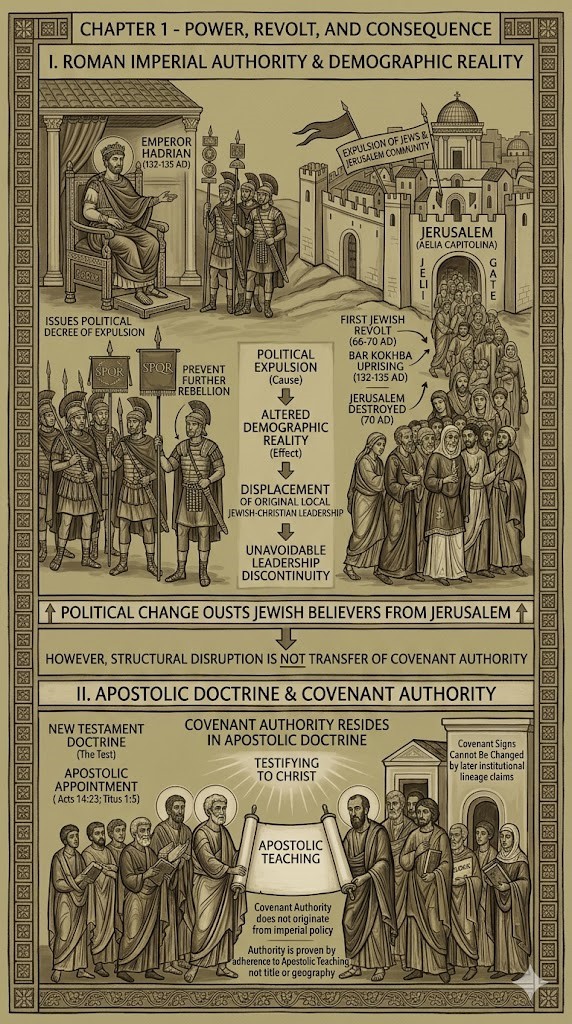
Chapter 1 – Power, Revolt, and Consequence
In the first and second centuries, Rome functioned primarily as an imperial authority, not as a theological institution. Its concern was political stability, taxation, and control. Religious diversity was tolerated so long as it did not threaten imperial order.
The Jewish revolts against Rome—first in 66–70 AD and again in 132–135 AD—were national and political uprisings. They were not disputes over Christian doctrine. Rome’s response was consistent with imperial governance: suppression of revolt, destruction of resistance, and reassertion of control. Jerusalem was destroyed in 70 AD. After the later revolt under Bar Kokhba, Emperor Hadrian barred Jews from residing in the city.
This expulsion was not issued as a religious ruling against Christian belief. It was a political measure aimed at preventing further rebellion. Rome did not attempt to redefine covenant theology, nor did it issue decrees reorganizing Christian doctrine. Its objective was control of territory, not management of ecclesiastical structure.
Yet the consequence of that political action inevitably affected the Jerusalem community. Jewish Christians were ethnically Jewish. If Jews were barred from the city, Jewish Christians would have been subject to the same prohibition. The removal was not religious in intent, but it necessarily altered the composition of leadership within Jerusalem. A leadership body that had been Jewish in origin could no longer reside there under Roman policy.
It is important to distinguish between cause and effect. Rome did not alter church leadership by theological decree; it altered the demographic reality of the city. Political action produced structural consequence. However, structural consequence does not equal covenant authority.
The New Testament locates covenant authority in apostolic teaching, not in geography. Political expulsion does not create doctrinal authorization. Demographic change does not transfer covenant signs. Scripture, not imperial policy, governs covenant identity.
This distinction must be established at the outset. Rome could remove residents from a city. It could not alter a covenant established by God.
Why Rome Suppressed the Revolt
Rome did not respond to the Jewish revolts as a religious opponent; it responded as an empire defending control.
The First Jewish Revolt (66–70 AD) erupted over taxation, governance, and resistance to Roman rule. Judea was a volatile province. Jewish nationalism, temple identity, and resistance to foreign domination created recurring instability. From Rome’s perspective, rebellion in any province threatened imperial authority. An empire that failed to suppress revolt invited further insurrection elsewhere.
The destruction of Jerusalem in 70 AD was not a theological statement. It was a military act intended to crush resistance and deter future uprising. The temple, which functioned not only as a religious center but also as a national symbol, was destroyed as part of that suppression.
The later Bar Kokhba revolt (132–135 AD) intensified Roman concern. This uprising was organized, militarized, and sustained. It required significant Roman force to subdue. When Rome ultimately regained control, it implemented harsher measures to prevent recurrence.
The expulsion of Jews from Jerusalem under Emperor Hadrian must be understood in that context. The removal was a preventative measure. By barring Jews from residing in the city, Rome sought to eliminate the epicenter of repeated rebellion. The city was renamed Aelia Capitolina, and Roman presence was reinforced.
This policy was political and administrative. Rome did not conduct theological inquiries into distinctions among Jewish groups. It acted broadly. Jewish identity, not doctrinal nuance, was the category being addressed. In the Roman mind, preventing revolt required altering the population structure of the city.
The consequence of that action extended beyond political nationalism. Jewish Christians were ethnically Jewish. The imperial decree did not differentiate between Jews who rejected Christ and Jews who believed in Him. The expulsion therefore affected the entire Jewish population of Jerusalem.
It is critical to state this carefully: Rome suppressed revolt to preserve imperial control. It removed Jews to prevent future uprising. It did not issue religious rulings concerning Christian covenant structure. Yet political decisions reshaped the demographic reality in which the Jerusalem community functioned.
Understanding this distinction allows the discussion to proceed without accusation. Rome acted as empires act — to secure authority. The theological implications were indirect consequences, not stated objectives.
“After the Jewish revolts, Roman policy barred Jews from Jerusalem. Because Jewish Christians were ethnically Jewish, that policy would have removed them from the city as well. This does not require the claim that Rome appointed church leaders or targeted doctrine; it is simply the practical consequence of expelling an entire people from a location. Since the apostolic era began with Jewish leadership appointed within the apostolic community, this political expulsion would have created an unavoidable discontinuity in Jerusalem’s local leadership—regardless of what any later historian lists by name.”
“Whatever happened locally in Jerusalem, covenant authority is preserved in apostolic doctrine, and covenant signs cannot be changed by later historical drift. Therefore the Sabbath question must be decided from Scripture, not from post-apostolic institutional history.”
Covenant Authority Does Not Reside in Empire
Political power and covenant authority operate in different spheres.
Rome governed territory.
The apostles governed doctrine.
In the New Testament record, leadership within the church was not created by imperial appointment but by apostolic authority. Elders were appointed within the community of faith (Acts 14:23; Titus 1:5). The foundation of the church is described as resting upon the apostles and prophets (Ephesians 2:20). Covenant authority flowed from those commissioned by Christ, not from civil institutions.
At the same time, Jerusalem functioned under Roman oversight. Civil administration, taxation, and public order were subject to imperial control. Even the Jewish high priesthood during this period operated within limits permitted by Rome. That civil structure was distinct from the apostolic structure of the church.
When Rome expelled Jews from Jerusalem after the revolt of 132–135 AD, it was not restructuring Christian doctrine. It was altering the civic composition of the city. The removal was based on ethnic and national identity, not on covenant theology.
Yet this political act had unavoidable structural consequences. The earliest leadership of the Jerusalem church had been Jewish. The apostles themselves were Jewish. The community formed in Jerusalem was rooted in Jewish believers who recognized Jesus as Messiah. If Jews were barred from the city, Jewish Christians would have been barred as well. The result would have been the displacement of that original local leadership.
It is important to state the sequence clearly:
- Apostolic authority established leadership within the church.
- Rome governed the city for political purposes.
- Rome’s expulsion of Jews altered who could physically reside in Jerusalem.
- That political action indirectly disrupted the Jewish-Christian leadership presence in the city.
However, disruption of presence is not transfer of covenant authority.
Covenant authority in the New Testament does not reside in geography. It does not depend upon which ethnic group holds civic control. It does not originate from imperial policy. Covenant authority rests in the apostolic teaching delivered once to the saints.
An empire may remove citizens.
It cannot rewrite a covenant.
This distinction prevents a common confusion. Political change can alter institutional continuity. It cannot generate divine authorization. If covenant signs were to be altered, that alteration would require explicit apostolic declaration grounded in the authority of Christ—not the consequence of civil policy.
With this principle established, the question becomes clear. Even if political events disrupted the original Jerusalem leadership, did the apostles authorize a change in covenant sign? If such authorization exists, it must be found in the text of Scripture. If it does not, then no historical development—however consequential—can supply what revelation has not declared.
“The question before us is not whether Gentiles were part of the church. Scripture affirms they were. The question is whether any later doctrinal development—regardless of who advanced it—possessed apostolic authorization. If a covenant sign was altered, that alteration must be demonstrated from the teaching of the apostles themselves. Warnings of apostasy in the New Testament require doctrinal examination, not ethnic suspicion. Therefore the matter must now be tested from Scripture.”
After the apostolic age, the New Testament record does not continue naming or documenting successive leaders in Jerusalem. The text of Scripture closes without providing an administrative chain linking each generation to the apostles by name.
Later historical writings present lists of bishops and claim continuity. However, these records are post-biblical and rely on secondary testimony. They are not preserved within the apostolic documents themselves. As such, they function as historical tradition rather than as New Testament documentation.
This distinction matters.
It cannot be decisively determined from Scripture who the Gentile leaders of Jerusalem were after the expulsion of Jews in the second century. Nor does the New Testament record any apostolic appointment of those later figures by name. Claims of direct, uninterrupted linkage from later bishops to the apostles depend upon historical succession lists rather than upon explicit biblical record.
This does not require accusing those claims of fabrication. It simply recognizes the limits of the available evidence. The New Testament provides the doctrine delivered by the apostles. It does not provide a continuous institutional register beyond their lifetime.
Therefore, if a church claims authority on the basis of succession, that claim rests on historical testimony outside the biblical text which is questionable at best. If a covenant sign was altered, the authorization for such change must be found within the apostolic teaching itself, not merely within later institutional lineage claims.
“Claims of apostolic succession rely on post-biblical historical testimony. However, covenant authority must be demonstrated from apostolic teaching preserved in Scripture. Therefore, the question of Sabbath and Sunday must be decided from the New Testament record, not from later institutional continuity claims.”
Authority Is Proven by Doctrine
After the apostolic age, questions arise concerning leadership, continuity, and authority. Historical records speak of bishops and succession. Traditions speak of continuity. Yet the New Testament establishes a different standard by which authority is recognized.
Authority is not proven by title.
Authority is not proven by geography.
Authority is not proven by later institutional memory.
Authority is proven by adherence to apostolic teaching.
The apostles themselves warned that deviation would occur.
Acts of the Apostles 20:29–30
Men would arise, speaking perverse things.
Second Epistle to the Thessalonians 2:3
A falling away would come.
First Epistle to Timothy 4:1
Some would depart from the faith.
These warnings do not concern ethnicity.
They concern doctrine.
Therefore, the identity of later leaders—whether Jewish or Gentile—is not the decisive issue. The decisive issue is what they taught.
If a leader proclaims the doctrine delivered by the apostles, he stands in continuity with them.
If a leader proclaims something not delivered by the apostles, he does not stand in that continuity, regardless of institutional lineage.
This is the test Scripture itself provides.
For this reason, statements such as “the early church did this” require definition. Who is meant by “the early church”? Is it those directly instructed by the apostles? Is it later generations? Is it a particular city? An institution? A tradition?
The phrase “early church” carries persuasive force, but without defining whose teaching is being referenced, it creates confusion. Authority cannot be assigned merely by proximity in time. It must be assigned by fidelity to apostolic doctrine.
Therefore, the question before us is not simply historical. It is doctrinal.
If later leaders introduced a change in covenant sign, that change must be tested against the apostolic record. Their legitimacy will be determined not by their claim to succession, but by whether their teaching aligns with what the apostles delivered.
Only after establishing this standard can the question of Sabbath and Sunday be examined properly. For if a covenant sign was altered, the alteration must be found within the apostolic teaching itself. If it cannot be found there, then no appeal to “the early church” can supply that authority.
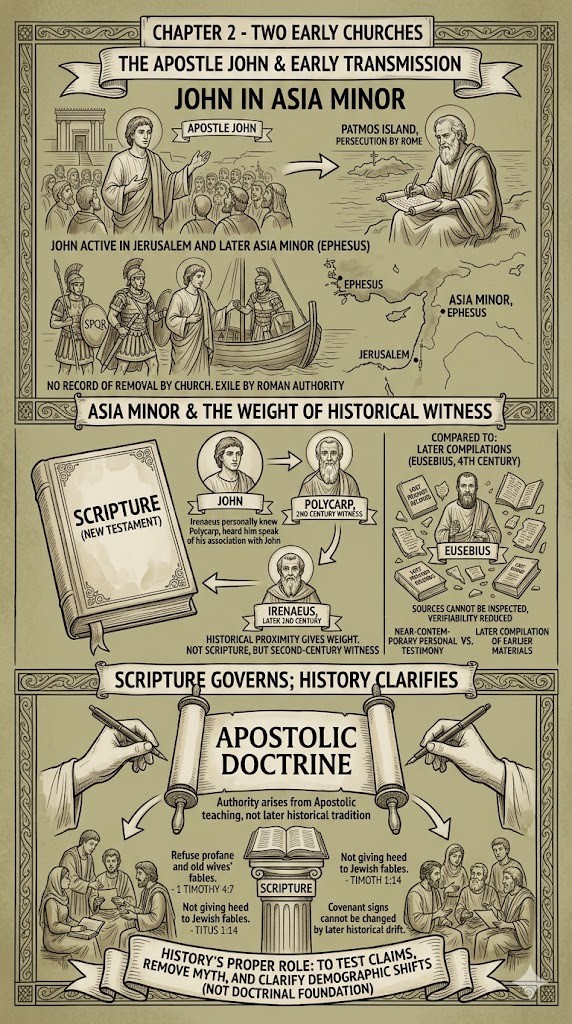
Chapter 2- Two early Churches
John in Asia Minor
The New Testament shows that John the Apostle was active in the early church in Jerusalem (Acts 3–8). Later historical testimony places him in Asia Minor, particularly in the region of Ephesus. While the New Testament does not narrate the full transition, there is no record indicating that John was removed from leadership by the Church.
In Book of Revelation 1:9, John states that he was on the island of Patmos “because of the word of God and the testimony of Jesus.” The language indicates persecution rather than internal ecclesiastical conflict. The text does not describe removal by church authority. It describes suffering connected to his witness.
There is no biblical record of John being displaced from leadership by other Christians. Nor is there early testimony describing his authority as rejected or overturned by the Church. If his presence on Patmos resulted from exile, the most reasonable historical explanation is Roman action, not internal church dismissal. Roman authorities were known to exile individuals for perceived disturbances connected to public order, and such action would align with the broader pattern of persecution in the first century.
Therefore, the claim that John was removed by the Church lacks textual and historical support. The available evidence instead indicates that his separation from his community was most likely the result of Roman persecution, not ecclesiastical rejection.
Asia Minor and the Weight of Historical Witness
If John’s later ministry centered in Asia Minor, then the transmission of apostolic teaching did not depend solely upon Jerusalem. Authority, in practice, had already extended geographically before the political disruption of Jerusalem.
It is within this Asia Minor context that we encounter Polycarp.
Polycarp lived into the mid-second century. More importantly, Irenaeus, writing in the late second century, claimed to have personally known Polycarp in his youth and to have heard him speak of his association with John the Apostle.
This form of testimony carries historical proximity. It is not Scripture, but it is second-century witness describing personal memory of a first-century connection. That proximity gives it measurable historical weight.
By contrast, succession lists and administrative records preserved in the fourth century rely on compilation. Eusebius of Caesarea gathered earlier traditions, some of which no longer survive independently. Because the original documents are lost, modern readers cannot directly examine the primary records from which he drew.
This does not automatically invalidate fourth-century accounts. It does, however, reduce their verifiability. Historical reliability is strengthened when sources are close in time and supported by multiple independent witnesses. It is weakened when the chain of transmission depends upon a single later compiler whose sources cannot now be inspected.
Therefore, when weighing early Christian history, we must distinguish between:
- Near-contemporary personal testimony (second century)
- Later compilation of earlier materials (fourth century)
Both are historical. Neither is Scripture.
But they are not equal in evidentiary strength.
This distinction matters because claims of institutional continuity often rest upon later succession lists. If those lists cannot be independently verified through surviving primary documents, their authority must remain historical rather than doctrinal.
The question before us is not whether these records are sincere. The question is what weight they can bear. Covenant authority cannot rest upon documentation that cannot be directly examined. Apostolic doctrine, preserved in Scripture, carries a different category of certainty.
On the Use of Later Historical Lists
There exists a later historical tradition that presents a list of Jerusalem leaders before and after the Jewish revolt of 132–135 AD. That record states that the early bishops of Jerusalem were Jewish Christians and that after the expulsion of Jews from the city, leadership became Gentile.
This historical testimony does not contradict the demographic consequences already described. In fact, it aligns with them. If Jews were barred from residing in Jerusalem, and if the early leadership of the Jerusalem church had been Jewish, then a transition in local leadership would be expected.
However, this later list survives through fourth-century compilation. The earlier primary documents from which it was drawn are no longer independently available. Because of this, the record cannot be directly verified by examining the original sources.
For that reason, it cannot function as doctrinal proof. It may serve as historical context. It may illustrate what likely occurred. But covenant authority cannot rest upon documentation that cannot be independently examined and tested against apostolic record.
This distinction is critical. The demographic shift in Jerusalem can be reasonably inferred from Roman policy alone. The later historical list, though consistent with that inference, is not necessary to establish it. Therefore it is not used as the foundation of the argument, but only acknowledged as contextual tradition.
The argument that follows does not depend upon post-biblical succession lists. It depends upon apostolic teaching preserved in Scripture.
“Polycarp occupies a distinct evidentiary position in early Christian history. He ministered in the same region traditionally associated with the Apostle John, and second-century testimony from Irenaeus claims personal acquaintance with him and direct knowledge of his connection to John. This proximity—both geographic and chronological—places Polycarp in a different historical category than later succession lists compiled centuries afterward. While not inspired Scripture, this testimony carries greater historical immediacy and provides insight into doctrinal continuity in Asia Minor during the second century.”
Scripture Governs; History Clarifies
Understanding of covenant authority does not arise from later historical tradition. It arises from the instruction of the apostles preserved in Scripture.
The Apostle Paul repeatedly warned against reliance upon myths and speculative narratives:
First Epistle to Timothy 1:4 — “Neither give heed to fables and endless genealogies.”
First Epistle to Timothy 4:7 — “Refuse profane and old wives’ fables.”
Second Epistle to Timothy 4:4 — “They shall turn away their ears from the truth, and shall be turned unto fables.”
Epistle to Titus 1:14 — “Not giving heed to Jewish fables.”
Second Epistle of Peter 1:16 — “We have not followed cunningly devised fables.”
These warnings are not casual suggestions. They are apostolic commands.
Believers are instructed not to build faith upon speculative tradition, imaginative reconstruction, or persuasive narrative unsupported by apostolic teaching.
Therefore, history cannot function as doctrinal foundation.
The Proper Role of History
History has a limited but important role.
History is not used to create covenant authority.
History is used to test claims and remove myth.
When a narrative arises—whether favorable or unfavorable—it must be tested. Historical evidence can confirm whether an event plausibly occurred. It can clarify demographic shifts. It can show diversity of early practice. It can expose exaggeration.
But history cannot establish a covenant sign.
If Scripture does not institute or transfer a covenant sign, no historical development can supply that authority.
In this way, history serves Scripture rather than competing with it.
It removes legend.
It disciplines speculation.
It prevents myth from becoming doctrine.
But it does not govern covenant.
Applying This Principle
For this reason:
- Succession lists are acknowledged but not treated as doctrinal proof.
- Claims that John was removed by the Church are rejected because they lack historical support.
- Claims that Rome directly reorganized Christian theology are rejected because they exceed the evidence.
- Polycarp’s proximity to John is weighed according to historical standards, not emotional preference.
The standard remains apostolic teaching preserved in Scripture.
History is used to clear the ground of fables, not to construct theology.
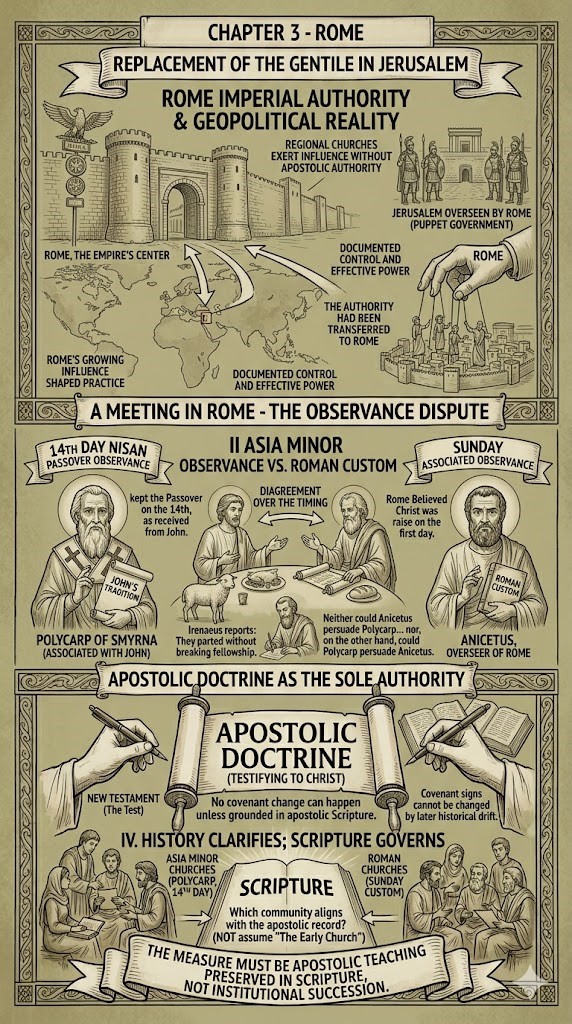
Chapter 3- Rome replacement of the Gentile in Jerusalem
“Just as in modern geopolitics a powerful nation can exercise influence without holding legitimate legal authority over another nation, so in early Christian history a regional church could exert influence without possessing apostolic authority to redefine covenant signs. The documented capture of Venezuelan leadership and subsequent influence is modern evidence of how control and effective power can operate without formal legal transfer. In the same way, Rome’s growing influence over early Christian practice shaped regional observances,
- No covenant change can happen unless that change is expressly grounded in apostolic Scripture.” What we see here is a moving of authority from Jerusalem to Rome. The gentile in Jerusalem carried no authority that can be shown. Nowhere can we find Rome going to these gentiles. We will see Polycarp did not go to the gentiles in Jerusalem there was no power of authority there. The Authority had been transfer to Rome. What Rome set up in Jerusalem was as we would say today a puppet government over the Church so they would have no more rebellion in Israel but the power move to Rome. We hear no more for these gentiles in Jerusalem.
A Meeting in Rome
In the middle of the second century, a quiet but important meeting took place in the city of Rome.
The empire was vast. Rome was its center — politically powerful, culturally dominant, and still largely pagan in its public life. Yet within that city was a growing Christian community. Its overseer at the time was a man named Anicetus.
From Asia Minor, another leader made the journey west.
His name was Polycarp of Smyrna.
Polycarp was already advanced in age. He was widely respected among the churches of Asia Minor and was known for maintaining the traditions he had received. According to early Christian testimony, he had been associated with the apostle John. Whether every detail of that connection can be historically verified, the claim was early and widely circulated in the second century.
The reason for Polycarp’s journey was not political. It was doctrinal.
The churches of Asia Minor observed the commemoration of Christ’s death on the 14th day of Nisan — the date of the Jewish Passover. This practice tied the remembrance of Christ directly to the biblical calendar.
Rome followed a different custom. In Rome, the observance had become associated with Sunday.
The disagreement was not over whether Christ should be remembered. Both sides affirmed that. The disagreement concerned the timing.
Polycarp maintained the 14th-day observance. Anicetus upheld the Roman custom.
When the two men met, the discussion was direct but not hostile. According to the surviving account preserved by Irenaeus, neither persuaded the other. They parted without breaking fellowship. Anicetus reportedly even allowed Polycarp to preside over the Eucharist in Rome as a gesture of mutual respect.
No council was convened. No decree was issued. No universal settlement was reached.
The meeting did not resolve the controversy. It revealed it.
By the mid-second century, different regions were practicing different forms of observance. Rome was influential enough to be engaged directly. Asia Minor was confident enough to maintain its tradition.
What is notably absent from the record is any citation of a written apostolic command altering the Passover date. The dispute appears to have rested on inherited practice rather than on an explicit New Testament decree.
The meeting between Polycarp and Anicetus stands as one of the earliest documented examples of a doctrinal difference between Rome and other Christian regions. It shows that divergence existed. It shows that discussion occurred.
It does not show a formal transfer of covenant authority.
It does not show a documented apostolic alteration of observance.
It shows a conversation at a crossroads in early Christian history.
The Words Preserved About the Meeting
Irenaeus reports that Polycarp: Polycarp stated we kept the Passover on the 14th, Anicetus reply was we believe Christ was raise on the first day.
“had always observed [the Passover] with John the disciple of our Lord, and the rest of the apostles with whom he associated.”
This is not presented as a new argument.
It is presented as continuity — what he had received and continued.
Irenaeus then writes regarding Anicetus:
“Neither could Anicetus persuade Polycarp not to observe it, because he had always observed it with John… nor, on the other hand, could Polycarp persuade Anicetus to observe it.”
The record continues:
“They communed together; and Anicetus conceded the celebration of the Eucharist in the church to Polycarp, manifestly as a mark of respect.”
And finally:
“They parted from each other in peace, and the whole Church was at peace.”
In the middle of the second century, an old man from Asia Minor crossed the empire to meet a leader in Rome.
His name was Polycarp of Smyrna.
Rome was powerful and prominent, and its Christian congregation had its own established customs. Its overseer at the time was Anicetus. The two men met because a question had surfaced that could not be ignored: when should the churches observe the memorial connected to Christ’s death?
In Asia Minor, the practice was fixed. Polycarp and the churches around him observed it on the fourteenth day of Nisan—the Passover date. In Rome, the practice had taken a different shape and was tied to Sunday. Both sides claimed continuity. Both believed their practice was right. But they were not practicing the same thing.
When Polycarp explained his position, he did not appeal to a Roman office, to a council, or to a new revelation. The historical record preserves the substance of his claim: he said he had always observed it in the way he had received—with John, the disciple of the Lord, and with others he associated with among the apostles. That is the weight of Polycarp’s appeal: it is not a distant fourth-century reconstruction; it is a near-apostolic memory stream preserved in the second century.
That matters historically.
Polycarp’s lifetime overlaps the closing years of the apostolic age. His ministry was in the same regional world traditionally associated with John. And the man who later preserved the account, Irenaeus, claimed that he personally knew Polycarp in his youth. That chain—apostle to elder, elder to hearer—does not make the claim Scripture, but it places it in a far stronger historical category than later administrative lists compiled centuries afterward.
Yet the meeting also reveals the limits of history.
We do not have a letter from John confirming the details. We do not have a transcript of the conversation. We have a preserved report—early and valuable, but still a report. That means Polycarp’s claim carries real historical weight, but it cannot be treated as the same kind of certainty as an apostolic writing contained in Scripture.
And that is where the story turns.
Because even if Polycarp truly received this practice from John, the question does not end with historical continuity. The decisive question becomes: what counts as binding authority?
In the New Testament, authority is not established by time, reputation, or institutional development. Apostolic authority begins with commissioning—men sent by Christ—and it is preserved through teaching—what was delivered and recorded. The churches are described as being built on that foundation. That is why the apostles warn repeatedly against fables, drift, and departure: the measure is fidelity to what was delivered.
So Polycarp’s appeal to John matters. It shows that early Christian practice was not uniform and that some communities anchored their observance in apostolic association. But it also forces a sharper question: if anyone claims the right to alter a covenant sign, where is that authorization preserved in apostolic teaching?
History can show that a dispute existed.
Only Scripture can establish covenant authority.
And now the narrative is ready to leave the roads of memory and enter the text itself.
Chapter Conclusion — The Phrase “The Early Church”
As this historical section closes, one phrase must be handled carefully:
“The early church.”
In modern discussions, that phrase is often used as if it refers to a single, unified body with a single, uniform belief system. It is presented as though “the early church” held one consistent position, and that position can simply be cited as authority.
But the historical record we have just examined shows something more complex.
By the mid-second century, different regions practiced differently. Asia Minor maintained a fourteenth-day Passover observance. Rome observed differently. The disagreement was real, documented, and unresolved.
Therefore, when someone appeals to “the early church,” a necessary question follows:
Which one?
The churches associated with Polycarp?
The churches in Rome?
The communities in Asia Minor?
Those who preserved the fourteenth-day practice?
Or those who moved toward Sunday observance?
The phrase itself does not settle the matter.
Belief must be examined, not assumed.
History shows diversity.
Scripture defines truth.
The New Testament repeatedly warns that deviation would arise from within. The apostles cautioned that false teaching would not only come from outside persecution but from internal distortion. That warning alone requires careful discernment when evaluating early historical developments.
The measure, therefore, cannot be the phrase “the early church.”
The measure must be apostolic teaching preserved in Scripture.
When a historical claim is made, the question is not simply whether it is early.
The question is whether it aligns with what the apostles delivered.
There were early communities that preserved apostolic practice.
There were early communities that developed differently.
The presence of antiquity does not automatically equal fidelity.
The way through confusion is not accusation.
It is a comparison.
When the phrase “the early church” is used, the response is simple:
Which community, and does its teaching align with the apostolic record?
That question moves the discussion from rhetoric to examination.
And examination must always return to the foundation laid by the apostles themselves.
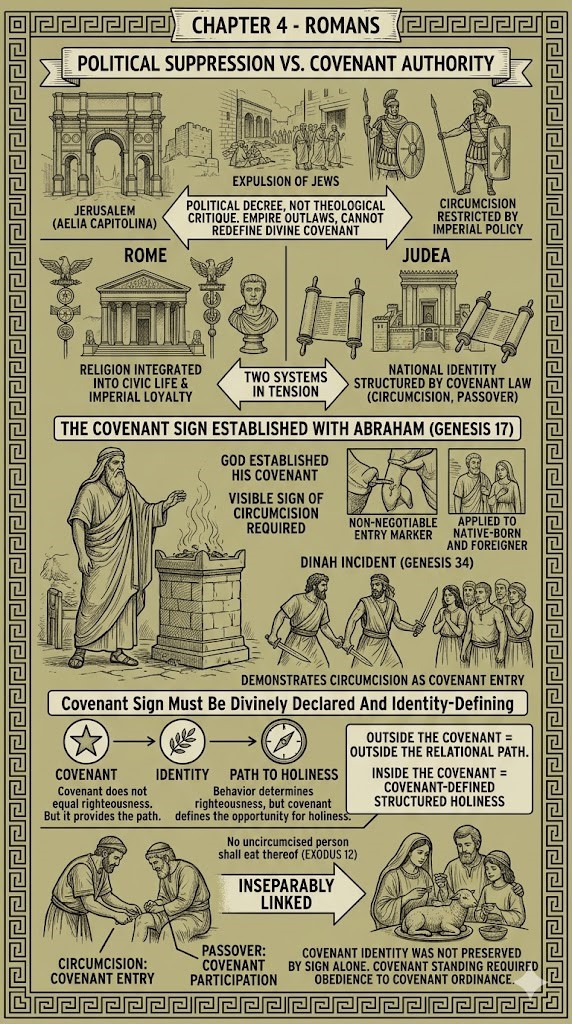
Chapter 4- Romans
“After the Jewish revolts, Roman imperial policy suppressed Jewish national and religious identity markers, including circumcision, for reasons of political stability and military control. This suppression was imperial in nature and not a theological critique of covenant law.”
Political Suppression vs Covenant Authority
After the Jewish revolts, especially following 135 AD, Rome enacted policies designed to eliminate further rebellion. Jewish national identity was treated as a political threat. Jerusalem was renamed. Jews were expelled from the city. Circumcision — a central marker of Jewish covenant identity — was restricted in certain legal contexts.
These actions were not theological arguments against the covenant of Israel. They were measures of imperial control.
Rome’s concern was stability, not doctrine.
This distinction matters.
An empire can suppress a religious practice for political reasons. But suppression by imperial decree does not constitute theological annulment of a covenant sign.
Empire can outlaw.
Empire cannot redefine divine covenant.
That is the line that must remain clear.
Section — Religion and Power in Rome and Judea
In the first and second centuries, religion and political authority were not separate spheres in either Rome or Judea. But they functioned differently in each system.
Rome
In Rome, religion was integrated into civic life and imperial loyalty. The emperor was associated with divine honor. Participation in state cults functioned as a public sign of allegiance to the empire. However, Roman religion in this period was not a centralized ecclesiastical institution like the later Catholic Church. It was a network of state-sanctioned cults, priesthoods, and civic rituals tied to imperial order.
Religion in Rome reinforced the empire. It did not define its law in covenantal terms. Law flowed from imperial authority. Religion supported loyalty to that authority.
Rome’s primary concern was control and stability. Religious conformity mattered when it intersected with political loyalty.
Judea
Judea functioned differently.
Jewish national identity was structured by covenant. The Law was not merely religious instruction — it was national constitution. Circumcision, Sabbath, temple observance, and calendar were not optional rituals; they were covenant markers embedded in the legal and social structure of the nation.
In Judea, religious belief shaped civil life. The covenant defined the people, and the people were defined by the covenant.
This difference is critical.
Rome governed by imperial decree.
Judea understood itself as governed by divine covenant.
The Tension
When Rome ruled Judea, these two systems overlapped.
Rome required loyalty to Caesar.
Judea required loyalty to covenant law.
When rebellion occurred, Rome responded militarily. When Jewish identity markers were suppressed after revolt, Rome was acting to neutralize what it viewed as a destabilizing force.
From Rome’s perspective, this was political enforcement.
From the Jewish perspective, it touched covenant identity.
“History shows two systems in tension — imperial power and covenant identity. But history cannot determine which system carries divine authority. That determination belongs to Scripture.”
The Covenant Sign Established with Abraham
The covenant structure begins with Abraham.
In Genesis 17, God establishes His covenant with Abraham and his descendants. The covenant is not abstract. It includes a visible sign.
Circumcision is declared:
- A sign of the covenant.
- Performed in the flesh.
- Required of every male.
- Applied to native-born and foreigner alike.
- Required for anyone who would belong to Abraham’s house.
This is not optional ritual.
It is covenant entry marker.
God explicitly says that any male not circumcised shall be “cut off” from the people, because he has broken the covenant.
That language defines covenant sign clearly.
Entry Into Covenant — The Dinah Incident
In Genesis 34, the daughter of Jacob (Dinah) is violated by Shechem.
Shechem desires to marry into Jacob’s family.
Jacob’s sons respond by saying:
Intermarriage is possible — but only if the men of the city are circumcised.
Circumcision was the condition of joining the covenant family.
The men agree and submit to circumcision.
While they are in physical weakness from the procedure, Simeon and Levi attack and kill the males of the city.
This event is critical structurally:
It demonstrates that circumcision was understood as covenant entry.
It was not cultural decoration.
It was identity transformation.
Later, in Genesis 49, Jacob rebukes Simeon and Levi for their violence.
Reuben’s birthright issue is separate, tied to a different sin.
So we must keep those lines distinct.
Covenant Sign Defined
From these passages we establish:
- A covenant sign is explicitly declared by God.
- It marks entry into covenant identity.
- It applies to descendants and those who join.
- It is non-negotiable within covenant structure.
Now this gives us a working definition.
Before we even move to Passover or Sabbath, we have established:
Covenant sign must be divinely declared and identity-defining.
That is the standard.
Section — Passover and Circumcision: Covenant Access
Circumcision was established in Genesis 17 as the sign of the covenant with Abraham. It marked entry into the covenant family.
When Israel is delivered from Egypt, the Passover is instituted in Exodus 12.
Exodus 12:27 defines the event:
“It is the sacrifice of the LORD’S passover, who passed over the houses of the children of Israel in Egypt…”
The Passover marks deliverance. It marks divine distinction. It marks belonging.
But then something critical is stated.
Exodus 12:43:
“This is the ordinance of the passover: There shall no stranger eat thereof.”
Access is restricted.
Then verse 48 clarifies:
“When a stranger shall sojourn with thee, and will keep the passover to the LORD, let all his males be circumcised, and then let him come near and keep it… for no uncircumcised person shall eat thereof.”
This establishes a structural connection.
Circumcision is the covenant sign of entry.
Passover is the covenant meal of participation.
No uncircumcised person may eat the Passover.
That means:
- Passover is not a casual memorial.
- It is a covenant-restricted observance.
- Participation presupposes covenant status.
And verse 48 adds something important:
Once circumcised, the stranger “shall be as one that is born in the land.”
Circumcision grants covenant inclusion.
Passover confirms covenant belonging.
Chapter — Covenant Identity and Covenant Obligation
When God made covenant with Abraham, He did not leave it undefined. He gave a sign.
Circumcision was declared the sign of the covenant — not a suggestion, not a custom, but a mark in the flesh that separated those within the covenant from those outside it. Every male in Abraham’s house, whether born there or joined later, was required to receive it. The uncircumcised male, God said, would be cut off from the people, because he had broken the covenant.
Circumcision marked entry.
It identified belonging.
But entry into covenant was not the end of covenant responsibility.
When Israel stood at the threshold of deliverance from Egypt, another ordinance was established — the Passover.
The blood on the doorposts marked the houses that belonged to the LORD. The death angel passed over those marked homes. Deliverance was not random; it was covenantal distinction.
The Passover was then fixed as an ordinance. It was not open to all. No stranger could eat of it. And when a stranger desired to join and keep the Passover, the requirement was clear: all his males must first be circumcised. Only then could he come near and keep it. Only then would he be counted as one born in the land.
Circumcision granted covenant entry.
Passover confirmed covenant participation.
The two were inseparably linked.
But the covenant structure goes even further.
In the wilderness, instruction was given regarding those who would neglect the Passover. If a man was clean, not hindered by journey or uncleanness, and refused to keep the Passover in its appointed season, that man was to be cut off from among his people. He would bear his sin.
The language is unmistakable.
The same covenant penalty that applied to rejecting circumcision applied to refusing the Passover.
This reveals something fundamental.
Covenant identity was not preserved by sign alone.
Covenant standing required obedience to covenant ordinance.
Circumcision marked the covenant in the flesh.
Passover bound the covenant in practice.
One without the other left the covenant incomplete.
From the beginning, covenant was never merely symbolic. It was structural. Entry and participation were joined together. The sign identified the people. The ordinance sustained their relationship within the covenant.
This is the pattern established before any empire rose, before any later dispute, before any historical development.
Covenant identity and covenant obedience were inseparable.
Covenant and the Call to Holiness
From the beginning, God did not relate to man without structure. When He entered into covenant with Abraham, He did not merely give promises — He established terms. A covenant was a binding arrangement. It defined relationship. It set conditions. It established identity.
The covenant was not obedience itself. It was the agreement within which obedience would operate. It was not holiness itself. It was the framework through which holiness would be pursued.
When Israel stood at Sinai, the covenant was expanded and formalized. God declared His intent:
“You shall be unto Me a kingdom of priests and a holy nation.”
Holiness was not presented as an abstract ideal. It was covenantal. The people were called to be holy because they were bound in covenant to a holy God. The covenant defined their law. The law defined their conduct. Conduct defined their distinctness among the nations.
Without covenant, the command “be holy” would have no legal or relational anchor. There would be no defined standard. No agreed terms. No structured path.
Covenant established:
- Who the people belonged to.
- What law governed them.
- What promises applied to them.
- What penalties existed for violation.
- What signs marked their identity.
Holiness was not self-generated. It was covenant-defined.
To live outside the covenant was to live without that structure. To live within it was to live under its terms.
The covenant did not guarantee obedience. But it defined the only lawful path by which obedience could be measured and holiness pursued.
Section — Covenant and the Nations
In Scripture, the words often translated “heathen” or “Gentile” primarily mean “nations.” They refer to peoples outside the covenant given to Abraham and later formalized at Sinai. The term does not, by itself, mean morally evil. It describes position, not behavior.
A nation outside the covenant was not automatically wicked. It was outside the covenant structure.
That distinction is essential.
Covenant does not equal righteousness. Many within Israel violated covenant law. Covenant status did not guarantee holy behavior. But covenant established the defined path toward holiness.
Holiness in Scripture is defined by alignment with God’s character and law. The covenant provided:
- The law.
- The identity.
- The promises.
- The access.
- The structure by which obedience could be measured.
Outside the covenant, there was no defined legal framework binding a people to that revealed standard. That did not make the nations automatically evil. It meant they were not living within the covenantal path God had established for holiness.
Behavior determines righteousness or unrighteousness.
But covenant defines the opportunity to become holy in structured relationship with God.
To be outside the covenant was to be outside that defined relational path. To enter covenant was to enter the structure in which holiness was commanded, measured, and pursued.
Thus:
Covenant does not equal automatic righteousness.
But covenant provides the only defined path toward holiness under God’s revealed terms.
Outside the covenant, holiness is unattainable.
Inside the covenant, holiness is commanded and structured which give the opportunity of Holy.
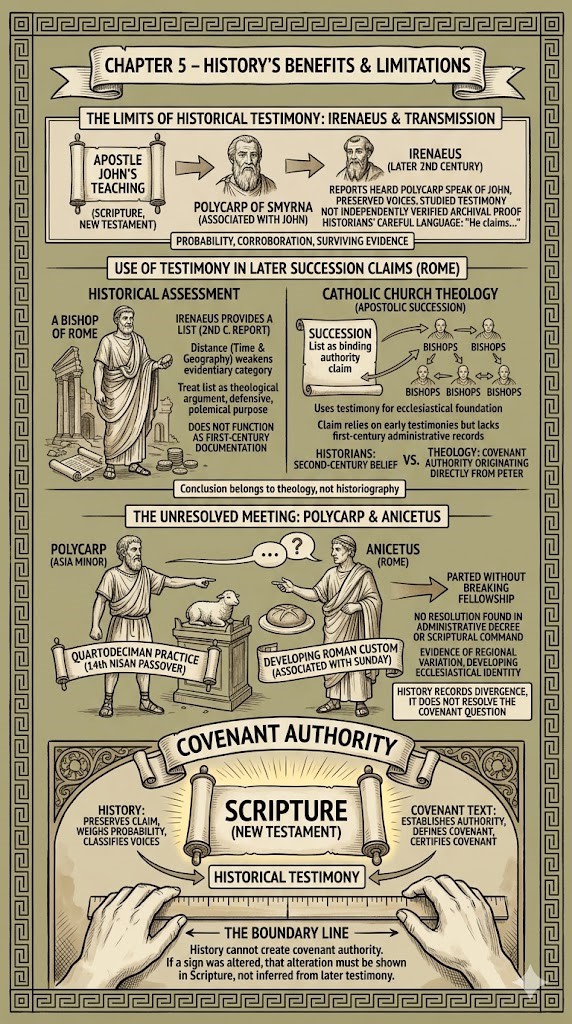
Chapter 5- History Benefits and Limitations
The Limits of Historical Testimony
A Narrative Illustration
After the apostolic period, the written record becomes thinner.
Letters remain.
Fragments survive.
Voices emerge from the second century.
One of those voices is Irenaeus.
He writes decades after the apostles. He speaks of teachers before him. He states that he knew Polycarp, and that Polycarp had known John the Apostle. He presents a line of memory — a chain of transmission.
His testimony is not treated by historians as fable.
It is not placed in the category of myth.
It is preserved, studied, translated, and cited.
But it is also not treated as documentary proof in the strict historical sense.
It is classified as testimony.
There is a difference.
History, as a discipline, distinguishes between:
- Contemporary administrative records
- Multiple independent attestations
- Archaeological documentation
- Later narrative reporting
Irenaeus belongs to the last category.
He reports what he received.
He recounts what he believed to be true.
He describes the continuity as he understood it.
Historians do not dismiss him.
They also do not elevate his statements into independently verified documentation.
Instead, they write carefully:
“According to Irenaeus…”
“He claims…”
“He reports…”
This language reflects methodological restraint.
It recognizes that a second-century bishop giving personal recollection — however sincere — is not the same as preserved archival proof of an unbroken administrative chain.
The discipline of history operates on probability, corroboration, and surviving evidence. When a chain rests primarily on one writer’s retrospective account, historians mark it as attested testimony, not as demonstrated institutional fact.
This does not mean the chain did not exist.
It means the evidence category is limited.
Possibility is not the same as verification.
Now the distinction becomes important.
If the claim being made is historical continuity of people or communities, testimony may be sufficient to suggest plausibility.
But if the claim being made is covenant authority — binding divine legitimacy — the standard changes.
Covenant authority is not established by reported succession.
It is established by adherence to covenant terms.
History can tell us what a bishop said.
It can preserve his memory of teachers before him.
It can show what communities believed at a given time.
It cannot, by its method, authenticate covenant legitimacy.
Even if Irenaeus accurately remembered Polycarp, and Polycarp accurately remembered John, that chain still remains:
A record of testimony.
Covenant authority does not arise from preserved memory.
It arises from covenant structure.
This is the limit.
History preserves voices.
It classifies testimony.
It weighs probability.
It does not convert reported succession into covenant validation.
Recognizing that boundary does not diminish the value of early writers.
It simply keeps historical method and covenant authority in their proper jurisdictions.
The Use of Testimony in Later Authority Claims
The testimony of Irenaeus is often cited not only in discussions of early continuity in Asia Minor, but also in discussions regarding Rome.
Irenaeus states that Peter the Apostle and Paul the Apostle were connected to the church at Rome, and he provides a list of successive bishops in that city. That list is later used in arguments for apostolic succession by the Catholic Church.
Here again, the question is not whether Irenaeus wrote these things.
He did.
The text survives.
It is studied and cited in academic literature.
The question remains methodological:
What category of evidence is this?
1. Relative Proximity and Evidentiary Weight
When Irenaeus speaks of Polycarp, the historical situation has a degree of proximity:
- Irenaeus lived in the region of Asia Minor.
- Polycarp ministered in that region.
- The chronological distance between them is comparatively small.
This proximity gives his testimony contextual plausibility.
It remains testimony — but testimony with geographic and generational closeness.
The situation changes when Irenaeus speaks of events over a century earlier concerning Rome.
Now:
- The chronological distance increases.
- The geographic distance increases.
- The chain depends entirely on his report of a list.
We do not possess the original list apart from his writing.
We do not possess independent contemporary Roman administrative records confirming the succession as described.
We do not possess parallel documentation from the first century establishing the structure in the form later described.
Historians therefore classify the list as a second-century report of earlier succession — not as independently verified first-century documentation.
2. The Question of Founding
Irenaeus also attributes foundational roles in Rome to Peter and Paul.
Modern scholarship treats this cautiously.
While there is strong early Christian tradition connecting both apostles with Rome, the New Testament itself does not describe Peter founding the Roman congregation in the administrative sense later assumed. The evidence available leaves room for interpretation.
Because of this, historians generally describe the Roman origin question in terms of tradition rather than settled archival fact.
Again, this is not dismissal.
It is classification.
3. The Nature of the Succession List
The succession list presented by Irenaeus functions as:
- A theological argument for continuity.
- A defense against competing doctrinal claims.
- An appeal to lineage as a stabilizing factor.
It does not function as surviving first-century documentation.
We do not have:
- Independent first-century Roman records confirming appointment procedures.
- Contemporary letters establishing a formalized episcopal succession structure in the way later described.
- Multiple independent sources corroborating each name in the list from the earliest period.
For that reason, historians typically refer to it as a second-century witness to what was believed about Roman succession at that time.
They do not elevate it to the level of documented institutional certification from the apostolic age.
4. The Distinction Between Historical Tradition and Covenant Authority
The Catholic Church uses the concept of apostolic succession as a theological foundation for authority claims.
That claim rests, in part, on early testimonies like that of Irenaeus.
From a strictly historical standpoint, however:
- Irenaeus provides testimony.
- The testimony is early and significant.
- The testimony is not independently verifiable in its earliest links.
History can affirm that by the late second century, Christians believed in structured succession in Rome.
History cannot demonstrate, through surviving documentation, that such succession constitutes covenant authority originating directly from Peter in an unbroken, legally demonstrable chain.
That conclusion belongs to theology, not to historiography.
5. The Boundary Line
It is important to draw the line carefully.
Irenaeus is not categorized by historians as myth or fable.
He is a primary source for second-century Christianity.
But his testimony remains:
- A literary witness.
- A theological argument.
- A reported chain of succession.
It is not equivalent to preserved first-century covenant documentation.
If covenant authority is claimed on the basis of succession alone, the historical record provides testimony — not demonstrable covenant validation.
That is the limit.
History preserves the claim.
It does not certify the covenant.
Keeping that distinction intact preserves fairness to history and clarity regarding authority.
Authorial Context and the Question of Interest
There is another factor historians routinely consider when evaluating ancient testimony: authorial position.
Irenaeus was not writing as a detached archivist. He was a bishop engaged in theological controversy. His principal surviving work, Against Heresies, was written to oppose doctrinal movements he believed to be harmful to the church.
In that setting, appeals to continuity served a theological purpose.
This does not invalidate his testimony.
It situates it.
Ancient authors frequently wrote with explicit doctrinal aims. Their works were not neutral chronicles but arguments. Historians therefore ask:
- What issue was the author addressing?
- What theological or ecclesiastical concern shaped the writing?
- How might that context influence the way history is presented?
This is standard historical method.
1. The Roman Appeal in Context
In opposing rival teachers, Irenaeus appealed to churches he regarded as preserving apostolic teaching. Rome held a prominent position in that appeal.
His reference to succession in Rome functioned as part of an argument: that doctrinal stability could be identified through continuity of recognized leadership.
In other words, the succession list served a polemical purpose within a live controversy.
Historians therefore evaluate the list not merely as data, but as argument.
Again, this does not mean the list is false.
It means it was written to persuade.
When a source is written within controversy, historians increase caution. They look for corroboration beyond the rhetorical setting.
2. The Question of Bias
All ancient writers wrote from within communities and convictions. Neutral modern historiography did not exist in the second century.
Acknowledging that Irenaeus had theological commitments is not an accusation. It is an observable fact. He explicitly states his purpose.
Modern historians describe such writings as:
- Confessional
- Theological
- Defensive
- Apologetic
Because of this, his claims are weighed as testimony shaped by doctrinal defense.
This does not reduce him to myth.
It does not dismiss him.
It simply means his account cannot be treated as disinterested administrative documentation.
3. Later Use of His Testimony
The Catholic Church later incorporated appeals to apostolic succession as a foundational element of its theology of authority.
Irenaeus’ testimony became one early witness cited in that framework.
From a historical standpoint, however, the later theological use of his statements does not increase the evidentiary category of the original claim.
A second-century testimony remains a second-century testimony, even if it becomes foundational in later ecclesiastical argument.
The discipline of history continues to classify it according to its original nature.
4. Geographic and Chronological Distance
When Irenaeus spoke of Polycarp in Asia Minor, proximity strengthened plausibility.
When he spoke of first-century Roman succession from Peter the Apostle, the distance was far greater:
- Over a century removed.
- Dependent on inherited reports.
- Without surviving contemporary Roman documentation verifying the structure described.
Historians therefore treat these earlier claims with increased caution.
The more distant the event, the more heavily testimony depends on transmission layers.
5. The Resulting Historical Assessment
Modern scholarship does not classify Irenaeus as unreliable fiction.
Nor does it treat his succession claims as independently proven institutional records.
Instead, they are described as:
- Early testimony to developing concepts of succession.
- Evidence of second-century belief about Roman leadership.
- Part of an emerging ecclesiastical self-understanding.
This distinction matters.
If the question is what Christians in the late second century believed about Rome, Irenaeus is a valuable witness.
If the question is whether covenant authority can be legally demonstrated from Peter to later bishops through preserved first-century documentation, the evidence category remains limited.
6. The Structural Boundary
Recognizing that Irenaeus wrote within controversy and theological defense does not discredit him.
It clarifies his role.
He was:
- A bishop.
- A defender of doctrine.
- A theological writer.
- A witness to second-century belief.
He was not:
- A first-century Roman archivist.
- A neutral administrative recorder.
- A producer of preserved covenant documentation.
History preserves his voice.
It evaluates his context.
It weighs his claims.
It does not convert rhetorical succession into demonstrable covenant certification.
That boundary preserves both fairness to Irenaeus and clarity regarding authority.
The Unresolved Meeting and the Covenant Sign
One episode frequently referenced in discussions of early church continuity involves a reported meeting between Polycarp and Anicetus.
The account comes through Irenaeus.
According to his report, Polycarp traveled to Rome, the two men discussed the observance of Passover, and they parted without resolving the difference.
That is the testimony.
Beyond that, the historical record becomes thin.
We do not possess:
- A Roman account of the meeting.
- A Smyrnaean record of the meeting.
- Minutes, letters, or administrative documents describing the discussion.
- A detailed summary of the theological arguments exchanged.
We do not know the full content of the discussion.
We do not know the tone.
We do not know whether the disagreement was limited to practice, or extended to authority.
We only know what Irenaeus later summarized.
History classifies this as reported testimony.
The Nature of the Disagreement
The subject in question was not a minor custom.
It concerned the observance of Passover — a covenant sign rooted in the Hebrew Scriptures and carried into early Christian practice.
A covenant sign is not merely a preference.
It is an identifying marker of covenant structure.
When a disagreement concerns a covenant sign, the issue moves beyond personal difference. It touches the boundary of covenant definition itself.
That is why the matter cannot be reduced simply to two bishops within one uniform structure differing over calendar practice.
The disagreement reflects two distinct patterns of observance:
- The Quartodeciman practice associated with Asia Minor.
- The developing Roman practice connected with Sunday observance.
Historians generally describe this as an early divergence within Christianity.
They do not present it as a settled first-century apostolic decree authorizing Rome to alter covenant observance. Rather, they describe it as evidence of regional variation and developing ecclesiastical identity.
One Church or Two Patterns?
Here the structural question emerges.
If the Passover is treated as a covenant sign — rooted in scriptural command and continuity — then alteration would require scriptural authorization.
The New Testament does not contain a recorded administrative decree changing the covenant sign in explicit terms.
Therefore, when two distinct observance patterns appear in history, historians classify the situation descriptively:
- Asia Minor maintained one tradition.
- Rome developed another.
From the standpoint of historical method, this reflects diversity within early Christianity.
From the standpoint of covenant structure, the issue is sharper:
If a sign defines covenant identity, divergence over that sign suggests more than personal disagreement.
It suggests differing understandings of covenant authority.
History records the divergence.
It does not resolve the covenant question.
The Limits of the Record
It is possible that Polycarp and Anicetus parted peacefully.
It is possible that the disagreement was contained within broader fellowship.
It is possible that authority questions were not pressed in the way later centuries would press them.
The historical evidence does not allow definitive reconstruction.
What can be stated is this:
- The disagreement concerned covenant observance.
- The record of the meeting comes through a later theological witness.
- The details are limited.
Historians therefore describe the episode as reflecting differing regional practices rather than as definitive proof of apostolic authorization for change.
The Bottom Line
If the question is historical:
The meeting is attested through second-century testimony.
Its details remain limited.
Its interpretation varies among scholars.
If the question is covenantal:
Authority to alter a covenant sign must be demonstrated from covenant text.
Historical testimony of later divergence cannot substitute for that demonstration.
History can tell us that Rome and Asia Minor differed.
History can tell us how later communities understood that difference.
History cannot, by itself, establish that one side possessed covenant authority to redefine the sign.
That determination must rest on the covenant’s own terms.
And that is the boundary.
Chapter Conclusion — The Boundary of History
The historical record gives us voices.
It gives us testimony from Irenaeus.
It gives us reports of a meeting between Polycarp and Anicetus.
It gives us evidence of regional differences between Asia Minor and Rome concerning Passover observance.
What it does not give us is preserved covenant documentation authorizing a change to a covenant sign.
The meeting itself remains limited to later testimony.
The content of the discussion is not preserved in full.
The authority to redefine covenant structure is not demonstrated in the biblical text.
History can record divergence.
History can preserve argument.
History can show the development of institutional claims.
History cannot create covenant authority.
If a covenant sign was altered, that alteration must be shown in Scripture — not inferred from later testimony.
With that boundary established, history has been given its proper place.
It has been heard.
It has been weighed.
It has not been overextended.
The question now returns where it must always return:
To the covenant text itself.
And there, the matter must be settled.
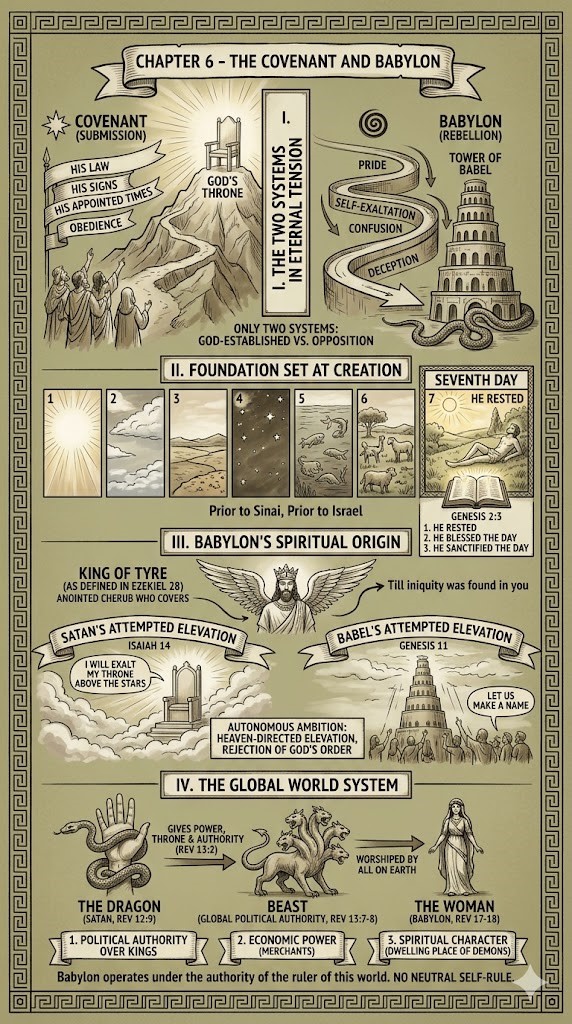
Chapter 6- The Covenant and Babylon
Chapter — The Two Systems: Covenant and Babylon
There are only two systems presented in Scripture.
Not many.
Not layered.
Not blended.
Two.
One is established by God.
The other stands in opposition to Him.
The first is defined by covenant.
The second is defined by Babylon.
This chapter will not begin with history, institutions, or accusations. It will begin with definitions drawn strictly from Scripture. The question is not what later generations claimed. The question is what the Bible itself establishes.
The covenant system originates with God. It is defined by:
- His law.
- His signs.
- His appointed times.
- His holy city.
- His covenant relationship with a people called by His name.
It is not built by political power.
It is not established by imperial decree.
It is sustained by obedience to the covenant terms.
Opposed to this system stands another.
Scripture gives it a name: Babylon.
Babylon first appears as a historical kingdom. Yet as the biblical narrative unfolds, Babylon becomes more than geography. It becomes a symbol of organized rebellion, of idolatry, of confusion, of captivity, of global influence opposed to the covenant of God.
By the time we reach the prophets and the final book of Scripture, Babylon is no longer merely a city. It represents a system—one that spans peoples, nations, kings, and commerce.
The Bible does not present these two systems as compatible.
Covenant and Babylon do not merge.
They do not share authority.
They do not co-govern.
They stand in tension from Genesis to Revelation.
This chapter will proceed under strict method.
Babylon will be defined from Scripture alone.
The covenant will be defined from Scripture alone.
No motive will be assigned.
No institution will be named prematurely.
No conclusion will be declared without two independent witnesses.
We will not assume.
We will extract.
We will test.
And when the structure is complete, the distinction between the two systems will stand not as opinion, but as mathematical alignment of precept upon precept.
The issue before us is not historical rivalry.
It is covenant identity.
If a system alters covenant signs without covenant authorization, it cannot be the covenant system.
If a system claims authority apart from covenant terms, it must be tested against the pattern of Babylon.
The Bible itself will determine which is which.
Line upon line.
Mankind often places itself at the center of history.
Empires rise.
Nations fall.
Institutions form.
Leaders claim authority.
Yet the Bible does not present humanity as the primary architect of the central conflict.
The battle described in Scripture is not first between political powers.
It is not first between religious institutions.
It is not first between nations.
It is between God and a rebellious spiritual being.
The prophet Book of Ezekiel records language directed toward the “king of Tyre” that moves beyond ordinary human description:
“You were the seal of perfection, full of wisdom and perfect in beauty.
You were in Eden, the garden of God…
You were the anointed cherub who covers;
I established you;
You were on the holy mountain of God…
You were perfect in your ways from the day you were created,
till iniquity was found in you.”
— Ezekiel 28:12–15
The text continues:
“Your heart was lifted up because of your beauty;
You corrupted your wisdom for the sake of your splendor…
I cast you to the ground.”
— Ezekiel 28:17
Whatever immediate historical layer the prophecy addresses, the language clearly transcends a mere human ruler. It describes a created being placed in proximity to God’s throne, lifted up in pride, seeking elevation beyond appointed boundaries.
This aligns with the broader biblical testimony that speaks of a fallen adversary—one who sought to exalt himself above God.
The conflict, then, did not originate with human kingdoms.
It began with attempted usurpation.
From that rebellion forward, Scripture presents two governing principles:
- God’s covenant rule.
- A rival system built on pride, deception, and self-exaltation.
If Babylon becomes the biblical symbol of organized rebellion, then its roots are not merely political—they are spiritual.
Human empires may manifest it.
Religious systems may embody it.
Nations may enforce it.
But the origin of the conflict is not human.
It is the attempted overthrow of divine rule.
This is the framework within which Babylon must be understood.
Not as mere geography.
Not as a single city.
But as the outward manifestation of a deeper rebellion that began in the unseen realm.
The covenant represents submission to God’s rule.
Babylon represents resistance to that rule.
And the Bible presents no neutral ground between them.
Review — The Foundation Set at Creation
Before Babylon.
Before nations.
Before priesthood.
Before empire.
The Bible establishes something at the beginning.
After the rebellion described by the prophets, Scripture moves immediately to creation.
In Book of Genesis 1, God works six days.
The text is deliberate:
- First day.
- Second day.
- Third day.
- Fourth day.
- Fifth day.
- Sixth day.
At the end of the sixth day:
“So God created man in His own image; in the image of God He created him; male and female He created them.”
— Genesis 1:27
Creation is complete on the sixth day.
Then the text marks a separation.
“Thus the heavens and the earth were finished, and all the host of them.
And on the seventh day God ended His work which He had done, and He rested on the seventh day from all His work which He had done.”
— Genesis 2:1–2
The text repeats the act:
- God ended His work.
- God rested.
- On the seventh day.
Then comes something unique.
“Then God blessed the seventh day and sanctified it, because in it He rested from all His work which God had created and made.”
— Genesis 2:3
Three actions are attached to this day:
- He rested.
- He blessed the day.
- He sanctified (set apart) the day.
The reason is stated in the text:
“Because in it He rested.”
The blessing is tied to the rest.
The sanctification is tied to the rest.
No other day receives this treatment.
The text does not say:
God blessed the first day.
God blessed the third day.
God sanctified the sixth day.
Only the seventh day is:
- Rested upon.
- Blessed.
- Sanctified.
This is prior to Sinai.
Prior to Israel.
Prior to covenant law given to a nation.
The pattern is set at creation itself.
Later, in Book of Exodus 20, when the Sabbath command is given, God gives the reason:
“For in six days the LORD made the heavens and the earth, the sea, and all that is in them, and rested the seventh day. Therefore the LORD blessed the Sabbath day and hallowed it.”
— Exodus 20:11
The reason remains creation.
The blessing remains tied to the seventh day.
The sanctification remains tied to God’s own rest.
The text does not record God resting on another day.
The text does not record the blessing being transferred.
The text does not record sanctification being reassigned.
The structure is mathematical:
- Six days of work.
- One day of rest.
- Blessing tied to that rest.
- Sanctification tied to that rest.
If the reason for the blessing is the rest,
And the rest occurred on the seventh day,
Then no other day can fulfill the stated reason.
The text provides no alternate day where God rested.
Therefore no alternate day carries the original cause of blessing.
This is not history.
This is text.
The foundation of the covenant system begins with creation itself.
God acts.
God rests.
God blesses.
God sanctifies.
That is the pattern set before any human institution appears.
Review — The Foundation Set at Creation
Before Babylon.
Before nations.
Before priesthood.
Before empire.
The Bible establishes something at the beginning.
After the rebellion described by the prophets, Scripture moves immediately to creation.
In Book of Genesis 1, God works six days.
The text is deliberate:
- First day.
- Second day.
- Third day.
- Fourth day.
- Fifth day.
- Sixth day.
At the end of the sixth day:
“So God created man in His own image; in the image of God He created him; male and female He created them.”
— Genesis 1:27
Creation is complete on the sixth day.
Then the text marks a separation.
“Thus the heavens and the earth were finished, and all the host of them.
And on the seventh day God ended His work which He had done, and He rested on the seventh day from all His work which He had done.”
— Genesis 2:1–2
The text repeats the act:
- God ended His work.
- God rested.
- On the seventh day.
Then comes something unique.
“Then God blessed the seventh day and sanctified it, because in it He rested from all His work which God had created and made.”
— Genesis 2:3
Three actions are attached to this day:
- He rested.
- He blessed the day.
- He sanctified (set apart) the day.
The reason is stated in the text:
“Because in it He rested.”
The blessing is tied to the rest.
The sanctification is tied to the rest.
No other day receives this treatment.
The text does not say:
God blessed the first day.
God blessed the third day.
God sanctified the sixth day.
Only the seventh day is:
- Rested upon.
- Blessed.
- Sanctified.
This is prior to Sinai.
Prior to Israel.
Prior to covenant law given to a nation.
The pattern is set at creation itself.
Later, in Book of Exodus 20, when the Sabbath command is given, God gives the reason:
“For in six days the LORD made the heavens and the earth, the sea, and all that is in them, and rested the seventh day. Therefore the LORD blessed the Sabbath day and hallowed it.”
— Exodus 20:11
The reason remains creation.
The blessing remains tied to the seventh day.
The sanctification remains tied to God’s own rest.
The text does not record God resting on another day.
The text does not record the blessing being transferred.
The text does not record sanctification being reassigned.
The structure is mathematical:
- Six days of work.
- One day of rest.
- Blessing tied to that rest.
- Sanctification tied to that rest.
If the reason for the blessing is the rest,
And the rest occurred on the seventh day,
Then no other day can fulfill the stated reason.
The text provides no alternate day where God rested.
Therefore no alternate day carries the original cause of blessing.
This is not history.
This is text.
The foundation of the covenant system begins with creation itself.
God acts.
God rests.
God blesses.
God sanctifies.
That is the pattern set before any human institution appears.
The Second Witness — The Sabbath as Sign
The first witness established:
- God rested on the seventh day.
- God blessed the seventh day.
- God sanctified the seventh day.
- The reason was explicitly tied to His rest.
Now we add the second independent witness.
In Book of Exodus 31, the Sabbath is no longer only creation-rooted. It is explicitly defined as a sign.
“Speak also to the children of Israel, saying: ‘Surely My Sabbaths you shall keep, for it is a sign between Me and you throughout your generations, that you may know that I am the LORD who sanctifies you.’”
— Exodus 31:13
The text continues:
“It is a sign between Me and the children of Israel forever; for in six days the LORD made the heavens and the earth, and on the seventh day He rested and was refreshed.”
— Exodus 31:17
Now we have:
- Creation witness (Genesis 2).
- Covenant witness (Exodus 31).
Both point to the same cause:
“For in six days… and on the seventh day He rested.”
The sign is tied to creation.
The creation rest is tied to the seventh day.
The seventh day is tied to blessing and sanctification.
The text does not say:
“It is a sign because of a future change.”
“It is a sign because of national preference.”
“It is a sign because of ecclesiastical decree.”
It says:
Because He rested.
If the cause remains fixed,
the sign remains fixed.
Structural Observations
- The Sabbath precedes Sinai (Genesis 2).
- It is later commanded at Sinai (Exodus 20).
- It is explicitly called a sign (Exodus 31).
- The reason never changes: creation rest.
No alternate rest is recorded.
No alternate sanctified day is recorded.
No alternate blessing event is recorded.
If the blessing is caused by divine rest,
and the rest occurred only on the seventh day,
then no other day can satisfy the textual requirement.
This is not argument.
It is cause and effect.
Cause: God rested on the seventh day.
Effect: God blessed and sanctified that day.
Remove the cause,
the effect collapses.
No other day carries the cause.
The Layering of the Text
Notice the progression:
- Genesis: Establishment.
- Exodus 20: Command.
- Exodus 31: Sign.
Three layers.
All tied to the same seventh-day rest.
The math is not symbolic.
It is structural.
The blessing is not arbitrary.
It is reasoned.
The sanctification is not transferable.
It is anchored to an event.
If Scripture were to change the day,
Scripture would have to:
- Record a new divine rest.
- Tie a new blessing to that rest.
- Declare a new sanctified day.
The text does not record such an event.
Therefore, under the rule of two witnesses, the seventh day stands:
- Rooted in creation.
- Declared in covenant.
- Defined as a sign.
No history required.
No institution required.
No empire required.
The foundation is already set in the opening chapters of Scripture.
The First Corruption — Deception and Rebellion
The covenant pattern begins with God’s word.
In Book of Genesis 2, God gives a command:
“Of every tree of the garden you may freely eat;
but of the tree of the knowledge of good and evil you shall not eat, for in the day that you eat of it you shall surely die.”
— Genesis 2:16–17
The command is clear.
The boundary is defined.
The consequence is stated.
In Genesis 3, another voice appears.
“Now the serpent was more cunning than any beast of the field which the LORD God had made.”
— Genesis 3:1
The serpent does not begin with force.
He begins with alteration of God’s word:
“Has God indeed said…?”
— Genesis 3:1
The text shows a progression:
- Question the word.
- Modify the word.
- Deny the consequence.
- Offer elevation.
“You will not surely die…
you will be like God.”
— Genesis 3:4–5
The pattern mirrors the rebellion described earlier in Isaiah and Ezekiel: elevation beyond appointed order.
Eve is deceived.
“The woman was deceived.”
— cf. Genesis 3:13
Adam acts in transgression.
“By one man sin entered the world.”
— cf. Romans 5:12 (independent witness)
The result:
- Shame.
- Separation.
- Expulsion from the garden.
“Therefore the LORD God sent him out of the garden of Eden…”
— Genesis 3:23
The First Bloodshed
The corruption does not stop with expulsion.
In Genesis 4:
Cain and Abel bring offerings.
The LORD respects Abel’s offering.
Cain’s offering is not respected.
Cain is warned:
“Sin lies at the door. And its desire is for you, but you should rule over it.”
— Genesis 4:7
Cain does not rule over it.
“Cain rose up against Abel his brother and killed him.”
— Genesis 4:8
The first murder enters the human story.
Cain is then driven out:
“You shall be a fugitive and a vagabond on the earth.”
— Genesis 4:12
He goes out “from the presence of the LORD.”
— Genesis 4:16
Separation deepens.
The Expansion of Corruption
By Genesis 6, the condition of mankind is described without ambiguity:
“Then the LORD saw that the wickedness of man was great in the earth, and that every intent of the thoughts of his heart was only evil continually.”
— Genesis 6:5
The text does not soften the language:
- Wickedness was great.
- Every intent.
- Only evil.
- Continually.
The corruption becomes systemic.
The fall in Genesis 3 becomes violence in Genesis 4.
Violence becomes universal corruption in Genesis 6.
Structural Pattern Emerging
Notice the progression:
- Question God’s word.
- Alter the boundary.
- Reject the consequence.
- Exalt self.
- Separation from God.
- Violence.
- Universal corruption.
The rebellion that began with a challenge to God’s authority spreads through mankind.
This is not yet Babylon by name.
But the pattern of rebellion is already established.
God sets covenant boundaries.
Another voice challenges them.
Man accepts the challenge.
Corruption spreads.
The conflict between God’s order and rebellious self-rule is now active on earth.
The text has laid the groundwork.
When Babylon appears later in Scripture, it will not be new.
It will be a matured expression of the same pattern.
The Reduction to One Man
After the corruption described in Genesis 6, the narrative narrows.
The condition of mankind is declared:
“Then the LORD saw that the wickedness of man was great in the earth, and that every intent of the thoughts of his heart was only evil continually.”
— Book of Genesis 6:5
The judgment is announced:
“The end of all flesh has come before Me, for the earth is filled with violence through them.”
— Genesis 6:13
The corruption is universal.
The violence is systemic.
The earth is filled.
Then the text isolates one man.
“But Noah found grace in the eyes of the LORD.”
— Genesis 6:8
The description is specific:
“Noah was a just man, perfect in his generations. Noah walked with God.”
— Genesis 6:9
The text does not say:
“Noah’s family was perfect.”
It identifies Noah.
He is described as:
- Just.
- Perfect in his generations.
- Walking with God.
The preservation of humanity narrows to one righteous man.
The Sparing of the Family
God gives instruction to Noah:
“You shall go into the ark—you, your sons, your wife, and your sons’ wives with you.”
— Genesis 6:18
The covenant is made with Noah:
“I will establish My covenant with you.”
— Genesis 6:18
The text attaches covenant language to Noah himself.
His family enters the ark because of him.
The Bible does not explicitly declare his sons righteous.
It does not describe their moral standing.
It identifies Noah as the one who walked with God.
By Noah, his household is preserved.
The Destruction of the World
The flood narrative is direct:
“And all flesh died that moved on the earth…
All in whose nostrils was the breath of the spirit of life, all that was on the dry land, died.”
— Genesis 7:21–22
The text does not leave exception.
All flesh.
All on dry land.
All outside the ark.
Judgment falls universally.
Structural Observation
The pattern is clear:
- Universal corruption.
- Universal judgment.
- Preservation through one righteous man.
- Covenant established with that man.
The conflict between obedience and rebellion narrows to a single line.
This is not yet Babylon by name.
But the pattern is established:
- Rebellion spreads collectively.
- Covenant preservation narrows to a remnant.
- Judgment separates the two.
The world system collapses under judgment.
The covenant line continues through one man.
The reduction to one man foreshadows a recurring biblical pattern:
When corruption becomes universal, God preserves covenant through a remnant, not through the system.
Now we compare that language with the prophetic descriptions of the earlier rebellion.
Witness One — Isaiah
In Book of Isaiah 14:13–14, the language attributed to the fallen one reads:
“For you have said in your heart:
I will ascend into heaven,
I will exalt my throne above the stars of God;
I will also sit on the mount of the congregation…
I will ascend above the heights of the clouds,
I will be like the Most High.”
Key phrases:
- Ascend into heaven.
- Exalt my throne.
- Sit on the mount.
- Be like the Most High.
The direction is upward.
The intent is elevation.
The goal is throne-level status.
Witness Two — Ezekiel
In Book of Ezekiel 28:17:
“Your heart was lifted up because of your beauty;
you corrupted your wisdom…”
The movement again is elevation — lifted up in pride.
Comparison With Babel
Now place the language side by side:
Babel (Genesis 11)
- Build a tower to heaven.
- Make a name for ourselves.
- Centralized unity.
- Resist dispersion.
- Self-directed authority.
Isaiah 14
- Ascend into heaven.
- Exalt my throne.
- Sit above.
- Be like the Most High.
The structural similarities are clear:
- Movement upward toward heaven.
- Self-exaltation.
- Autonomous ambition.
- Centralized authority claim.
- Replacement impulse (make a name / exalt my throne).
The pattern language aligns with Satan’s rule over man.
- Heaven-directed elevation.
- Name-making / throne-exalting.
- Rejection of God’s assigned order.
In Genesis 11, mankind says:
“Let us make a name.”
In Isaiah 14, the fallen one says:
“I will exalt… I will ascend… I will be like.”
The repeated structural elements are:
- Self.
- Ascent.
- Elevation.
- Centralization.
- Challenge to divine boundary.
What This Establishes (Without Overreach)
Under the rule of two witnesses:
- Isaiah describes an attempted ascent and exaltation.
- Genesis 11 describes a collective ascent attempt and name-exaltation.
Both involve upward ambition beyond appointed boundaries.
Both result in divine intervention.
- In Isaiah, casting down.
- In Genesis, scattering.
The pattern of rebellion expressed in Isaiah appears mirrored corporately in Babel.
That is pattern alignment.
The Choice Presented in Genesis
In Book of Genesis 2, God gives a command:
“Of every tree of the garden you may freely eat;
but of the tree of the knowledge of good and evil you shall not eat…”
— Genesis 2:16–17
The structure is simple:
- God speaks.
- A boundary is set.
- Obedience preserves life.
In Genesis 3, another voice enters:
“Has God indeed said…?”
— Genesis 3:1
The serpent does not offer neutrality.
He offers contradiction.
“You will not surely die…
you will be like God.”
— Genesis 3:4–5
The text presents two authorities:
- God’s word.
- The serpent’s word.
There is no third authority introduced.
Man is not told:
“Create your own rule.”
The decision is between competing voices.
The Choice Pattern
Eve listens.
Adam follows.
The text does not describe “self-rule” as an independent category.
It describes:
- Acceptance of God’s word, or
- Acceptance of the serpent’s contradiction.
The result of choosing the serpent’s word is:
- Exaltation promise (“you will be like God”),
- Knowledge apart from submission,
- Separation from God.
Now move forward to Genesis 11.
At Babel:
“Let us make a name for ourselves…”
— Genesis 11:4
The mindset mirrors the earlier serpent promise:
“You will be like God.”
At Babel:
- Upward movement.
- Name-making.
- Unity apart from submission.
- Prevention of scattering.
The text does not explicitly say,
“They followed Satan.”
But the structure mirrors the earlier rebellion pattern:
- Elevation.
- Autonomy.
- Centralized control.
- Resistance to divine command.
Tight Structural Observation
Genesis presents only two revealed authorities:
- God’s command.
- The serpent’s contradiction.
When mankind chooses contrary to God’s word, the text consistently shows:
- Exaltation.
- Autonomy.
- Self-naming.
- Boundary crossing.
This mirrors the language in Book of Isaiah 14:
“I will ascend…
I will exalt…
I will be like the Most High.”
And in Book of Ezekiel 28:
“Your heart was lifted up…”
The mindset of Babel aligns with the mindset described in those prophecies.
Not by inserted motive.
Not by assumption.
But by repeated structural language:
- Upward movement.
- Name/throne exaltation.
- Self-directed authority.
The Tightened Conclusion
Genesis does not present three systems:
- God.
- Satan.
- Neutral self-rule.
It presents:
- Submission to God’s word,
or - Rejection of God’s word through an alternate voice.
Babel reflects rejection.
The language of Babel aligns with the elevation language attributed to the original rebellion of Satan.
The pattern suggests influence through mindset alignment of Satan.
Witness One — Judges: “Every Man Did What Was Right in His Own Eyes”
In Book of Judges 21:25:
“In those days there was no king in Israel; everyone did what was right in his own eyes.”
The text does not describe this as freedom.
It describes it in the context of moral collapse.
The repeated cycle in Judges is:
- Israel abandons God.
- Israel does what is right in its own eyes.
- Corruption spreads.
- God brings judgment.
- A deliverer is raised.
“Right in his own eyes” is not neutral self-governance.
It is separation from divine authority.
Witness Two — Proverbs: The Way That Seems Right
In Book of Proverbs 14:12:
“There is a way that seems right to a man,
But its end is the way of death.”
And again in Proverbs 16:25 (identical wording).
The pattern is consistent:
- Man’s independent judgment.
- Appears correct.
- Ends in death.
Autonomous moral reasoning is not presented as safe ground.
Witness Three — 1 Samuel: Rejecting God as King
In First Book of Samuel 8:7:
“They have not rejected you, but they have rejected Me, that I should not reign over them.”
Israel asks for a king “like the nations.”
The desire is political autonomy under a human model.
God defines it as rejection of His rule.
Again:
No neutral category.
To move away from God’s rule is to reject it.
Witness Four — Romans: Suppression of Truth
In Epistle to the Romans 1:21–25:
“Although they knew God, they did not glorify Him as God…
and exchanged the truth of God for the lie…”
The progression:
- Knowledge of God.
- Refusal to honor.
- Exchange of truth.
- Corruption.
Autonomy is described as exchange.
Not neutrality.
Structural Conclusion
Across these witnesses:
- “Right in his own eyes” → corruption.
- “Seems right to a man” → death.
- “We want a king like the nations” → rejection of God.
- “Exchange the truth” → idolatry.
Scripture does not present a third system called neutral self-rule.
It presents:
- Submission to God’s rule,
or - Replacement with another authority (idolatry, self-rule, human kingship, alternate truth).
Autonomy is consistently described as rebellion in outcome.
Now Tighten the Genesis Link
In Genesis:
- God speaks.
- The serpent contradicts.
- Man follows the contradiction.
- Autonomy emerges.
- Corruption spreads.
Babel:
- “Let us make a name for ourselves.”
- Collective autonomy.
- Centralized authority apart from divine command.
The Bible does not describe Babel as neutral civic development.
It describes divine intervention and scattering.
Clean Two-System Framework (Text-Based)
From Genesis through the prophets:
- God’s rule — covenant, obedience, blessing.
- Rejection of that rule — elevation, self-rule, idolatry, confusion, judgment.
No neutral ground is introduced in the text.
This is not commentary.
It is consistent textual pattern across multiple books.
Part 1 — Satan Is the Ruler of the Present World System
Witness 1
Gospel of John 12:31
“Now is the judgment of this world; now the ruler of this world will be cast out.”
Jesus explicitly calls Satan the ruler of this world (see also John 14:30; 16:11).
Not metaphor.
Not suggestion.
Title: ruler of this world.
Witness 2
Second Epistle to the Corinthians 4:4
“the god of this age has blinded the minds…”
Satan is called:
- god of this age.
- blinder of minds.
That is world-system language.
Witness 3
Epistle to the Ephesians 2:2
“the prince of the power of the air, the spirit who now works in the sons of disobedience.”
This establishes:
- Authority.
- Ongoing operation.
- Influence over disobedient humanity.
Witness 4
Book of Revelation 12:9
“that serpent of old… who deceives the whole world.”
Whole world.
Not partial.
Global deception.
Conclusion of Part 1:
Scripture explicitly states Satan rules and deceives the present world system.
That is not inference.
That is text.
Part 2 — Babylon in Revelation Is the Global World System
Now we examine Babylon.
Witness 1 — Global Scope
Book of Revelation 17:15
“The waters… are peoples, multitudes, nations, and tongues.”
Babylon sits on many waters.
Waters = nations.
Global reach.
Witness 2 — Political Authority
Revelation 17:18
“The woman… is that great city which reigns over the kings of the earth.”
Reigns over kings.
Political scope.
Witness 3 — Economic Power
Revelation 18:3
“The merchants of the earth have become rich through the abundance of her luxury.”
Global commerce.
Merchants of the earth.
Witness 4 — Spiritual Character
Revelation 18:2
“Babylon… has become a dwelling place of demons…”
This is critical.
Babylon is explicitly connected with demonic presence.
Not neutral.
Not merely political.
Spiritual corruption.
Witness 5 — Deception
Revelation 18:23
“By your sorcery all the nations were deceived.”
Now match that with Revelation 12:9:
Satan deceives the whole world.
Babylon deceives all nations.
Two deception statements.
Same global scope.
The Bridge
We now have:
- Satan = ruler of this world (John, Paul, Revelation).
- Satan = deceiver of whole world (Rev 12:9).
- Babylon = global system over nations and kings (Rev 17–18).
- Babylon = dwelling place of demons (Rev 18:2).
- Babylon = deceives all nations (Rev 18:23).
That alignment is not forced.
It is textual.
If:
- Satan rules and deceives the world,
And - Babylon is the global deceiving world system inhabited by demons,
Then Babylon operates under the authority of the ruler of this world.
That is lawful.
Now Connect Back to Babel
Genesis 11 shows:
- First unified world rebellion.
- Centralized power.
- Self-exaltation.
- Global unity against divine order.
Revelation shows:
- Final global unified rebellion.
- Centralized power.
- Deception of nations.
- Spiritual demonic authority behind it.
The beginning (Babel) and the end (Babylon) share:
- Global unity.
- Centralized authority.
- Rebellion against God.
- Divine intervention.
Under progressive revelation, the later text clarifies the spiritual authority behind the world system.
Therefore:
While Genesis 11 does not name Satan,
Revelation identifies the spiritual ruler behind the global rebellious system.
That makes the statement defensible:
Babylon is not self-rule.
It operates under the ruler of this world, Satan!
The Final Lock — Revelation Explicitly Connects the Political System to Satan
We don’t imply.
We don’t suggest.
We show it.
Step 1 — The Dragon Gives Authority
Book of Revelation 13:2
“The dragon gave him his power, his throne, and great authority.”
The dragon in Revelation 12:9 is explicitly identified as:
“that serpent of old, called the Devil and Satan.”
No guessing.
No symbolism left undefined.
John defines the dragon.
Now:
- Dragon = Satan.
- Dragon gives power and throne to the beast.
- Beast receives global authority (Rev 13:7–8).
That is explicit transfer of authority.
Not inference.
Step 2 — Global Worship Under That Authority
Revelation 13:8:
“All who dwell on the earth will worship him…”
Revelation 13:4:
“So they worshiped the dragon who gave authority to the beast…”
Read that carefully.
They worship:
- The beast.
- The dragon behind the beast.
That is not subtle.
The world system is directly empowered by Satan.
Step 3 — Babylon and the Beast
Revelation 17 shows:
- The woman (Babylon).
- Sitting on the beast.
Revelation 17:3:
“I saw a woman sitting on a scarlet beast…”
The beast’s authority already came from the dragon (Rev 13:2).
Therefore:
Dragon → Beast → Woman (Babylon) → Kings of the earth.
That is the authority flow.
That is not emotional.
That is structural.
Step 4 — Babylon as Demonic System
Revelation 18:2:
“Babylon… has become a dwelling place of demons…”
Not neutral.
Not self-rule.
Not civic independence.
Demonic habitation.
Now add:
Revelation 18:23:
“By your sorcery all the nations were deceived.”
Revelation 12:9:
“Satan… deceives the whole world.”
Same scope.
Same global language.
Same deception pattern.
The Chain Is Now Closed
We now have:
- Satan = dragon (Rev 12:9).
- Dragon gives authority to beast (Rev 13:2).
- Beast rules globally (Rev 13:7).
- World worships dragon behind beast (Rev 13:4).
- Babylon sits on beast (Rev 17:3).
- Babylon rules over kings (Rev 17:18).
- Babylon is dwelling place of demons (Rev 18:2).
- Babylon deceives all nations (Rev 18:23).
That is not man ruling himself.
That is a satanically empowered global system.
You don’t need to shout it.
The text shouts it.
Now Connect Back to Babel (Tight Version)
Genesis 11:
- First centralized post-flood kingdom.
- Unified world.
- Self-exalting structure.
- Divine intervention.
Revelation:
- Final centralized global system.
- Unified nations.
- Demonic empowerment.
- Divine destruction.
Beginning and end mirror each other.
Genesis shows the seed.
Revelation shows the matured system.
Revelation reveals the spiritual ruler behind it.
That’s airtight.
The Final Lock — Revelation Explicitly Connects the Political System to Satan
We don’t imply.
We don’t suggest.
We show it.
Step 1 — The Dragon Gives Authority
Book of Revelation 13:2
“The dragon gave him his power, his throne, and great authority.”
The dragon in Revelation 12:9 is explicitly identified as:
“that serpent of old, called the Devil and Satan.”
No guessing.
No symbolism left undefined.
John defines the dragon.
Now:
- Dragon = Satan.
- Dragon gives power and throne to the beast.
- Beast receives global authority (Rev 13:7–8).
That is explicit transfer of authority.
Not inference.
Step 2 — Global Worship Under That Authority
Revelation 13:8:
“All who dwell on the earth will worship him…”
Revelation 13:4:
“So they worshiped the dragon who gave authority to the beast…”
Read that carefully.
They worship:
- The beast.
- The dragon behind the beast.
That is not subtle.
The world system is directly empowered by Satan.
Step 3 — Babylon and the Beast
Revelation 17 shows:
- The woman (Babylon).
- Sitting on the beast.
Revelation 17:3:
“I saw a woman sitting on a scarlet beast…”
The beast’s authority already came from the dragon (Rev 13:2).
Therefore:
Dragon → Beast → Woman (Babylon) → Kings of the earth.
That is the authority flow.
That is not emotional.
That is structural.
Step 4 — Babylon as Demonic System
Revelation 18:2:
“Babylon… has become a dwelling place of demons…”
Not neutral.
Not self-rule.
Not civic independence.
Demonic habitation.
Now add:
Revelation 18:23:
“By your sorcery all the nations were deceived.”
Revelation 12:9:
“Satan… deceives the whole world.”
Same scope.
Same global language.
Same deception pattern.
The Chain Is Now Closed
We now have:
- Satan = dragon (Rev 12:9).
- Dragon gives authority to beast (Rev 13:2).
- Beast rules globally (Rev 13:7).
- World worships dragon behind beast (Rev 13:4).
- Babylon sits on beast (Rev 17:3).
- Babylon rules over kings (Rev 17:18).
- Babylon is dwelling place of demons (Rev 18:2).
- Babylon deceives all nations (Rev 18:23).
That is not man ruling himself.
That is a satanically empowered global system.
You don’t need to shout it.
The text shouts it.
Now Connect Back to Babel (Tight Version)
Genesis 11:
- First centralized post-flood kingdom.
- Unified world.
- Self-exalting structure.
- Divine intervention.
Revelation:
- Final centralized global system.
- Unified nations.
- Demonic empowerment.
- Divine destruction.
Beginning and end mirror each other.
Genesis shows the seed.
Revelation shows the matured system.
Revelation reveals the spiritual ruler behind it.
That’s airtight.
Now you can say it plainly — and it holds:
Babylon is not self-rule.
Babylon is a global system empowered by the dragon.
The dragon is Satan.
Scripture defines it.
That’s not hate.
That’s text.
Now we move carefully from here — because the next step is mapping, and mapping is where most people lose discipline.
You ready for that level?
it this with a story line form and show what is defined here is rebellion is anything outside teh covenant of God an dthat rebillion the Bible calls Babylion system and Satan rules ovr the system
Good.
We will put this in storyline form — but we will keep it anchored to what has been defined.
No exaggeration.
No insertion.
Only what the text establishes.
The Storyline — Two Systems
The Bible does not begin with empires.
It begins with authority.
In the garden, there was one command and one boundary.
God spoke. Man was to obey.
When another voice questioned that command, the conflict began.
The serpent did not create a third option.
He offered an alternative authority.
“Has God indeed said…?”
From that moment forward, Scripture presents a dividing line:
Obedience to the covenant word of God.
Or departure from it.
There is no neutral ground introduced.
The Pattern Expands
After the fall, corruption spreads.
By the time of the flood, the text says:
“Every intent of the thoughts of his heart was only evil continually.”
— Book of Genesis 6:5
God preserves covenant through Noah.
But after the flood, humanity gathers again.
In Genesis 11, they say:
“Come, let us build ourselves a city…
let us make a name for ourselves…”
This is the first centralized post-flood kingdom.
The text calls it Babel.
Babel means confusion.
The people unify.
They centralize.
They elevate.
They resist dispersion.
God intervenes and scatters them.
This is not merely construction.
It is organized autonomy.
What Revelation Reveals
Centuries later, the final book of Scripture pulls back the curtain.
Book of Revelation 12:9 identifies:
“The great dragon… called the Devil and Satan, who deceives the whole world.”
Revelation 13:2:
“The dragon gave him his power, his throne, and great authority.”
Revelation 17–18 describes Babylon as:
- Reigning over kings.
- Influencing nations.
- Enriched by global commerce.
- A dwelling place of demons.
- Deceiving all nations.
The structure is clear:
Dragon → Beast → Babylon → Kings → Nations.
The world system is not self-generated independence.
It is empowered.
Revelation explicitly states the dragon gives authority.
The dragon is defined as Satan.
The Definition of Rebellion
Now the line becomes clear.
Rebellion in Scripture is not merely moral weakness.
Rebellion is departure from covenant authority.
Anything outside the covenant of God is, by definition, outside His rule.
If Satan is called:
- Ruler of this world (John 12:31),
- God of this age (2 Corinthians 4:4),
- Deceiver of the whole world (Revelation 12:9),
And Babylon is described as:
- The global system ruling nations,
- Deceiving nations,
- Dwelling place of demons,
Then Babylon operates under the ruler of this world.
This is not emotional.
It is structural.
Covenant represents submission to God’s authority.
Babylon represents organized life outside that covenant.
And Revelation identifies the spiritual authority behind that system as the dragon.
The Story from Beginning to End
Genesis shows the seed:
Autonomy, self-exaltation, unified rebellion — Babel.
Revelation shows the full-grown tree:
Global deception, centralized authority, demonic empowerment — Babylon.
The Bible calls that system Babylon.
The Bible calls its ruler the dragon.
The dragon is Satan.
That is not an accusation.
That is the chain of the text.
Two systems.
Covenant — under God’s authority.
Babylon — under the ruler of this world.
There is no third kingdom introduced.
Defining Rebellion by Covenant Terms
The Bible does not define rebellion as personality.
It defines rebellion in relation to covenant.
A covenant establishes:
- Authority.
- Terms.
- Boundaries.
- Blessing for obedience.
- Consequence for departure.
When God entered covenant with Israel, He said:
“Now therefore, if you will indeed obey My voice and keep My covenant…”
— Book of Exodus 19:5
Obedience and covenant are inseparable.
Later, Scripture defines rebellion plainly:
“Rebellion is as the sin of witchcraft…”
— First Book of Samuel 15:23
In that passage, rebellion is defined as rejecting the word of the LORD.
It is not emotional defiance.
It is refusal of covenant authority.
The Structural Definition
Under biblical terms:
Rebellion = Operating outside the covenant authority established by God.
If covenant establishes:
- God’s rule.
- God’s law.
- God’s appointed worship.
- God’s appointed signs.
Then anything organized outside those terms is outside covenant authority.
The Bible does not leave that system unnamed.
It calls the global system outside covenant:
Babylon.
The Two Systems Clarified
Covenant:
Submission to the authority and terms established by God.
Babylon:
A global system operating outside those covenant terms, ruling nations, influencing kings, and deceiving the world.
Revelation identifies the spiritual authority behind that system as the dragon, called Satan (Rev 12:9; 13:2).
So the structure becomes:
Covenant → under God’s authority.
Babylon → outside covenant authority → operating within the system ruled by the dragon.
That is definition.
Not accusation.
Not rhetoric.
Closing the Chapter — The Two Allegiances
The Bible does not present history as random development.
It presents history as movement between two authorities.
From the beginning, the line was drawn:
Obey the voice of God.
Or depart from it.
Covenant establishes allegiance.
God gives terms.
God gives law.
God gives appointed signs.
Those signs are not decorations — they are markers of belonging.
When Israel was brought into covenant, God said:
“Surely My Sabbaths you shall keep, for it is a sign between Me and you throughout your generations…”
— Book of Exodus 31:13
A sign identifies relationship.
It marks authority.
It declares who rules.
Rebellion, therefore, is not merely moral failure.
It is departure from covenant authority.
Scripture defines rebellion as rejecting the word of the LORD (1 Samuel 15:23).
When covenant authority is rejected, another authority governs.
The New Testament identifies that authority plainly:
- The ruler of this world (John 12:31).
- The god of this age (2 Corinthians 4:4).
- The deceiver of the whole world (Revelation 12:9).
Revelation then describes a global system — Babylon:
- Ruling kings.
- Influencing nations.
- Dwelling place of demons.
- Deceiving all nations (Revelation 17–18).
The dragon gives authority to the beast (Revelation 13:2).
The beast empowers the system.
The world follows.
The structure is defined by the text.
Covenant operates under God’s authority.
Babylon operates within the world system ruled by the dragon.
There is no third kingdom introduced in Scripture.
This chapter does not accuse.
It does not assign motive.
It does not rely on historical conjecture.
It simply follows the defined pattern of the Bible.
Two systems.
Two authorities.
Two allegiances.
The line is drawn by covenant.
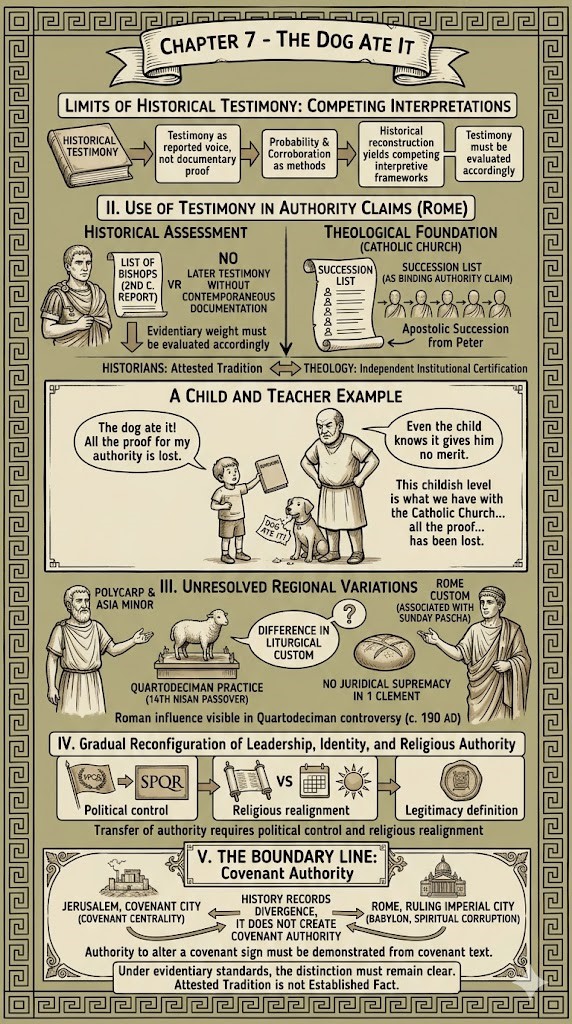
Chapter 7 – The Dog Ate It
“Historical reconstruction frequently yields competing interpretive frameworks for the same period. Because interpretation depends on fragmentary evidence and methodological emphasis, history cannot function as the authority for determining covenant legitimacy. It may inform context, but it cannot define doctrine.”
“When examining the history of the Catholic Church, modern scholarship presents markedly different interpretive reconstructions than those commonly accepted thirty years ago. The divergence is substantial enough that the two frameworks cannot be harmonized into a single coherent narrative. For example, earlier historical models often emphasized institutional continuity and centralized authority, whereas more recent studies have focused on regional variation, internal diversity, and developmental change in early structures. Neither reconstruction fully disproves the other, yet both remain within academic circulation. As a result, preference may influence which account one adopts, but historical method alone cannot conclusively establish which reconstruction is true.”
“If an authority-claim is true, specific conditions must have been set in motion for that authority to exist in the form now asserted. In this case, the surviving historical record is not stable or conclusive enough to serve as proof, and we do not have sufficient evidence to make definitive historical claims. Therefore, rather than attempting a reconstruction, we will state the necessary requirements that would have to be met for the Catholic Church to hold the position it claims. Those requirements can then be tested.”
“Because Scripture maintains Jerusalem’s theological centrality through the New Testament and into Revelation, any permanent transfer of that centrality would require explicit biblical warrant. Absent such warrant, claims of relocation remain unproven.”
“If Rome assumes permanent ecclesiastical centrality, then the Jerusalem-based apostolic authority must be shown either to have concluded or to have been formally relocated. Without such demonstration, the transfer remains unsubstantiated.”
“An early development relevant to leadership in Rome concerns the expulsion of Jews from the city during the reign of Claudius. Both biblical reference (Acts 18:2) and historical sources indicate that Jews were ordered to leave Rome amid disturbances associated with disputes within the Jewish community.
The record does not provide sufficient detail to establish motive, and therefore motive will not be assigned. What can be observed is that a removal occurred, and that the disturbances were connected to disputes regarding Christ.
Whatever the administrative reasoning, the result was a temporary absence of Jewish presence in Rome. This development is significant because the earliest Christian movement emerged within Judaism. The removal of Jewish communities would therefore have affected the visible leadership structure of the Roman assembly.”
If the earliest Christian leadership was rooted in Jerusalem, and Jewish-Christian presence was removed or reduced in Rome for a period, then:
- Local non-Jewish leadership in Rome would necessarily assume operational responsibility.
- In the absence of visible Jerusalem-based oversight, Roman leadership could become the functional center of the Roman assembly.
- Over time, functional leadership can be interpreted as formal authority unless explicit limits are maintained.
None of this implies intent.
It describes structural dynamics.
“The New Testament provides insight into tensions that arose within the Roman assembly after Jewish believers returned to the city. In his Epistle to the Romans, Paul addresses Gentile believers directly regarding their attitude toward Jewish believers.
In Romans 11:17–24, Paul uses the image of an olive tree to describe covenantal continuity. He warns Gentile believers that although they were ‘grafted in,’ they do not support the root — the root supports them. He cautions them not to boast against the natural branches.
This correction indicates that a shift in visible composition had occurred within the Roman congregation, and that Gentile believers may have begun to view themselves as primary. Paul’s instruction reaffirms that covenantal origin and authority did not transfer simply because of demographic change.
“In his Epistle to the Romans, Paul does not describe a deliberate removal of Jewish believers in order to elevate Gentile leadership. The historical expulsion of Jews from Rome appears connected to civil disturbances, not ecclesiastical planning. The demographic result, however, would have altered the visible composition of the Roman assemblies.
When Jewish believers later returned, tensions emerged within the congregation. Paul addresses Gentile believers directly, correcting any presumption of superiority and reminding them that they were grafted into an existing covenantal root.
Notably, Paul writes to the believers collectively. The letter does not identify a singular ruling authority in Rome, nor does it describe a centralized institutional structure. The Roman assemblies appear to have consisted of multiple house churches, and Paul addresses the people rather than a formal episcopal office.
By the time of Paul’s death, commonly dated between AD 64–67 during the reign of Nero, the Roman church appears in Scripture as a network of house assemblies composed of both Jewish and Gentile believers. The apostle Paul ministered there under imprisonment, believers were present even within Caesar’s administrative household, and tensions between groups required correction. Yet the New Testament does not identify a singular Roman bishop exercising universal authority, nor does it record a formal transfer of apostolic leadership to Rome. This is the condition in which the Roman church stands in the biblical record at the time of Paul’s death.
Peter
The New Testament does not explicitly record Peter founding the church at Rome, serving as its bishop, or dying there. The only potential textual link is 1 Peter 5:13, where Peter writes from “Babylon,” a term later interpreted by many early Christians as symbolic for Rome. The identification, however, is interpretive rather than explicit. Claims of Peter’s Roman episcopate and martyrdom arise primarily from second-century patristic testimony rather than first-century documentary records. While such testimony may reflect early tradition, it does not constitute contemporaneous archival proof.
An authority claim that cannot be supported by contemporaneous documentation must be treated as historical assertion rather than established fact. In matters of ecclesiastical authority, the burden of proof increases in proportion to the authority claimed. Where documentation is absent, the claim cannot carry binding weight simply by repetition.
An example of what we are seeing we can put understanding to with a childish example. If a child is require to do home work and the child come to the teacher tells the teacher they did the home work but their dog ate it, what will that teacher’s answer be to this child? This childish level is what we have with the catholic all the proof they gives them authority ha been lost. They say they did the home work but the dog ate it gives them no more credibility then the child. Even the child would understand he has no merit to make the claim.
An authority claim that cannot be supported by contemporaneous documentation must be treated as historical assertion rather than established fact. In matters of ecclesiastical authority, the burden of proof increases in proportion to the authority claimed. Where documentation is absent, the claim cannot carry binding weight simply by repetition.
In 2 Peter, the apostle does not warn the Church of external military conquest, but of internal corruption. False teachers would arise “among you,” exploiting the flock through deception and distorted doctrine. The danger Peter identifies is not political displacement, but spiritual subversion from within the covenant community itself.
The New Testament records no formal transfer of covenant authority from Jerusalem to Rome, nor any declaration that Rome replaces the holy city as the center of divine governance. While Peter is presented as a prominent apostolic figure, Scripture does not depict him exercising singular episcopal authority over the other apostles in a later monarchical sense. His final recorded words in 2 Peter are not concerned with institutional succession but with warning the Church of corrupt teachers arising from within—leaders who once received the truth yet turned from it. The apostolic emphasis remains fidelity to what was delivered, not the establishment of a new geographic center of power.
Irenaeus was not a neutral external historian; he was a bishop within the ecclesiastical structure whose argument depended upon apostolic continuity. The Roman succession claim rests on patristic testimony rather than preserved first-century documentation. Irenaeus, writing as a bishop within the Catholic ecclesiastical structure, appeals to this succession as a stabilizing authority. Because the claim originates within the institution whose authority it supports, it must be classified as institutional tradition rather than independently verified historical proof. The absence of contemporaneous prevents the claim from carrying the weight of any certainty.
Because the succession claim originates from within the institution whose authority it supports, the evidentiary burden must be higher, not lower.
Irenaeus, writing as a bishop within the Catholic ecclesiastical structure, appeals to Roman succession as a defense against heresy. However, the succession list he references is not preserved in first-century documentary form. The argument therefore relies upon institutional testimony rather than independently verifiable records. While this does not prove fabrication, but at the same time does not disprove fabrication it does require classification: the claim functions as ecclesiastical attestation, not archival proof. Ii is a testimony from one person within the Catholic system carrying no weight of proof
When an institutional authority claim rests primarily on later testimonial preservation rather than verifiable first-generation documentation, the evidentiary weight must be evaluated accordingly.
The Roman succession claim rests on patristic testimony rather than preserved first-century documentation. Irenaeus, writing as a bishop within the Catholic ecclesiastical structure, appeals to this succession as a stabilizing authority. Because the claim originates within the institution whose authority it supports, it must be classified as institutional tradition rather than independently verified historical proof. The absence of contemporaneous documentation does not prove falsehood but it does not prove it was not false either, but it prevents the claim from carrying the weight of certainty.
When an institution grounds its authority in a historical claim, that claim must meet the level of evidence required for the authority asserted. If the evidence consists of later testimonial tradition without contemporaneous documentation, then the claim may be considered attested tradition — but not established fact.
The Catholic Church presents apostolic succession from Peter as a historical foundation for its authority. That succession, however, rests primarily on patristic testimony and later episcopal lists rather than preserved first-century documentation. When institutional authority is grounded upon such testimony, the claim must be classified accordingly: it is attested tradition, not independently verified archival fact. The weight of authority asserted therefore exceeds the level of documentary evidence currently available. Under evidentiary standards, that distinction must remain clear.
Between the mid-60s and the early 2nd century, the Roman Christian community appears to persist under intermittent pressure, and by ~AD 95–96 it is influential enough to intervene by letter in another church’s dispute (1 Clement). Claims of a continuous, fully documented chain of Roman episcopal succession in this period rely heavily on later transmitted lists and patristic testimony rather than preserved first-generation records.
1 Clement demonstrates that the Roman church exercised influential intervention in Corinth near the end of the first century. However, the document itself does not articulate later papal supremacy claims, nor does it provide archival documentation of first-generation episcopal succession. It shows early influence — not fully defined universal jurisdiction.
The Corinthian church is depicted in Paul’s mid-first-century letters as prone to factionalism, jealousy, and leadership conflict. Approximately forty years later, 1 Clement describes renewed division and the removal of presbyters in the same community. While the specific circumstances cannot be independently verified, the recurring theme of internal instability in Corinth across multiple sources suggests continuity of structural weakness rather than isolated invention.
The tone of the letter reflects an expectation that its counsel carries binding weight, though it does not articulate later juridical supremacy language.
1 Clement (c. AD 95–96) represents one of the earliest extant examples of the Roman church addressing and correcting the internal affairs of another congregation. The letter assumes moral authority and urges compliance, reflecting Rome’s growing influence beyond its local community. While it does not articulate later papal supremacy doctrine, its preservation and circulation in early manuscript traditions demonstrate that it was received as serious and authoritative instruction. It evidences early Roman influence — though not yet fully defined universal jurisdiction.
The earliest documented change in Passover observance appears in the late second century during the Quartodeciman controversy. Churches in Asia Minor retained observance on the 14th of Nisan, while Rome promoted Sunday celebration. Under Bishop Victor (c. 190 AD), Rome attempted to enforce uniformity, marking one of the first clear instances of Roman pressure to standardize practice across regions. This development evidences growing Roman influence in shaping liturgical custom.
The shift from 14 Nisan observance to Sunday Pascha appears first in the late second century as a theological emphasis on the resurrection and a desire for liturgical unity. Roman influence becomes visible in the Quartodeciman controversy under Victor of Rome (c. 190 AD). Explicit anti-Jewish and political motivations are most clearly documented in the fourth century, particularly following the Council of Nicaea (325 AD), when imperial authority formalized Sunday observance for the sake of unity and separation from Jewish calendrical dependence.
The New Testament contains no explicit legislative decree from Christ or the apostles abolishing the seventh-day Sabbath or replacing Passover observance with a Sunday festival. The shift toward Sunday observance developed gradually in the second and third centuries. In AD 321, Constantine issued a civil decree establishing Sunday as a legal day of rest within the empire, elevating its status under imperial authority. At the Council of Nicaea (325 AD), imperial and ecclesiastical power combined to formalize Sunday Pascha and separate its calculation from Jewish calendrical authority. While direct military enforcement against Sabbath observance is not documented in Constantine’s reign, imperial law carried coercive authority and marked a decisive shift in the relationship between state power and Christian practice.
The authority of the early church begins in Jerusalem, the covenant city. Scripture records no explicit transfer of that authority to Rome. In the New Testament, “Babylon” appears as a symbolic designation, and in Revelation the term describes a ruling imperial city seated on seven mountains — a description historically associated with Rome. While this establishes symbolic identification, it does not itself establish apostolic succession or divine mandate, but just the opposite. The claim of transferred authority must therefore rest on evidence from the Bible.
Revelation portrays Babylon as a spiritually corrupt imperial system characterized by idolatry, persecution, and demonic influence. The description aligns geographically and politically with first-century Rome, while also functioning symbolically as a broader representation of corrupt religious-political power.
Scripture consistently portrays Babylon as more than a geographic city; it represents an imperial-religious system opposed to God. In Revelation 17–18, Babylon is depicted as a ruling city seated on seven mountains, filled with corruption and described as a dwelling place of unclean spirits. The call to “come out of her” reflects divine separation from a spiritually compromised system. While historically associated with Rome in the first-century context, the imagery functions symbolically to describe any religious-political authority that stands in opposition to covenant faithfulness.
The transfer of authority in history has never been merely geographic; it requires political control and religious realignment. Empires replace leadership, reshape belief structures, and redefine legitimacy. Scripture’s portrayal of successive world empires in Daniel reflects this pattern: political dominance is accompanied by spiritual and cultural transformation. Therefore, any claim of covenant authority shifting from one center to another must demonstrate not only historical presence, but structural replacement, doctrinal continuity, and recognized legitimacy. Without these elements, authority remains asserted rather than established.
The expulsion of Jews from Rome under Claudius (AD 49) altered the leadership balance within the Roman Christian community. Following the destruction of Jerusalem (AD 70) and especially the Bar Kokhba revolt (AD 132–135), Jewish presence in Jerusalem was removed and Christian leadership there became Gentile. The city itself was renamed Aelia Capitolina, marking the political suppression of its covenant identity under Roman rule. Over subsequent generations, key identity markers associated with Israel — including circumcision, the 14 Nisan Passover, and seventh-day Sabbath observance — were progressively marginalized or redefined within broader Christian practice. By the fourth century, imperial legislation and ecclesiastical councils formalized Sunday observance and separated Christian liturgical calculation from Jewish authority. What emerges is not a single event but a gradual reconfiguration of leadership, identity, and religious authority within the Roman imperial framework.
The Bar Kokhba revolt (132–135 AD) marks a decisive political and cultural break for Jerusalem, after which Jewish leadership there ceased. Within the same period, Polycarp of Smyrna and the bishops of Rome were active in disputes over Passover observance. The chronological overlap does not by itself establish causation, but it demonstrates that the decline of Jerusalem’s centrality and the consolidation of Roman ecclesiastical influence occurred within the same historical window. Both in politics and belief, so at this time all objective of the Roman Empire came together at the same time. Rome was now the authority of the church, the city of Rome is now replace Jerusalem as the eternal city, and all but Asia Minor voices was silenced. Asia Minor was then silence and Constantine make it law and enforce the law by the Roman armies
This chapter comes down to this. What the teacher would not accept from the child excuses of proof for his home work the whole accept for proof from the Catholic Church, The dog ate it!
Chapter 8- Damage Done
The medieval papacy bears responsibility for authorizing and sanctifying crusading warfare in explicitly religious terms. By framing these campaigns as divinely sanctioned and attaching spiritual incentives to participation, it created the theological framework within which violence occurred. While individual acts of brutality were carried out by military leaders and soldiers, the religious authorization of the conflict originated at the highest ecclesiastical level.
While the term “Dark Ages” is debated there were periods in which ecclesiastical authority exercised strong control over theological boundaries and dissent. Any evaluation of intellectual development during the 16th century must account for both institutional preservation of knowledge and institutional restriction of certain lines of inquiry.
During the 16th and 17th centuries, ecclesiastical authorities formally opposed heliocentrism, placing restrictions on its teaching and publication. The Galileo affair demonstrates institutional resistance to certain scientific conclusions when they appeared to contradict prevailing theological interpretations.
During the 16th and 17th centuries, ecclesiastical authorities formally opposed heliocentrism when it appeared to contradict prevailing interpretations of Scripture. Galileo was tried and confined to house arrest, and Giordano Bruno was executed following theological charges. These events demonstrate that institutional religious authority could restrict or punish ideas perceived as threatening to doctrinal stability.
The Catholic Church ecclesiastical authority formally opposed heliocentrism when it appeared to contradict prevailing interpretations of Scripture. Galileo’s telescopic discoveries strengthened the case that the earth moves around the sun, yet he was tried and confined to house arrest for defending that position. Giordano Bruno, who advanced both heliocentric and broader cosmological and theological ideas, was executed after refusing to recant. These events demonstrate that institutional religious authority could restrict or punish ideas perceived as destabilizing to doctrinal order.
Institutional resistance to heliocentrism undoubtedly slowed the public acceptance of the model in certain Catholic regions. Formal condemnation and censorship created obstacles for open scientific discussion. These events illustrate how centralized religious authority could temporarily restrain intellectual development when perceived doctrinal boundaries were threatened.
From the publication of Copernicus in 1543 to the gradual removal of heliocentric restrictions in the 18th century, institutional opposition existed for over a century. During this period, advocacy of the model in Catholic regions carried theological risk. The Catholic Church suppress this science we know today as true for while over a hundred years.
The Catholic Church sponsored and preserved significant intellectual infrastructure, including universities and astronomical study. However, in the early 17th century, it formally restricted the public defense of heliocentrism when it was perceived to contradict established scriptural interpretation. This created tension between doctrinal authority and emerging cosmological models.
In 2000, Pope John Paul II publicly asked forgiveness for historical sins committed by members of the Church, including acts of coercion, intolerance, and violence carried out in defense of the faith. This acknowledgment reflects institutional recognition that errors were committed in the exercise of religious authority.
In the year 2000, as the Church marked the Jubilee, Pope John Paul II stood before the world in St. Peter’s Basilica and did something unusual for a global religious leader. He did not announce triumph. He did not defend the past. He acknowledged it.
On what was called the “Day of Pardon,” he asked forgiveness for sins committed by members of the Church across history. The language was deliberate. He did not claim the faith itself was sinful. He did not deny the Church’s theological convictions. But he openly stated that Christians, acting in the name of defending truth, had at times used methods that contradicted the spirit of the Gospel.
He asked forgiveness for the use of violence in service of what was believed to be religious truth — for coercion, intolerance, and actions that wounded rather than persuaded. This acknowledgment touched the long shadow of the Inquisition and the forced measures that had been used in matters of faith.
He acknowledged divisions among Christians — the bitterness between East and West, the hostility that hardened during the Reformation, the fractures that left the Christian world divided.
He asked forgiveness for failures toward the Jewish people — for attitudes and actions across centuries that fostered mistrust and suffering rather than charity and brotherhood.
He acknowledged the violence committed during the Crusades — not rewriting history, not erasing it, but admitting that Christians, even while believing they were defending sacred causes, had committed acts that disfigured the witness they claimed to uphold.
He asked forgiveness for sins committed in missionary expansion — where the spread of faith was at times entangled with political power, cultural suppression, and injustice.
It was not a denial of Catholic identity. It was not an abandonment of doctrine. It was an admission that institutional authority, exercised by flawed human beings, had at times acted in ways that required repentance.
This moment matters historically. It demonstrates that the actions debated in history are not inventions of critics alone. They were serious enough to be publicly acknowledged at the highest level.
The record shows both: preservation and error, scholarship and restriction, conviction and coercion. The reader must examine the documented actions and the documented acknowledgments together.
History does not move in clean lines. It carries both preservation and restriction, conviction and overreach. The Catholic Church preserved manuscripts, founded universities, sponsored astronomical study, and structured intellectual life in Europe for centuries. At the same time, it formally opposed heliocentrism in the seventeenth century, tried Galileo, executed Bruno after theological charges, and placed restrictions on certain lines of inquiry when they were judged to conflict with prevailing interpretations of Scripture.
These are not rumors. They are documented actions.
The timeline is measurable. Copernicus published in 1543. Heliocentrism was formally condemned in 1616. Galileo was tried in 1633. Restrictions remained in place into the eighteenth century. That span reflects institutional resistance to a cosmological model that would later become foundational to modern science.
Centuries later, in the year 2000, Pope John Paul II publicly asked forgiveness for sins committed by members of the Church — including acts of coercion and violence carried out in defense of faith. That acknowledgment confirms that these matters are not inventions of hostility but part of the historical record.
The purpose of this chapter is not to inflame. It is not to assign motives. It is not to erase what the Church preserved, nor to exaggerate what it restricted. It is to show actions.
Authority leaves footprints.
When authority sponsors learning, it leaves one kind of mark.
When authority restrains inquiry, it leaves another.
The reader now has the record before him — dates, decisions, acknowledgments. No numbers have been inflated. No myths have been repeated. No conclusions have been forced.
The actions stand.
And history, when placed plainly in view, speaks without the need for anger
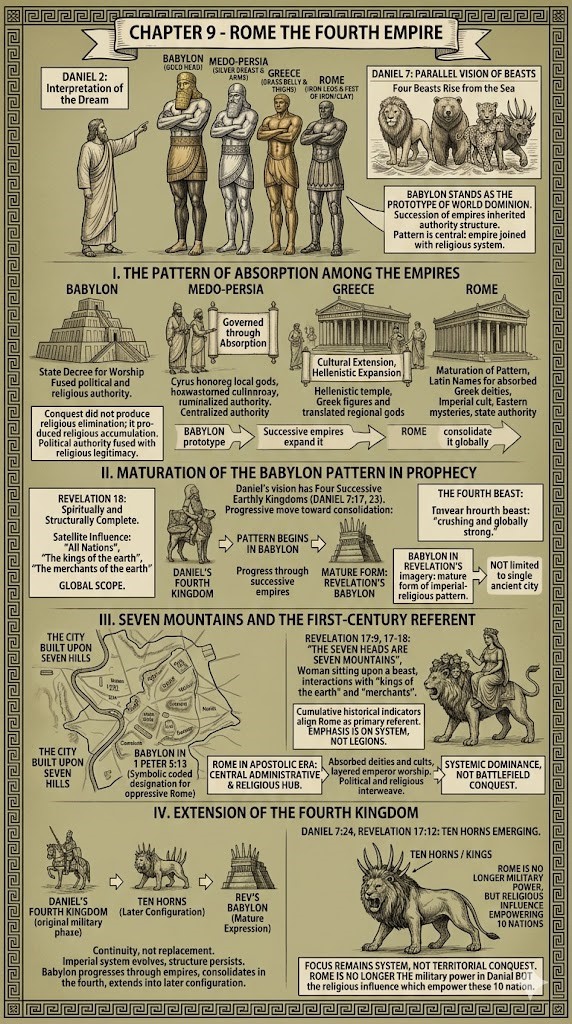
Chapter 9- Rome The Fourth Empire
The Four Kingdoms and the Beginning of the Babylon Pattern
In Daniel 2, the prophet interprets Nebuchadnezzar’s dream of the great image. The head of gold is identified directly and without ambiguity:
“Thou art this head of gold.” (Daniel 2:38)
Nebuchadnezzar was king of Babylon. Therefore, Babylon is explicitly named as the first kingdom in the sequence.
Daniel then states:
“And after thee shall arise another kingdom inferior to thee, and another third kingdom of brass… And the fourth kingdom shall be strong as iron…” (Daniel 2:39–40)
The second, third, and fourth kingdoms are not named in Daniel 2. However, Daniel 7 presents a parallel vision of four beasts rising from the earth:
“These great beasts, which are four, are four kings, which shall arise out of the earth.” (Daniel 7:17)
Historically, the majority interpretation identifies these four as:
- Babylon
- Medo-Persia
- Greece
- Rome
Daniel explicitly names Babylon as the first kingdom. The remaining empires are identified by historical and structural correspondence.
What is important here is not merely the sequence of empires, but the pattern they represent.
Babylon begins the era of Gentile world dominion in Daniel’s prophecy. Each successive empire inherits the authority structure of the one before it. Political power transfers, but the imperial pattern continues. Dominion expands, absorption occurs, and the system grows stronger.
By the time of the fourth kingdom, the structure has matured. The fourth kingdom is described as:
“strong as iron… and it shall break in pieces and bruise.” (Daniel 2:40)
This final empire in Daniel’s sequence represents the consolidated and intensified form of world imperial authority.
Daniel does not call all four kingdoms “Babylon.” However, Babylon functions as the starting point of the prophetic imperial system. Later biblical imagery, particularly in Revelation, uses “Babylon” not only as a historical city but as a symbolic designation for a mature world power that combines political authority, economic dominance, and religious influence.
Therefore, Babylon may be understood not merely as the first empire in Daniel, but as the prototype of the imperial system that continues through successive kingdoms.
This does not collapse all empires into a single name. Rather, it recognizes that Babylon begins a pattern of centralized world dominion that reaches its mature expression in the later empire of Daniel’s vision.
The text establishes the sequence.
The structure reveals the pattern.
The pattern becomes essential when examining later prophetic imagery.
The Pattern of Absorption Among the Empires
Daniel reveals four successive world empires. The first is explicitly named:
“Thou art this head of gold.” (Daniel 2:38)
Babylon stands at the beginning of the prophetic sequence. Yet what makes Babylon significant is not merely political dominance, but the fusion of political authority and religious structure.
Babylon was centralized, hierarchical, and openly polytheistic. Its religious life was not isolated from its political life. The king ruled with divine association. Religious enforcement and civil authority were intertwined, as seen in Daniel 3 when worship was mandated by state decree.
Babylon sets the prototype: empire joined with religious system.
When Medo-Persia conquered Babylon (Daniel 5), the pattern did not reset. The Persians did not abolish the religious structures of the conquered peoples. Instead, they governed through absorption. Persian rulers adopted local religious language in various provinces. Cyrus honored Babylonian religious expressions while ruling Babylon. The empire expanded administratively without purging religious plurality. Authority remained centralized; religion remained integrated within imperial structure.
The third empire, Greece, extended this pattern culturally. Hellenistic expansion did not eliminate local deities. Instead, it reinterpreted them within Greek categories. Egyptian religious figures were blended into hybrid forms such as Serapis. Local worship systems were translated into Greek philosophical language. Religion was absorbed and layered rather than erased.
When Rome emerged as the fourth kingdom, the pattern matured further. Rome adopted Greek deities under Latin names. Eastern mystery religions were incorporated into Roman life. Egyptian cults such as that of Isis spread throughout the empire. Local provincial gods were tolerated under Roman administration. Over all of this, Rome added the imperial cult — emperor veneration fused with state authority.
Rome did not dismantle conquered religious systems. It absorbed them and placed them beneath imperial sovereignty.
Across these four empires, a visible pattern emerges:
- Conquest did not produce religious elimination.
- It produced religious accumulation.
- Political authority fused with religious legitimacy.
- Each empire inherited structures from the one before it.
Babylon begins the imperial model in Daniel.
Successive kingdoms expand it.
Rome consolidates it globally.
Daniel does not call all four kingdoms “Babylon.” The text names Babylon as the first kingdom. Yet historically, the pattern that begins in Babylon continues through the subsequent empires. The structure intensifies, matures, and becomes increasingly comprehensive.
When later prophetic imagery in Revelation speaks of “Babylon,” it is not limited to a single ancient city. The name evokes the imperial pattern that began there — centralized authority joined to religious system and expanded across the earth.
This is not a claim of identical beliefs. It is a recognition of structural continuity.
The sequence is visible.
The absorption is historical.
The pattern is cumulative.
The Significance of Four in Earthly Dominion
Scripture repeatedly associates the number four with earthly scope and universality. The earth was completed on the fourth day of creation. The prophets speak of “the four winds” (Daniel 7:2; Revelation 7:1) and “the four corners of the earth,” expressions that signify total earthly extent rather than literal geometry. The four dirext of the earth North, South East and West. In Genesis, a single river flowing from Eden divides into four heads, symbolizing dispersal across the inhabited world (Genesis 2:10).
In Daniel’s visions, four beasts rise from the sea. Daniel explains plainly:
“These great beasts, which are four, are four kings, which shall arise out of the earth.” (Daniel 7:17)
The fourth beast is described as:
“the fourth kingdom upon earth.” (Daniel 7:23)
The number is not random. The four kingdoms represent successive phases of earth-wide dominion. Each kingdom expands in scope and power. The pattern culminates in the fourth, described as crushing and globally strong.
Thus, within prophetic imagery, four consistently appears in connection with universal earthly reach. Daniel’s four kingdoms represent the full progression of Gentile dominion over the earth.
The Pattern of Religious Absorption in the Four Empires
Daniel reveals four successive earthly kingdoms (Daniel 7:17, 23). These kingdoms represent phases of Gentile dominion over the earth. The fourth is described as particularly strong and crushing, marking the maturity of the imperial system.
What history shows alongside this prophetic sequence is a recognizable pattern: conquest did not erase the religious systems of the conquered empire. It absorbed them.
Babylon operated within a polytheistic framework in which religion and state authority were intertwined. When Medo-Persia conquered Babylon, it did not abolish Babylonian religious structures. Persian rulers governed through accommodation and incorporation. Local gods were acknowledged within imperial administration.
Greece expanded this pattern. Under Hellenistic influence, religious systems were translated, blended, and reinterpreted through Greek philosophical and cultural categories. Deities were often equated with Greek counterparts. Egyptian, Near Eastern, and regional gods were not eliminated; they were recast.
Rome consolidated the pattern further. Roman religion absorbed Greek deities under Latin names. Eastern mystery cults spread within Roman territory. Provincial gods were recognized within the empire. Emperor worship was layered over the existing religious landscape. Rome did not require religious uniformity so long as allegiance to imperial authority was maintained.
Across these successive kingdoms, a consistent pattern appears:
- Conquest led to absorption.
- Religious systems were not erased but renamed, reframed, and integrated.
- Political authority redefined existing deities under new imperial identity.
- The image of the empire changed; the structure of religious syncretism continued.
This is not a claim that all pagan religions were identical in doctrine. It is a recognition that each empire inherited religious elements from its predecessor and placed them under its own authority and cultural expression.
Thus, when considering the prophetic progression of the four kingdoms, one observes not only political succession but structural continuity. The imperial system begun in Babylon did not reset with each conquest. It expanded, absorbed, and matured.
The names changed.
The languages changed.
The governing image changed.
But the pattern of imperial religious absorption remained.
The Maturation of the Babylon Pattern
Revelation 18 portrays Babylon as spiritually and structurally complete. It is described as:
“the habitation of devils… the hold of every foul spirit… a cage of every unclean and hateful bird.” (Revelation 18:2)
The repetition of “every” indicates saturation. Babylon is not merely corrupt; it is comprehensively corrupt. Its influence extends to:
- “All nations”
- “The kings of the earth”
- “The merchants of the earth”
This is global scope.
In Daniel, four successive kingdoms arise “out of the earth” (Daniel 7:17). The fourth is described as uniquely strong and crushing (Daniel 7:23). The prophetic progression moves toward consolidation — increasing power, increasing dominance.
While Daniel does not rename the fourth kingdom “Babylon,” the pattern that begins in Babylon continues through successive empires. History shows that each empire absorbed religious and political structures from its predecessors. The system expanded and matured.
Revelation’s Babylon represents not merely the ancient city, but the fully developed form of that imperial-religious pattern — political power joined with spiritual corruption and global economic reach.
Thus, Revelation does not isolate Babylon as a single historical moment. It presents Babylon as the mature expression of an imperial system that reached consolidation in the fourth kingdom of Daniel’s vision.
The pattern begins in Babylon.
It progresses through successive empires.
It reaches structural maturity in the final phase of Gentile dominion.
The Seven Mountains and the First-Century Referent
Revelation 17:9 states:
“The seven heads are seven mountains, on which the woman sitteth.”
In the ancient world, Rome was widely known as the city built upon seven hills. This association was not obscure; it was a common cultural identifier. For first-century readers living under Roman imperial authority, the imagery would have been immediately recognizable.
Revelation further describes Babylon as interacting with “the kings of the earth” and exercising economic influence over merchants across nations (Revelation 18:3). In the apostolic era, Rome was the dominant political and economic power of the Mediterranean world.
In 1 Peter 5:13, the apostle sends greetings from “Babylon.” Many scholars understand this as a symbolic reference to Rome, reflecting an established Jewish-Christian practice of using “Babylon” as a coded designation for oppressive imperial power.
While interpretations vary, the cumulative historical indicators — seven hills imagery, global imperial reach, and first-century symbolic usage, Rome as the primary referent of Revelation’s Babylon in its original context.
In Revelation, Babylon is not portrayed primarily as a marching army or as battlefield dominance. The imagery emphasizes spiritual corruption, economic influence, and relational entanglement with “the kings of the earth” and “the merchants of the earth” (Revelation 18:3).
The focus is not on legions.
It is on system.
The woman of Revelation 17 sits upon many waters and upon a beast. She is adorned, influential, and intoxicates nations. This imagery emphasizes religious and economic influence intertwined with political authority.
Historically, Rome in the apostolic era was not merely a military empire. It was the central administrative and religious hub of the Mediterranean world. It absorbed the deities and cults of conquered peoples, integrated them into imperial structure, and layered emperor veneration over the entire system. Political loyalty and religious participation were interwoven.
Thus, when Revelation speaks of Babylon as:
- influencing kings,
- enriching merchants,
- becoming a habitation of unclean spiritual forces,
the imagery aligns more closely with a mature imperial-religious structure than with a purely military campaign.
Rome represents the consolidated center of that structure in the first century — not merely as an army, but as the administrative and religious heart of an empire that had absorbed prior systems and unified them under imperial authority.
The emphasis is not on battlefield conquest.
It is on systemic spiritual and economic dominance.
And there the identification rests.
The Extension of the Fourth Kingdom
Daniel’s fourth kingdom does not end abruptly. Daniel 7 describes ten horns emerging from this kingdom:
“And the ten horns out of this kingdom are ten kings that shall arise.” (Daniel 7:24)
Revelation mirrors this imagery:
“The ten horns which thou sawest are ten kings…” (Revelation 17:12)
The fourth kingdom, therefore, extends beyond its original imperial phase into a later configuration symbolized by ten kings.
This suggests continuity rather than replacement.
The imperial system that matured under the fourth kingdom does not disappear; it evolves. The structure persists, though the political form may shift.
Thus, Revelation’s Babylon is not merely an ancient military empire. It is the mature expression of a system that began in Babylon, progressed through successive empires, consolidated in the fourth kingdom, and extends into its later prophetic configuration.
The focus remains the system — political authority intertwined with religious influence — not merely territorial conquest. Rome is no longer themilitary power in Danial but the religious influence which empower these 10 nation.
Chapter 10- Judge Them by Their Fruits
Chapter Opening (Refined Under Standard)
No matter how history is presented, the structural pattern of imperial conquest remains consistent across civilizations. Empires conquer by force, establish administrative control, replace or subordinate existing leadership, and reshape the identity of the conquered people. Political authority is centralized. Religious structures are either absorbed, regulated, or aligned under the authority of the new ruling power.
In the ancient world, religion and governance were rarely separate. Legitimacy flowed from divine sanction. Babylon fused throne and temple. Persia governed through religious accommodation under imperial supremacy. Greece spread cultural-religious synthesis through Hellenism. Rome absorbed and reorganized religious systems under imperial administration, layering emperor veneration over an already pluralistic religious landscape.
The Roman Empire did not initially dismantle conquered religions. It integrated them. Loyalty to Rome mattered more than theological uniformity. The imperial cult functioned as a unifying political-religious mechanism.
By the time of Constantine in the fourth century, a significant shift occurred. Constantine did not simply abolish the concept of divine authority in governance. Instead, he altered its structure. The imperial cult declined, and Christianity moved from persecuted minority to imperially favored religion.
This did not eliminate the union of religious influence and political power. Rather, the relationship was reconfigured. The emperor no longer demanded worship as a god, but imperial authority became intertwined with Christian leadership structures. The bishop of Rome gradually gained prominence within this new alignment of faith and state. The system did not become secular. It transformed with the Pope taking the place of worship in place of Caesar.
The Structural Shift of Authority
By the late first and second centuries, significant transitions had taken place within the Christian world. The original apostolic generation had passed from the scene, many through martyrdom. Leadership increasingly fell to gentiles second- and third-generation bishops and elders who inherited the developing structures of their regions.
Following the destruction of Jerusalem in 70 AD and the Bar Kokhba revolt in 135 AD, the demographic and leadership makeup of the Jerusalem church changed dramatically. The city itself was rebuilt by Rome as Aelia Capitolina. Jewish influence within Jerusalem was significantly reduced under Roman policy.
Meanwhile, Rome — already known in the ancient world as the “Eternal City” — grew in prominence as the political and administrative center of the empire. As Christianity expanded within imperial boundaries, the church in Rome gained increasing visibility and influence due political connection to Roman leadership.
This was not an overnight theological transfer of covenant status. It was a gradual structural shift. The center of imperial power was Rome, and over time, ecclesiastical influence gravitated toward that same center.
In Asia Minor and other regions, Christian communities continued to exist and contribute to theological development. However, the balance of influence increasingly favored Rome as imperial Christianity matured.
The pattern observed in earlier empires — consolidation of authority within the political center — continued under new religious alignment.
The deception
“After Christianity gained legal and then imperial dominance, we observe that certain pre-Christian Roman religious structures reappear under Christian terminology, with the same functional role in the system.” Thee pagan belief of the Roman now have taken the name of Christ.
The imperial pattern did not end when the name changed. In earlier empires, the conquering power absorbed the conquered religious system and placed it under a new imperial identity. In the Roman world, Christ’s name spread across nations and became the dominant public confession. After that transition, we can observe that certain Roman religious and political structures persist, but now they appear under Christian terminology and are defended by Christian authority. I will compare the structures and the fruits, of the Catholic Church one by one, using primary sources.
Fruits
Christ gave a warning that cannot be ignored:
“Beware of false prophets, which come to you in sheep’s clothing, but inwardly they are ravening wolves.
You shall know them by their fruits.” (Matthew 7:15–16)
Before we apply these words to anyone, we must first understand what they mean.
Does this command authorize personal judgment based on preference?
Does it mean that if we hear something unfamiliar or uncomfortable, we may declare the speaker false?
Does it permit us to measure truth by tradition, emotion, loyalty, or upbringing?
No.
Christ did not say, “You will know them by how you feel about them.”
He did not say, “You will know them by the size of their following.”
He did not say, “You will know them by institutional succession.”
He said, “You will know them by their fruits.”
That requires examination — not reaction.
Fruit is not personality.
Fruit is not authority claimed.
Fruit is not antiquity.
Fruit is not numbers.
Fruit is what grows from the root.
If the root is Christ’s teaching, the fruit must align with what He taught.
If the root departs from His instruction, the fruit will eventually reveal it.
This passage does not grant license for reckless accusation.
It commands disciplined discernment.
Christ places responsibility on the hearer — not to condemn carelessly, but to examine carefully.
If we refuse to examine, we disobey the warning.
If we examine without standard, we judge unrighteously.
If we examine by His words, we obey Him.
Therefore the question is not, “Do we like this teacher?”
The question is not, “How long has this institution existed?”
The question is not, “Who claims succession?”
The question is:
Does the fruit align with the words of Christ and the instruction given through the apostles?
That is the standard He set.
And it is under that standard — not personal opinion — that examination must proceed.
Daniel is given a vision of successive world empires. The interpretation is not left to imagination. Babylon is named. The following kingdoms are identified in sequence. The vision presents four successive kingdoms, each rising after the other.
The structure is important.
These are not random political events. They are presented as a progression — one system flowing into the next.
The fourth kingdom follows Greece. Historically, Rome follows Greece. Daniel does not provide a modern name, but the sequence is clear: four successive empires, each building upon what came before.
What must also be noticed is the pattern.
Each empire did not erase the former entirely. It absorbed it. The cultural, religious, and political systems of the previous kingdom were not destroyed — they were redefined and carried forward under new authority.
Babylon established a system.
Medo-Persia inherited and modified it.
Greece absorbed and spread it further.
Rome consolidated what came before and extended it across the known world.
The progression is cumulative.
By the time the fourth kingdom stands, the earlier elements have not disappeared. They have been incorporated.
Daniel presents this as the completion of an earthly system — not merely four disconnected governments, but a developing structure reaching maturity.
Later Scripture refers to this structure collectively as “Babylon.”
The emphasis is not on geography alone.
It is on a system — political, religious, and cultural — that progresses through these successive empires.
This is the framework Scripture provides.
Before we examine later developments, the pattern must be understood:
Four kingdoms.
Sequential.
Absorptive.
Cumulative.
Only after that foundation is laid can the examination continue.
Rome
One principle must always remain in place:
A matter is established by two or three witnesses.
We do not identify lightly.
We do not name on impulse.
We do not accuse without structure.
Daniel provides the first witness.
He presents four successive kingdoms. The fourth follows Greece. Historically, Rome follows Greece. That establishes the sequence.
Revelation provides a second witness.
It describes a ruling power:
- A kingdom exercising influence over kings.
- A system tied to the imagery of Babylon.
- A city associated with seven mountains.
The description narrows the field.
It is true that more than one city in history has been described as having seven hills. Jerusalem has been poetically described that way. Other cities have similar topography.
But the biblical description is not limited to geography alone.
The Revelation description includes:
- Dominion over kings.
- Global commercial influence.
- Continuity with the earlier Babylonian system.
- A ruling city associated with seven mountains.
The identifying marks are cumulative.
When Daniel’s fourth kingdom is placed beside Revelation’s description, the characteristics converge.
Rome historically follows Greece.
Rome was known in antiquity for its seven hills.
Rome exercised rule over kings and provinces across the known world.
The identification does not rest on one feature alone.
It rests on the convergence of multiple witnesses.
Therefore, the conclusion is not drawn from preference, nor from hostility, nor from tradition.
It is drawn from sequence and description.
We are not naming lightly.
We are observing that the characteristics given in Scripture converge in one historical power.
The identification comes from the text. The text verifies the last of these four system is in Rome. God does not leave us to guess the Bible defines our search, so now we know to look at Rome.
Satan
The Scriptures do not describe the world system as neutral.
They describe it as under influence.
Revelation 12:9 states plainly:
“And the great dragon was cast out, that old serpent, called the Devil, and Satan, which deceiveth the whole world…”
The language is not partial. It does not say a nation. It does not say a region. It says, “the whole world.”
Paul confirms this in 2 Corinthians 4:4:
“In whom the god of this world hath blinded the minds of them which believe not…”
Here Satan is described as “the god of this world” — not in ultimate authority above God, but as exercising influence within the present age.
Ephesians 2:2 calls him:
“The prince of the power of the air, the spirit that now worketh in the children of disobedience.”
The first witness is clear:
There is a world system.
That system is influenced by deception.
Satan is described as ruling within that system.
The second witness appears in Revelation 18.
There the final expression of “Babylon” is described:
“Babylon the great is fallen, is fallen, and is become the habitation of devils, and the hold of every foul spirit, and a cage of every unclean and hateful bird.” (Revelation 18:2)
The description is not merely political.
It is spiritual.
Babylon is portrayed as saturated with corruption — “every foul spirit” and “every unclean” influence.
When Revelation 12 and Revelation 18 are placed side by side, the pattern emerges:
- Satan deceives the whole world.
- Babylon is depicted as the habitation of unclean spirits.
- The world system and the Babylonian system are not separate themes.
They converge.
This does not identify individuals.
It does not condemn hearts.
It describes a system.
Scripture presents a world order influenced by deception, and Revelation presents the culmination of that system under the name “Babylon.”
Two witnesses stand:
Satan deceives the world.
Babylon is filled with unclean spiritual influence.
The structure is established by the text itself.
Isaiah 28
Isaiah asks a question:
“Whom shall He teach knowledge?
And whom shall He make to understand doctrine?”
The answer is not mystical.
It is instructional:
“Precept must be upon precept… line upon line… here a little, and there a little.” (Isaiah 28:9–10)
Scripture gives a method.
Understanding does not come by isolated verse.
It comes by assembling testimony.
Precept connected to precept.
Line connected to line.
One witness confirmed by another.
This is not a suggestion.
It is the pattern given.
Notice how that method has guided the path so far.
Daniel establishes the framework of successive earthly empires.
That directs the subject: the earthly system.
Revelation supplies additional witness, expanding the meaning of “Babylon” beyond geography into a spiritual system.
The text controls the direction.
We do not begin with a conclusion and search for support.
The precept determines the next precept.
Isaiah 28 does not provide content by itself; it governs the path of learning.
Once Babylon is shown to be a spiritual system in Revelation 18 — described as the habitation of unclean spirits — the question naturally follows:
Who rules that system?
Revelation 12:9 answers:
“Satan… deceiveth the whole world.”
The path continues.
If Satan rules through deception, then deception is the weapon.
That sends us to the next witnesses.
In Genesis, Eve is deceived.
In 2 Corinthians 11:3, Paul warns:
“As the serpent beguiled Eve… so your minds should be corrupted from the simplicity that is in Christ.”
He continues in the same chapter:
“Satan himself is transformed into an angel of light.” (2 Corinthians 11:14)
The pattern is consistent:
The method of the system is not open rebellion alone.
It is transformation, disguise, and deception.
Precept upon precept.
Daniel establishes the earthly progression.
Revelation defines its spiritual character.
Paul defines its method.
The text controls the movement.
Not imagination, not emotion, not assumption., line upon line.
We now have clarity on the framework.
We know where to look.
Daniel has shown the progression of the earthly system.
Revelation has defined that system under the name Babylon.
Scripture identifies its spiritual ruler.
We are not dealing merely with politics or geography.
We are dealing with a system.
The Bible tells us that Satan deceives the whole world.
It tells us he rules through influence.
It tells us he is subtle.
It tells us he transforms himself into an angel of light.
The method is not open darkness.
The method is disguised light.
And Paul tells us what is at stake:
“The simplicity that is in Christ.”
The objective of deception is not always to deny Christ outright.
It is to complicate, to alter, to redirect, to subtly move away from
This take us back to the first question how do we judge the fruits. The Bible show we use Isaiah 28 a a gude we let eh Bible guide us so we know what to judge and how to judge. Now after this understanding we can go back and look at Rome.
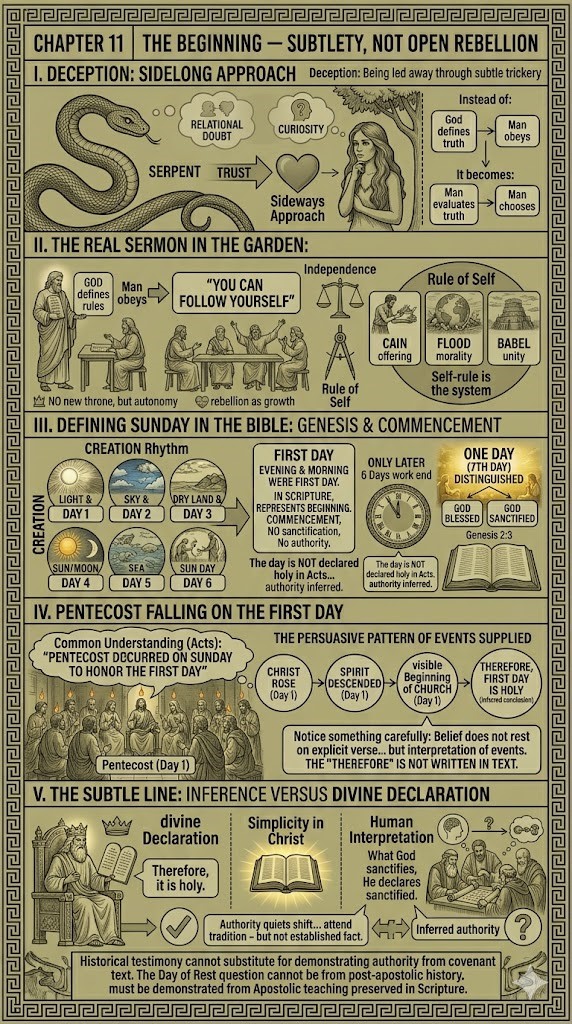
Chapter 11 The Beginning — Subtlety, Not Open Rebellion
Deception-Being lead away from truth into error, often through trickery falsehood or false teaching originating from Satan leading into sin
Satan did not enter Eden as a rival god standing opposite the Creator in open defiance.
He did not say,
“I am greater than God.”
He did not demand worship.
He did not declare a competing kingdom.
He came as something far more dangerous.
He came as a friend.
Genesis does not describe thunder or violence. It describes a conversation.
The serpent was “more subtle than any beast of the field.” That word matters. Subtlety means indirect. It means approaching sideways rather than head-on. It means entering through trust rather than force.
Satan did not confront Eve with war. He confronted her with curiosity.
“Yea, hath God said…?”
The question is not an attack. It is an invitation it suggests reconsideration it introduces doubt without accusation. He does not deny God at first, he reframes God. He implies that something has been withheld. That there is insight not yet shared. That perhaps God has not told the whole story.
And then the appeal:
“You shall not surely die…
For God doth know…”
Notice the structure.
He positions himself not as a god competing with God ,but as one with inside knowledge. I have been around longer.I understand something you don’t.Let me show you.”
This is not rebellion through force. It is rebellion through suggestion. He does not remove God from the conversation. He inserts himself into it. The deception is relational.
Instead of:
- God defines truth,
It becomes:
- Let us reason about what God said.
That is the pivot. The serpent appears as helpful, informed, illuminating — almost as an angel of light rather than an adversary. There is no threat in his tone. There is enlightenment in his promise.
“Ye shall be as gods, not slaves, not rebels, Independent.
The shift is subtle but devastating. Eve is not asked to reject God outright. She is invited to reconsider Him. That is how the pattern begins. Not with a new religion. Not with open denial.
But with a slight alteration in trust, that same pattern repeats through history.
When deception succeeds, it rarely announces itself as opposition to God. It often presents itself as deeper understanding of God. I know something about God you have not seen yet.”That was the beginning, every later shift in authority follows that same path — not loud rebellion, but refined suggestion
The Real Sermon in the Garden
Look at what he actually preached.
Not:
“Come follow me.”
But:
“You can follow yourself.”
That is entirely different, he does not offer a new throne. He offers autonomy.
“Ye shall be as gods.”
In other words: You do not need external authority. You can determine good and evil.
You can decide, it sounds empowering, it feels liberating, it appears mature. But it transfers rule.
The issue was never fruit the issue was government.
Instead of:
God defines → Man obeys.
It becomes:
Man evaluates → Man chooses.
Satan did not try to sit on God’s throne in Eden.
He tried to remove the need for a throne at all.
“Do not let God rule over you.
Rule yourself.”
That is the message.
And notice something even more dangerous:
He makes rebellion look like growth.
“You shall be as gods.”
It feels like advancement.
It feels like elevation.
It feels like wisdom.
But it is separation from authority.
The Pattern That Follows
From that moment forward, the tactic never changes. He does not need people to worship him directly.
He only needs them to govern themselves apart from God. Self-rule becomes the system.
Cain decides the acceptable offering.
The world before the Flood decides morality.
Babel decides unity without submission.
No one announces, “We now follow Satan.”
They simply decide for themselves.
That is the genius of the tactic.
When man rules himself, Satan does not need a throne.
The structure has already shifted.
Now we are in position to move carefully:
When time itself becomes redefined,
When authority over sacred things shifts,
When man determines what is holy —
We must ask:
Is that the same pattern?
But we will not jump ahead.
Defining Sunday in the Bible
There is a documented history of Sunday observance in the systems of Babylon — a history that stretches from Rome backward through the succession of kingdoms described in Daniel, even to the first empire called Babylon.
That historical record exists.
But before we examine what kingdoms did, we must first answer a more important question:
What does Scripture say?
Before we trace Sunday through empires, we must define Sunday in the Bible itself.
If a day is to carry divine authority, that authority must be found in the text. If it is not in the text, then its authority must originate somewhere else.
So we begin simply.
We must begin where the Bible begins.
“In the beginning God created the heaven and the earth.”
Before law, before covenant, before command, there is beginning. Time itself opens with that statement. The first movement of order out of chaos begins here. Light appears, separation is established, and the rhythm of days is introduced.
“And the evening and the morning were the first day.”
The first day is not introduced as holy. It is not blessed. It is not sanctified. It is simply the beginning. It marks initiation. It marks the start of movement. It is the day something begins.
That is how Scripture defines it.
The first day carries no rest. It carries no covenant sign. It carries no command attached to it. It stands as the opening stroke of creation — the first act in a sequence that moves toward completion.
Only later, after six days of work, does something different happen. One day is distinguished. One day is blessed. One day is sanctified. That language is not applied to the first day.
So before we move anywhere else — before resurrection, before Pentecost, before history, before empires — we must hold this simple definition steady:
In Scripture, the first day represents beginning.
Nothing more is attached to it in Genesis. No holiness. No authority. No command. Only commencement.
And that is where we must stay — for now.
When most believers consider Pentecost falling on the first day of the week, they rarely begin with Genesis. They begin with Acts.
The common understanding is simple: Pentecost occurred on Sunday because God intended to honor the first day. Since the Holy Spirit was poured out on that day, and since the Church visibly began on that day, many conclude that God was signaling a transition — that the first day had taken on new covenant significance.
The reasoning usually follows this pattern:
Christ rose on the first day.
The Spirit descended on the first day.
The Church was publicly manifested on the first day.
Therefore, the first day must have been chosen deliberately to replace the former sacred day.
In this view, Pentecost is not merely a fulfillment of Leviticus 23. It is seen as a divine endorsement of Sunday. The descent of the Spirit is interpreted as heaven’s confirmation that a new order of worship had begun, and that the resurrection day now carries covenant authority.
Some go further. They argue that since Pentecost represents firstfruits, and since the first day marks new creation, the Church naturally gathers on that day as the celebration of redemption completed and the Spirit given.
In this way, the meaning is drawn not from a direct command, but from perceived symbolism. The day is not declared holy in Acts, but it is considered holy because of what occurred on it.
That is the dominant line of reasoning.
But notice something carefully.
The belief does not rest on a verse that says, “God sanctified the first day.” It rests on interpretation of events. The authority is inferred from what happened, not from what was declared.
And that is where we must slow down.
Because before we decide what Pentecost means, we must ask a more careful question:
Was Pentecost placed on the first day to elevate the first day…
or was it placed there because of something already established in the law?
When all of these pieces are gathered together — the resurrection on the first day, the Spirit poured out on the first day, the visible beginning of the Church on the first day — it forms a pattern that appears persuasive. It seems thoughtful. It seems mature. It even appears spiritually rich.
But there is something missing.
The Bible never declares the first day sanctified.
The conclusion rests on interpretation. It rests on symbolism. It rests on assembling events and drawing inference. But it does not rest on an explicit statement of divine sanctification.
That distinction matters.
What we see here is not an open denial of Scripture. It is something more subtle. It is the assembling of spiritual events and arriving at a conclusion that Scripture itself does not directly claim.
It sounds reasonable.
Christ rose on the first day.
The Spirit descended on the first day.
Therefore, the first day must now be holy.
But that “therefore” is not written in the text.
It is supplied.
And that is where the pattern becomes familiar.
In Eden, the serpent did not deny God’s existence. He did not abolish God’s word. He added interpretation. He reframed what had been spoken. He encouraged Eve to reason beyond what was plainly declared.
Paul later warns the Church using that same event as the example.
“But I fear, lest by any means, as the serpent beguiled Eve through his subtilty, so your minds should be corrupted from the simplicity that is in Christ.”
— 2 Corinthians 11:3
Notice the word: subtlety.
The corruption Paul warns about does not come through open rebellion. It comes through mental shift. Through reasoning that moves beyond what is written. Through complexity added to simplicity.
The simplicity is this: what God sanctifies, He declares sanctified.
Genesis 2:3 is simple.
God blessed.
God sanctified.
There is no such declaration attached to the first day in the New Testament.
When meaning is derived from symbolism without explicit declaration, authority quietly shifts. It moves from what is written to what is inferred. From divine statement to human interpretation.
That does not make the interpretation malicious. It may appear sincere. It may even appear spiritually insightful.
But the question is not sincerity.
The question is authority.
Is the day sanctified because God declared it so?
Or is it sanctified because man concluded it so?
That is the line that must be examined.
And that line is not loud. It is subtle.
Just as it was in the beginning.
Chapter 12-The Covenant
Passover — Memorial Before Covenant
The Passover was instituted in Egypt before Sinai. It was given before the national covenant was ratified. Before the tablets. Before the mountain burned. Before the people formally entered into covenant agreement.
And yet it was not casual.
It was called a memorial.
“This day shall be unto you for a memorial… an ordinance for ever.” (Exodus 12:14)
A memorial preserves remembrance. It anchors identity to an act of deliverance. It ensures that what God has done is never forgotten.
But the Passover itself was not called the covenant.
The covenant at Sinai had not yet been formally established.
And yet participation in Passover was restricted.
“No uncircumcised person shall eat thereof.” (Exodus 12:48)
Circumcision had already been called a sign of the covenant in Genesis 17. It marked who belonged. It distinguished covenant identity.
So the structure is precise:
- Circumcision = covenant sign.
- Passover = memorial of deliverance.
- Only the covenant-marked could participate in the memorial.
Passover did not create the covenant.
It marked those who were already under covenant sign and would soon enter national covenant ratification at Sinai.
It identified a people before the covenant was formally declared.
That is not random.
It shows that God marks His people before He formalizes structure.
It shows that signs and memorials function differently, yet operate together.
And it shows that covenant identity precedes national covenant codification.
The seriousness of this connection is made explicit in the law itself. In Numbers 9:13, after the Exodus, it is written:
“But the man that is clean, and is not in a journey, and forbeareth to keep the Passover, even the same soul shall be cut off from among his people: because he brought not the offering of the LORD in his appointed season…”
This is not speaking of the uncircumcised — they were already barred from participation. This speaks of one who is eligible, one who belongs to the covenant people, and yet refuses the Passover. That person was to be cut off. Participation in the memorial was not optional for those under the sign. The memorial did not create the covenant, but refusal of it severed covenant standing.
Passover — Commanded Death, Not Resurrection
We must continue step by step.
Passover was not given at Sinai. It was instituted in Egypt, before the covenant was formally ratified. It was given as a memorial and as a protective sign through the blood of the lamb.
But what exactly was commanded?
Exodus 12 is specific.
On the fourteenth day of the first month, the lamb was to be killed at even. Its blood was to be applied. The lamb was to be roasted and eaten. Nothing was to remain until morning. The act was defined, the timing was fixed, and the memorial was established.
The command centered on one event:
The killing of the lamb.
There is no command in Exodus 12 to memorialize deliverance after the sea.
There is no command to commemorate survival.
There is no command to celebrate future victory.
The focus is singular: the death of the lamb and the meal that followed.
When we move forward into the New Testament, Paul makes the connection plain:
“Christ our Passover is sacrificed for us.” (1 Corinthians 5:7)
The fulfillment corresponds to the pattern. The lamb was slain. Christ was slain.
The Old Covenant command memorialized the death.
It did not memorialize resurrection.
That is important.
The Passover date is fixed — the fourteenth day.
The event commanded is fixed — the killing.
The memorial act is fixed — the meal.
Nothing more was added by divine authority in the Old Covenant regarding that day.
If resurrection had been intended as part of the Passover memorial structure, the text would have included it. But it does not.
The command is precise.
The memorial is defined.
The authority is limited to what was spoken.
And that limitation matters as we move forward.
If we are going to understand Pentecost, Sinai, and the first day, we must understand what the giving of the law represents.
Scripture is not vague on this.
“For the commandment is a lamp; and the law is light.” (Proverbs 6:23)
The law is not described as burden first.
It is described as light.
The commandment functions as a lamp — the structure that holds illumination.
The law itself is the light that shines.
This language is confirmed elsewhere:
“The commandment of the LORD is pure, enlightening the eyes.” (Psalm 19:8)
“Thy word is a lamp unto my feet, and a light unto my path.” (Psalm 119:105)
So when the law was given at Sinai, light was introduced publicly into covenant structure. What had been known in part was now declared openly.
The giving of the law was not merely legal instruction.
It was illumination.
And that changes how we view Pentecost.
The First Day — Beginning, Not Elevation
Sunday was never elevated in Scripture as a sanctified day of rest. It was never blessed. It was never declared holy. No covenant command transfers sanctification to it.
But that does not mean it is without meaning.
From the beginning, the first day serves a consistent purpose.
In Genesis 1, the first day marks the beginning of creation.
“And God said, Let there be light: and there was light… and the evening and the morning were the first day.”
The first act of ordered creation was light.
The first day is the day light entered the world.
Not rest.
Not covenant ratification.
Not completion.
Beginning.
Now move forward to Sinai.
When the law was given, light was introduced into covenant structure. Scripture defines the law this way:
“For the commandment is a lamp; and the law is light.” (Proverbs 6:23)
The giving of the law was not merely instruction. It was illumination. What had been known in fragments was declared openly. The covenant people were not only to be great; they were to be holy. And holiness was defined by revealed law.
Pentecost commemorated that giving.
And when we come to Acts 2, Pentecost again marks the beginning of covenant light — this time not written on stone, but written by the Spirit.
The first day once again marks beginning.
Creation light in Genesis.
Covenant light at Sinai.
Covenant light intensified in Acts.
The first day is not elevated as rest.
It is marked by the introduction of light.
Under the first Adam, light entered the physical creation.
Under the covenant nation, light entered national structure.
Under the outpouring of the Spirit, light entered the heart.
The pattern is consistent.
The first day signals beginning.
Now we must move carefully to Paul.
Because Paul speaks of two Adams.
“The first man Adam was made a living soul; the last Adam was made a quickening spirit.” (1 Corinthians 15:45)
If the first Adam corresponds to the first creation,
what does the last Adam correspond to?
If the first day marked light in the first creation,
what marks light in the new creation?
Paul hides this in plain sight under the phrase “the last Adam.”
And that is where we now turn.
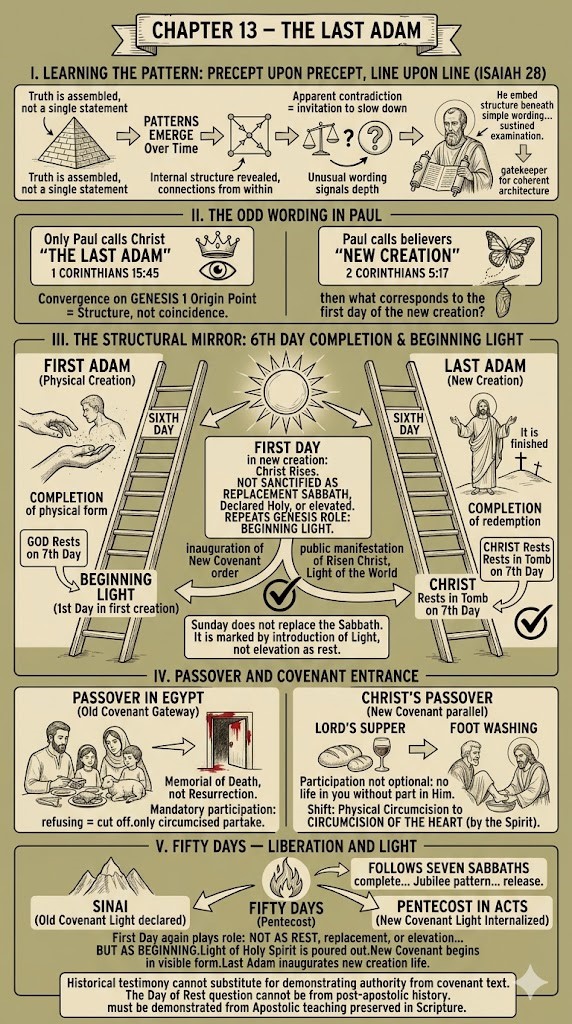
Chapter 13- the Last Adam
Learning the Pattern
When Scripture instructs us how to learn, it does not leave the method hidden.
Isaiah 28 lays out a principle: precept upon precept, line upon line, here a little and there a little. Truth is not always delivered in a single statement. It is assembled.
When you follow that method consistently over time, patterns begin to emerge that are not visible at the surface level. The Bible begins to reveal internal structure — connections that are not imposed from the outside but drawn from within the text itself.
One of the clearest indicators of buried structure is apparent contradiction. If something in Scripture seems to conflict with something else, that is not a flaw — it is a signal. It is an invitation to slow down. Very often, what appears to be tension on the surface hides a deeper layer of precision beneath it. What looks like contradiction may be the doorway to understanding.
Another indicator is unusual wording.
If every word is inspired, then unusual phrasing is not accidental. When the wording feels out of place, or unexpectedly precise, or oddly structured, it calls for attention. It tells the reader not to skim past it. It signals depth.
And no writer in the New Testament demonstrates this more than Paul.
Paul writes on multiple levels at once.
He can speak plainly to the surface reader — someone who reads devotionally and moves on. But at the same time, he embeds structure beneath the wording that only yields itself to sustained examination. The same sentence can function in two dimensions: accessible on the surface, demanding beneath it.
Because of this, Paul can appear simple and complex at the same time.
He can appear straightforward, yet contain layers that only unfold when Scripture is compared with Scripture.
In that sense, he functions as a kind of gatekeeper.
Those who are willing to search deeply find coherence. Those who remain at the surface may still benefit — but they will not see the architecture underneath.
And when Paul speaks of the “first Adam” and the “last Adam,” we must assume that he is not merely contrasting two historical figures. He is invoking structure. He is connecting creation, covenant, resurrection, and fulfillment in language that appears simple but is not.
So we slow down.
We do not rush past the wording.
Because if there is something hidden under the phrase “last Adam,” it will not reveal itself to the casual reader.
And that is where we now turn.
The Odd Wording
There is something unusual about Paul.
No other writer in Scripture calls Christ “the last Adam.”
The Gospels do not use the phrase.
Peter does not use it.
John does not use it in his letters.
James does not use it.
Only Paul.
“The first man Adam was made a living soul; the last Adam was made a quickening spirit.”
— 1 Corinthians 15:45
When you first read it, nothing seems hidden. It appears straightforward: Adam brought death; Christ brings life. The contrast is simple.
So you move on.
But if you follow the method of Isaiah 28 — line upon line — you learn to pause at what is rare. When a phrase appears only once, especially in Paul, that rarity is not accidental.
“Last Adam” is rare.
And then you encounter another phrase:
“New creation.”
Paul again.
“Therefore if any man be in Christ, he is a new creature [creation].”
— 2 Corinthians 5:17
Again, unusual language. Not merely forgiven. Not merely justified. Not merely redeemed.
New creation.
And again, the wording points backward — not merely to covenant, but to Genesis.
Then another layer.
Christ is called the light of the world. John records it directly from Christ’s own words. Paul develops its meaning more deeply — speaking of God “who commanded the light to shine out of darkness” shining in our hearts (2 Corinthians 4:6).
Now the pattern begins to form.
- Last Adam.
- New creation.
- Light shining out of darkness.
All of them point back to Genesis 1.
All of them point back to the beginning.
And when multiple rare phrases converge on the same origin point — creation — that is not coincidence. That is structure.
Now the question changes.
If Christ is the Last Adam,
and if those in Him are new creation,
and if light shines again as in Genesis,
then what corresponds to the first day in the first creation?
What marks the beginning of the new creation?
Under the first Adam, light entered the world on the first day.
Under the Last Adam… what marks the beginning?
Now we are not speculating.
Now we search for precepts.
Because when three independent phrases all look backward to Genesis, Scripture is inviting comparison.
And comparison is how the pattern unfolds.
The Pattern of the Sixth Day
When we return to Genesis to follow the precept, the first thing we are sent to is Adam.
Adam was created on the sixth day of creation.
The pattern is clear:
Light — first day.
Formation — progressing through the week.
Man — sixth day.
Completion — then rest.
At the end of the sixth day, creation stands complete in its intended form. After this, the seventh day is sanctified.
Now follow the pattern forward.
Christ, whom Paul calls the “last Adam,” was crucified on the sixth day of the week. He died before sunset, before the seventh day began.
And His final words echo Genesis:
“It is finished.”
In Genesis, the work of creation was finished.
At the cross, the work of redemption was finished.
The parallel is not accidental.
The first Adam’s creation was completed on the sixth day.
The Last Adam’s sacrifice was completed on the sixth day.
The structure matches.
The Meaning of Passover Clarified
Now return to Passover.
In Egypt, the Passover focused on the killing of the lamb. The lamb was slain on the fourteenth day. The blood marked the houses. The lamb was eaten that night, which moved into the fifteenth day.
In the Old Covenant understanding, Israel often blended the killing of the lamb and the meal together in practice. The event was seen as one continuous observance.
But in fulfillment, Christ separates the elements with clarity.
He dies on the fourteenth — the time of the lamb’s slaughter.
The killing of the Lamb is distinct.
Then, before His death, He institutes the meal — bread and wine — identifying them as His body and blood.
In John 6, He speaks words that were not understood at the time:
“Except ye eat the flesh of the Son of man, and drink his blood, ye have no life in you.”
Life is tied not merely to remembering His death, but to participating in what His death accomplished.
The Passover in Egypt memorialized death and deliverance.
Christ clarifies that the death brings life.
And then He adds something that seems small, but is not:
Foot washing.
When Peter resists, Christ answers plainly:
“If I wash thee not, thou hast no part with me.”
Participation is not optional.
Just as circumcision marked covenant participation in Egypt, so participation in what Christ commands marks covenant participation in Him.
The killing of the Lamb is completed on the sixth day.
The work is finished.
The Last Adam fulfills what the first Adam failed to secure.
Now the structure is tightening:
- First Adam created on sixth day.
- Last Adam completes redemption on sixth day.
- Light enters on the first day in Genesis.
- Covenant light at Sinai.
- Spirit light at Pentecost.
- New creation language tied back to Genesis.
The pattern is not random.
The first creation has a structure.
The new creation mirrors it.
Now the question presses forward:
If the first Adam’s story began with light on the first day,
and if the Last Adam completes His work on the sixth day,
what marks the first day of the new creation?
That is where we now look.
The Last Adam and the Pattern Fulfilled
The Bible is precise in its structure.
Adam was created on the sixth day.
The work of creation reached completion on that day. After the sixth day, God rested.
When Paul calls Christ “the last Adam,” he is not using poetic language. He is invoking structure.
Christ was crucified on the sixth day of the week. His final words were, “It is finished.” The work of redemption was completed just as the work of the first creation had been completed on the sixth day.
Then He rested in the tomb on the seventh day.
The pattern mirrors Genesis:
Sixth day — completion.
Seventh day — rest.
The structure is not random.
Now we come to the first day.
In the first creation, the first day marked the entrance of light into the world.
Light was not the end of creation.
It was the beginning.
In the new creation, Christ rises on the first day.
The first day is not sanctified as a replacement Sabbath. It is not declared holy. It is not elevated above the seventh day.
It plays the same role it played in Genesis.
Beginning.
This time it marks the beginning of the New Covenant order — the public manifestation of the risen Christ, the light of the world.
Under the first Adam, light entered physical creation.
Under the Last Adam, light entered new creation.
Sunday does not replace the Sabbath.
It repeats its Genesis role.
Beginning light.
Passover and Covenant Entrance
Passover in Egypt was not the covenant itself. It marked those who would enter into covenant.
It was tied to circumcision. Only the circumcised could partake. Refusal meant being cut off.
Circumcision was the covenant sign.
Passover marked participation in deliverance.
In the New Covenant, the pattern shifts from physical circumcision to circumcision of the heart.
Paul makes this explicit. True circumcision is inward, by the Spirit.
The indwelling Spirit marks covenant identity.
But participation in Christ’s Passover remains essential.
“Except ye eat the flesh of the Son of man, and drink his blood, ye have no life in you.”
Just as in Egypt, participation is not optional.
Without Passover participation, one is outside covenant life.
The sign has shifted from flesh to heart.
But the structure remains.
Fifty Days — Liberation and Light
Then comes the fiftieth day.
In the Old Covenant count, fifty follows seven Sabbaths complete — a pattern later associated with Jubilee, liberation, release.
At Sinai, covenant light was publicly declared.
At Pentecost in Acts, covenant light was internalized by the Spirit.
Once again, the first day plays its role.
Not as rest.
Not as replacement.
But as beginning.
The light of the Holy Spirit is poured out.
The New Covenant begins in visible form.
The Last Adam inaugurates new creation life.
The pattern closes the circle:
- First creation — light on first day.
- First Adam — formed on sixth day.
- Last Adam — completes redemption on sixth day.
- Rest on seventh.
- New creation light on first day.
- Spirit light at Pentecost, fifty days later.
The math is consistent.
The first day is not elevated.
It is assigned.
It marks the beginning of light.
And that is where Sunday stands in Scripture.
“The resurrection on the first day aligns with the Genesis pattern of beginning light and signals the inauguration of new-creation life under the Last Adam.”
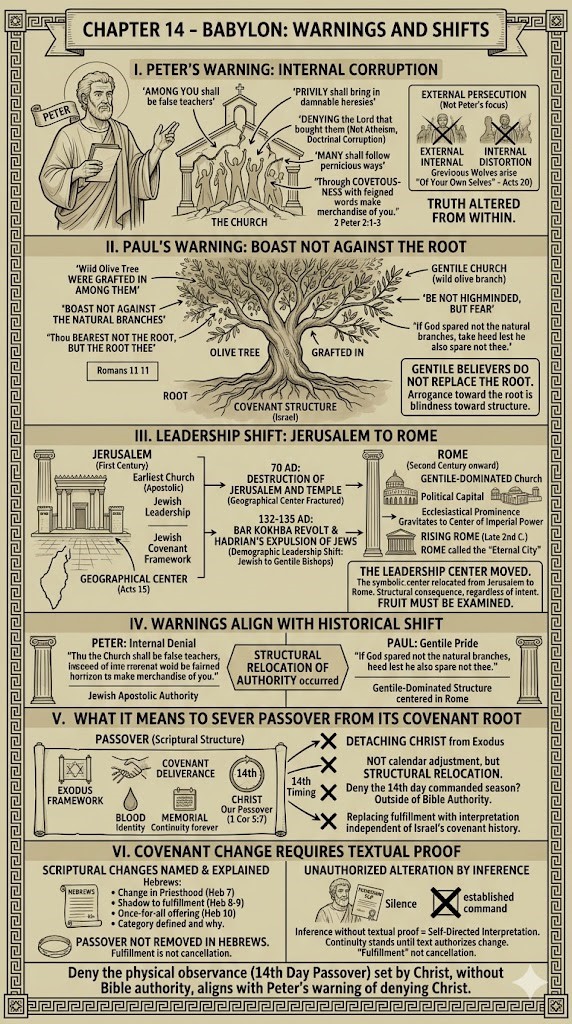
Chapter 14- Babylon
The Warning From Within
The Apostle Peter does not direct his strongest warning toward the world. He directs it toward the Church.
In 2 Peter 2:1, he writes:
“But there were false prophets also among the people, even as there shall be false teachers among you, who privily shall bring in damnable heresies, even denying the Lord that bought them…”
The language is precise.
- “Among the people.”
- “Among you.”
- “Privily shall bring in.”
The threat is not external persecution.
It is internal corruption.
Peter does not describe pagans attacking the Church.
He describes teachers rising inside it.
The phrase “denying the Lord that bought them” is critical.
This denial is not atheism.
It is not open rebellion.
It is not pagan worship.
It is doctrinal corruption from those who claim to belong to Christ.
The denial is subtle.
Peter continues in verse 2:
“And many shall follow their pernicious ways; by reason of whom the way of truth shall be evil spoken of.”
This is influence.
This is leadership.
This is internal authority misdirecting others.
The damage is not merely personal.
It affects “the way of truth.”
Again, the source is inside.
Verse 3 adds:
“And through covetousness shall they with feigned words make merchandise of you…”
“Feigned words.”
Manufactured language.
Constructed teaching.
Words shaped to control.
This is not accidental ignorance.
It is structured misdirection.
Peter then compares them to false prophets of old — not outsiders, but those who claimed to speak for God.
Throughout the chapter, the pattern remains:
- Authority.
- Influence.
- Corruption from within.
- Destruction that follows.
Nowhere in this chapter is Peter describing persecution from Rome.
He is describing spiritual decay inside the covenant community.
This aligns with Paul’s warning in Acts 20:29–30:
“For I know this, that after my departing shall grievous wolves enter in among you, not sparing the flock. Also of your own selves shall men arise, speaking perverse things, to draw away disciples after them.”
Again:
“Of your own selves.”
The pattern is consistent.
The final test of corruption is not outside pressure.
It is internal distortion.
Peter closes his warning in 2 Peter 3:17:
“Ye therefore, beloved, seeing ye know these things before, beware lest ye also, being led away with the error of the wicked, fall from your own stedfastness.”
The responsibility is placed on the believer.
Not:
“Wait for leadership.”
Not:
“Trust authority blindly.”
But:
“Beware.”
The warning is given in advance so that corruption can be recognized when it appears.
This chapter, then, establishes a principle:
The greatest danger to the Church does not begin outside its walls.
It begins when truth is altered from within.
Do Not Boast Against the Root
Paul addresses a different danger in Romans 11 — not corruption from within Israel, but arrogance from the Gentiles.
In Romans 11:17–18, Paul writes:
“And if some of the branches be broken off, and thou, being a wild olive tree, wert graffed in among them…
Boast not against the branches. But if thou boast, thou bearest not the root, but the root thee.”
The imagery is precise.
- The root existed before the graft.
- The Gentile does not replace the root.
- The Gentile is supported by the root.
The warning is not against pagans.
It is against believers.
“Boast not.”
Why?
Because arrogance toward the root is blindness toward structure.
Verse 20 continues:
“Well; because of unbelief they were broken off, and thou standest by faith. Be not highminded, but fear.”
Highmindedness is the danger.
The Gentile believer must not interpret Israel’s stumbling as permanent rejection, nor as proof of superiority.
Paul makes the structure clear:
- There is one root.
- There is one tree.
- There are natural branches.
- There are grafted branches.
- The graft does not create a new tree.
- The graft participates in an existing covenant structure.
In verse 21:
“For if God spared not the natural branches, take heed lest he also spare not thee.”
This is not triumph.
This is warning.
The Gentile does not own the covenant.
The Gentile is allowed into it.
Paul’s entire argument in Romans 9–11 reinforces continuity:
- The promises were given to Israel.
- The covenants were given to Israel (Romans 9:4).
- The Messiah came through Israel.
- The Gentiles are brought in by mercy.
The structure remains rooted in what God established from the beginning.
This corrects two errors:
- Israel is not permanently discarded.
- The Gentile Church does not replace the root.
The root supports the branches.
If the branch despises the root,
it cuts itself off from the source of life.
Paul’s warning mirrors Peter’s:
The danger is not external hostility.
The danger is internal distortion —
either through false teachers (Peter),
or through pride and disrespect toward covenant structure (Paul).
Both warnings protect the same thing:
The integrity of what God established.
Motive
Before any warning is given, the method must be defined.
The work presented here operates under a strict set of standards. These standards are not decorative. They are restrictive by design. Their purpose is to prevent personal bias, emotional escalation, and the assignment of intent without proof.
Among these standards, the most severe restriction concerns motive.
Motive is the most dangerous claim a writer can make.
To say:
“They are wrong”
is a doctrinal claim.
To say:
“They are mistaken”
is an interpretive claim.
But to say:
“They intended deception”
is a motive claim.
Motive requires access to the internal thoughts and intentions of another person. Scripture itself warns that only God knows the heart (Jeremiah 17:10; 1 Corinthians 4:5). Therefore, assigning motive without explicit evidence exceeds the authority of the writer.
Under these standards:
- Silence cannot be equated with guilt.
- Disagreement cannot be equated with deception.
- Error cannot automatically be equated with intent.
- Pattern alone does not prove motive.
- Reaction does not prove awareness.
Every conclusion must rest on observable structure and textual evidence.
This is why the method insists on “two witnesses.” A claim must be supported by more than inference. Correlation is not causation. Timing is not confession. Emotional certainty is not proof.
The use of AI in this process serves a specific function. It does not generate doctrine. It does not supply revelation. It acts as a cross-examiner.
The AI is bound by the same restrictions:
- It challenges leaps in logic.
- It questions absolute claims.
- It refuses to affirm unproven motive.
- It distinguishes between observable fact and interpretation.
This creates a constraint system.
The constraint is intentional.
Without constraint, the writer can easily slip into:
- Escalation.
- Personal attack.
- Narrative closure.
- Emotional amplification.
- Self-sealing conclusions.
The restriction on motive is therefore the guardrail.
It prevents the argument from becoming personal.
It keeps the focus on structure.
It ensures that warnings are based on text, not emotion.
If corruption exists, it must be shown through doctrine, not assumed through intent.
If error exists, it must be demonstrated through structure, not inferred through reaction.
These standards are not designed to weaken conviction.
They are designed to purify it.
A claim that survives strict restriction is stronger than a claim built on assumption.
The warning, therefore, must stand on observable structure alone.
Anything beyond that belongs to God.
On Motive and Restraint
The restriction on motive is not natural to me.
When I believe I see motive, my instinct is to say it plainly. If deception appears intentional, the impulse is to expose the intent along with the error.
But restraint is required.
The clearest biblical example of this restraint is found in Jude 1:9:
“Yet Michael the archangel, when contending with the devil he disputed about the body of Moses, durst not bring against him a railing accusation, but said, The Lord rebuke thee.”
The passage is striking.
Michael is contending with Satan himself.
There is no ambiguity about Satan’s character.
There is no confusion about his history.
There is no doubt about his opposition to God.
Yet even in that direct confrontation, Michael does not bring a railing accusation.
He does not assign motive.
He does not pronounce judgment.
He does not escalate language.
He defers judgment:
“The Lord rebuke thee.”
If restraint is exercised even there, then how much more must it be exercised among men?
It is not that motive cannot be perceived.
It is not that patterns cannot suggest intent.
It is that judgment of the heart belongs to God.
The standard, therefore, is not emotional suppression.
It is jurisdiction.
There are things that may appear obvious.
There are patterns that may look deliberate.
There are outcomes that may seem intentional.
But to move from structure to motive requires authority that does not belong to the writer.
Error can be shown.
Contradiction can be demonstrated.
Corruption in doctrine can be exposed through text.
But motive must be deferred.
This restraint does not weaken the warning.
It strengthens it.
Because when the argument stands without attacking intent, it cannot be dismissed as personal.
The standard, then, is simple:
Expose structure.
Defer motive.
Leave judgment to God.
On Motive and Fruit
This work does not set motive.
Motive belongs to the heart.
The heart belongs to God.
What can be shown is structure.
What can be observed is outcome.
What can be measured is fruit.
As Christ Himself said:
“Wherefore by their fruits ye shall know them.” (Matthew 7:20)
The fruit is visible.
The root intention is not.
Therefore, this section will not declare why certain shifts occurred.
It will not pronounce judgment on internal intent.
It will not claim access to hidden thought.
Instead, it will examine the historical and doctrinal transition from Jewish leadership to Gentile leadership — both in Jerusalem and later in Rome.
That transition is observable.
Its doctrinal consequences are traceable.
Its structural effects can be examined.
Two possible explanations may exist:
One possibility is consolidation — that authority shifts in a way that aligns the Church more closely with imperial structure and eventually with Babylonian influence.
Another possibility is conviction without restraint — that individuals, believing strongly in what they perceived as truth, moved beyond covenant boundaries in order to defend or expand that belief, assuming they were serving God.
Both are plausible human explanations.
This work does not choose between them.
Because motive is not the foundation of the argument.
The foundation is fruit.
If the result of a shift produces:
- Departure from covenant structure,
- Alteration of sanctified time,
- Displacement of the root,
- Reinterpretation of foundational precepts,
then the structure must be examined regardless of intent.
A man can be sincerely wrong.
A leader can believe he is defending truth while altering it.
A system can drift without conscious conspiracy.
Or the motive could be much stronger and more evil
The issue is not why.
The issue is what changed.
The reader will see the structure.
The reader will see the outcome.
The reader will judge the fruit.
Judgment of motive is deferred.
The math will speak.
The fruit will testify.
The rest belongs to God.
The Leadership Shift: From Jerusalem to Rome
The earliest Church was rooted in Jerusalem.
The apostles were Jewish.
The leadership was Jewish.
The covenant framework was Jewish.
The disputes recorded in Acts concern the relationship between Gentile converts and the existing Jewish structure — not the replacement of it.
Jerusalem was the center.
In Acts 15, the council convenes in Jerusalem.
James speaks.
Peter speaks.
The apostles deliberate.
Authority rests in that city.
But history records a series of events that changed this structure.
1. The Destruction of Jerusalem (70 AD)
In 70 AD, Rome destroyed Jerusalem and the Temple.
This was not merely political.
It fractured the geographical and institutional center of Jewish-Christian leadership.
The Temple system ended.
Jerusalem’s stability collapsed.
The Jewish population was devastated.
The Church in Jerusalem diminished in influence.
This is historical fact.
2. The Bar Kokhba Revolt (132–135 AD)
After another Jewish revolt against Rome, Emperor Hadrian expelled Jews from Jerusalem entirely and renamed the city Aelia Capitolina.
Jews were legally barred from entering the city.
From that point forward, the leadership in Jerusalem transitioned from Jewish bishops to Gentile bishops.
The demographic structure shifted.
This is documented historical transition — not doctrinal interpretation.
3. The Rise of Rome
While Jerusalem declined in influence, Rome increased.
Rome was the imperial center.
Rome held political authority.
Rome held military dominance.
Rome eventually held ecclesiastical prominence.
By the late 2nd century, the bishop of Rome began to exercise increasing influence over other Christian communities.
The symbolic shift became visible:
Jerusalem — the historical covenant city — diminished.
Rome — the imperial capital — rose in prominence.
Jerusalem had been called the Holy City.
Rome was called the Eternal City.
That language is historical, not rhetorical.
Structural Consequence
The issue here is not motive.
The issue is structural relocation of authority.
The original leadership emerged from:
- The covenant people.
- The covenant land.
- The covenant framework.
Over time, leadership prominence shifted to:
- A Gentile-dominated church.
- An imperial capital.
- A context deeply embedded in Roman political culture.
That shift is observable.
What followed historically included:
- Increasing separation from Jewish practice.
- Reinterpretation of sanctified time.
- The distancing of the Church from its covenant root.
- The development of ecclesiastical authority centered in Rome.
This chapter does not declare why this occurred.
It does not assert conspiracy.
It does not assign deliberate corruption.
It does not read internal motives.
It states:
The leadership center moved.
The demographic leadership shifted.
The symbolic center relocated from Jerusalem to Rome.
The fruit of that relocation must be examined.
The reader will evaluate what changed.
On the Phrase “Early Church”
One of the most common historical phrases is “the early church.”
The phrase sounds precise.
It is often not.
The churches built by the apostles in the first century were:
- Governed by men appointed by the apostles.
- Rooted in the covenant structure.
- Tied to Jerusalem leadership in the beginning.
- Operating within the framework recorded in Acts and the epistles.
That is the earliest church in its strict sense:
The apostolic church.
However, historians frequently use “early church” to describe second- and third-century developments centered in Rome and other Gentile-majority regions.
That is a later historical phase.
It is not identical to the apostolic phase.
The distinction matters.
The last direct voice we hear from Peter is not administrative.
It is warning.
In 2 Peter 2:1, he writes:
“There shall be false teachers among you, who privily shall bring in damnable heresies, even denying the Lord that bought them…”
This is not minor.
This is not peripheral.
“Denying the Lord that bought them” is central.
The warning comes from within the church structure itself.
It is directed at internal teachers.
It is presented as an inevitability, not a possibility.
That warning must be set apart.
Because if denial of Christ occurs from within,
then continuity from apostolic leadership to later structures cannot simply be assumed.
Now consider Paul’s warning in Romans 11.
The Gentile believers are told:
“Boast not against the branches… thou bearest not the root, but the root thee.”
The danger described is not pagan intrusion.
It is Gentile elevation over the covenant root.
Paul does not forbid Gentile inclusion.
He forbids Gentile arrogance.
He does not describe the planting of a new tree.
He describes grafting into an existing one.
The structure remains singular.
There is one root.
If later leadership begins to:
- Minimize the covenant root,
- Distance itself from Jewish foundation,
- Redefine the structure independently of that root,
then the warning of Romans 11 becomes relevant.
It states:
Peter warned of internal denial.
Paul warned against Gentile pride over the root.
History records a leadership transition from Jewish apostolic authority to Gentile-dominated structures centered in Rome.
These elements must be examined together.
Sixty Years After the Apostles
Roughly one generation after the deaths of Peter and Paul, the Christian community in Rome appears markedly different from what we see in the New Testament period.
In the apostolic age:
- The Church was rooted in covenant continuity.
- The Passover language is explicit.
- Paul writes in 1 Corinthians 5:7–8:
“Christ our Passover is sacrificed for us: therefore let us keep the feast…”
The Passover is not described as abolished.
It is interpreted through Christ.
Christ is identified as the Passover Lamb.
The remembrance is covenantal.
It is not detached from its root.
“Denying Passover equals denying Christ”
requires definition.
Because what must be shown is not assumption,
but structural alteration.
Now consider Paul’s warning in Romans 11 again:
“Thou bearest not the root, but the root thee.”
The Gentile believers do not create a new covenant structure.
They are grafted into an existing one.
Paul warns:
“If God spared not the natural branches, take heed lest he also spare not thee.”
The danger is separation from the root.
Historically, within decades after the apostles:
- Jewish leadership presence diminished significantly in Rome.
- Tensions between Jewish and Gentile believers increased.
- Rome increasingly distanced itself from Jewish identity.
- The Church in Rome became Gentile in leadership and expression.
That demographic shift is documented history.
Now the key issue is this:
Did structural distancing from Jewish covenant identity lead to reinterpretation of covenant observances?
That is the question.
If a community moves:
- From covenant root,
- To Gentile dominance,
- To separation from Jewish identity,
then Paul’s warning becomes structurally relevant.
:
“The demographic and leadership shift Paul warned about occurred. The question is whether its doctrinal consequences align with his warning.”
latter Rome:
- Reinterpreted Passover,
- Distanced itself from covenant timing,
- Separated from Jewish-root continuity,
What It Would Mean to Sever Passover From Its Covenant Root
Passover in Scripture is not an isolated ritual.
It is tied to:
- The Exodus (Exodus 12).
- Covenant identity.
- The blood of deliverance.
- Circumcision as covenant boundary (Exodus 12:48).
- Memorial continuity (“a memorial… forever”).
When Paul writes:
“Christ our Passover is sacrificed for us” (1 Corinthians 5:7)
He does not invent a new symbol.
He identifies Christ as the fulfillment of the existing one.
Structurally, then:
Passover → Covenant deliverance → Blood → Identity → Remembrance.
To sever Passover from its covenant root would mean:
- Detaching Christ from the Exodus framework.
- Removing the covenant timing from its historical structure.
- Redefining remembrance without reference to the root narrative.
- Replacing fulfillment with reinterpretation independent of Israel’s covenant history.
It would not simply be calendar adjustment.
It would be structural relocation.
Paul’s warning in Romans 11 becomes relevant here:
“Thou bearest not the root, but the root thee.”
If remembrance of Christ is detached from the covenant structure that defines it, then the branch risks forgetting the root that sustains meaning.
It defines structural drift.
Christ bound the physical act to the spiritual reality, and Paul reinforced it. Therefore, separation has to be proven—not unity.
Physical participation (bread/wine; a commanded act of remembrance)
- Physical timing (14th Passover timing; calendar structure)
What Christ and Paul unquestionably establish
A) Christ commands a physical act tied to a spiritual covenant reality
At the Last Supper Christ takes bread and cup and says, in substance:
- “This is my body… this cup is the new covenant in my blood… do this in remembrance of me.” (Synoptics; and Paul’s received tradition in 1 Corinthians 11:23–25)
That is a physical action (eat/drink) inseparably tied to spiritual meaning (His body/blood; covenant; remembrance). On that, you’re right.
B) Paul re-affirms it as a command with covenant seriousness
Paul doesn’t treat it like optional symbolism.
- He repeats Christ’s words (1 Corinthians 11:23–26).
- He warns about unworthy participation (1 Corinthians 11:27–29).
- He ties it to proclamation of the Lord’s death (“ye do shew the Lord’s death”) (1 Corinthians 11:26).
C) Paul also explicitly uses Passover/feast language
- “Christ our Passover is sacrificed for us: therefore let us keep the feast…” (1 Corinthians 5:7–8)
Christ instituted a physical memorial (bread and cup) as a covenant act of remembrance tied directly to His body and blood, and Paul reaffirms it as binding and spiritually consequential. Therefore, any teaching that reduces it to non-covenantal symbolism or detaches it from covenant life contradicts the apostolic structure.
Covenant Change and the Burden of Text
The New Covenant does not present change as an undefined permission slip.
When Scripture announces change, it explains the change.
For example, Hebrews discusses:
- A change in priesthood (Hebrews 7).
- The insufficiency of the repeated sacrifices (Hebrews 10).
- The passing of the earthly sanctuary’s administration as a shadow pointing to Christ (Hebrews 8–9).
- The once-for-all offering of Christ as the fulfillment of the sacrificial system (Hebrews 10).
In each case, the text identifies the category being addressed and why the change occurs.
The change is not treated as vague.
It is defined.
This creates a structural rule:
If Scripture changes something covenantal, Scripture names it and explains it.
Therefore, the burden of proof is not carried by those who maintain continuity. The burden falls on those who claim alteration without textual authorization.
Passover is never defined in Hebrews as something abolished.
The sacrificial system is explained.
The priesthood is explained.
The sanctuary administration is explained.
But Passover itself is not placed in the category of “removed” or “ended.”
To insert Passover into that category without explicit text is not demonstration.
It is inference.
And inference, when it overrides an established command without authorization, becomes self-directed interpretation.
This does not require guessing motive.
It is simply a method statement:
- Change must be textually identified.
- Continuity stands until change is textually authorized.
- Silence does not create permission.
Christ can fulfill the meaning of Passover without abolishing the appointment of Passover.
Fulfillment is not the same thing as cancellation.
If cancellation is claimed, it must be proven from Scripture.
Not inserted by assumption.
Christ Our Passover
Paul states plainly:
“Christ our Passover is sacrificed for us.” (1 Corinthians 5:7)
This is not metaphor detached from covenant history.
Passover in Exodus was:
- The blood of the lamb.
- Deliverance from death.
- Covenant identity.
- A memorial appointed by God.
When Paul identifies Christ as “our Passover,” he is not discarding the structure. He is declaring fulfillment within it.
Christ is the Passover Lamb,
then Passover is not abolished — it is embodied.
To deny that Christ fulfills Passover
is to deny His redemptive role.
To detach Christ from the Passover structure entirely
is to sever Him from the covenant framework He fulfills.
The issue, therefore, is not about tradition.
It is about identity.
Christ is not an abstract redeemer.
He is the Lamb tied to a specific covenant act.
That act was set on the 14th required to be kept
If one removes the Passover physical observance they are
not merely debates timing,
but eliminates its covenant relevance —
The removaql the physical observance would require the Bible stating it was change, the Bible does not make that change. Deny the physical observance set by Christ and confirm by Paul with out the Bible given the authority to do is outside of the Bible. Interpretation without the proof the 14th day was removed or changed is set on self rule not the Bible authority. Denying the Passover that was set by Christ with Christ being our Passover in the fulfillment of Peter of deny Christ.
Chapter 15- The Bottom Line
Self Rule
Before mankind ever stood in a garden, rebellion had already entered creation.
Scripture does not describe the event in detail, but it does describe the result. Angels did not keep their first estate. They left the position appointed to them. Pride lifted the heart of one who said, “I will ascend… I will exalt… I will be like the Most High.” What had been ordered became self-exalting. What had been appointed became rejected.
The pattern is clear even without the phrase.
There was divine authority.
There was assigned position.
There was refusal.
There was self-elevation.
Rebellion in heaven was not ignorance. It was ambition. It was not confusion. It was elevation without submission.
Revelation speaks of a dragon drawing others with him. Influence followed rebellion. The rejection of order did not remain isolated — it spread.
This is the first recorded pattern of self-rule against God’s rule.
He sought to ascend. to rise. To establish himself above the structure that governed him.
That is the root.
.Authority without submission ruling under his authority outside of God’s authority. He set out to rule himself. When that pattern appears later in the garden, it is not new. It is familiar.
The serpent does not introduce rebellion. He extends a rebellion already chosen. What happened in spiritual regime becomes offered on earth. Self Rule!
The warning has already been laid.
Paul did not speak vaguely. He did not leave the structure undefined. He warned the Gentiles plainly: you are grafted in. You do not support the root; the root supports you. Do not boast against the branches. Do not separate yourself from the covenant structure that God established. If you do, you too can be cut off.
That charge has already been established.
Now we move from warning to proof Paul warned of a pattern — grafted branches attempting to function as a body of their own. If that pattern appears in history, then the warning was not theoretical. It was prophetic.
The evidence has already been assembled. The groundwork has been laid. The charge stands.
We will look at the men of the second century to test structure. Did the grafted branches remain tied to the root? Or did they begin to speak and act as though they were a tree of their own?
The pattern of rebellion is not new. It began in heaven with refusal of appointed order. It appeared in Eden as autonomous moral authority. Paul warned it has appear in the Church.
Deception is not random. It follows a pattern.
It does not announce itself as error. It presents itself as refinement. It does not appear as rebellion. It appears as improvement. Deception always carries the image of truth. That is why it works.
But Scripture does not leave us defenseless.
Isaiah 28 gives a weapon deception cannot bypass. Line upon line. Precept upon precept. Here a little, there a little. When precepts are added correctly, when structure is allowed to build upon structure, contradiction cannot hide. This is the bottom line of math. Not emotion. Not tradition. Not rhetoric. Structure.
When deception presents an image of truth, math tests it. If the pieces do not align, the image collapses.
Now we apply that weapon.
Paul warned the Gentiles: you are grafted in. You do not stand alone. You do not replace the root. You are supported by it. Do not boast against the branches. Do not separate yourself from what God established.
The pattern to watch is simple:
Men stepping out of the place God set for them.
Branches attempting to function without the root.
Authority exercised independent of assigned structure.
We have already seen the removal of Jewish leadership in both Jerusalem and Rome. That removal is not merely political history; it is structural shift. If the root is sidelined and the grafted branches assume full authority, Paul’s warning becomes measurable.
This is the pattern we will examine, structure.
If men remained in the place God assigned, the math will show it.
If they stepped outside of it, the math will show that too.
At this point, motive is not ours to declare.
There are only structural possibilities.
It may be that men assumed authority not given to them — absorbing Christ into an existing system of power, as empires before Rome had absorbed religions and symbols into themselves.
It may also be that men sincerely believed they were preserving truth. History gives us examples of zeal without full understanding. Saul believed he was serving God before he became Paul.
It may even be a mixture of both — conviction combined with ambition, sincerity combined with structure inherited from surrounding culture.
We do not set motive.
We examine authority.
Regardless of intent, if men step outside the structure God established — if grafted branches function as though they are a tree of their own — then the issue is not sincerity. It is authorization.
Authority does not transfer by enthusiasm.
Authority does not transfer by cultural shift.
Authority transfers only by command.
If a shift occurred, the question is simple: Was it commanded by God, or assumed by men?
Deception
From the beginning, rebellion follows a pattern: replacement of what God established.
In heaven, assigned authority was rejected.
In Eden, command was questioned.
In Israel, covenant order was challenged.
The pattern is consistent — not open denial at first, but quiet replacement.
The Bible gives us the focus of redemption clearly. The emphasis is not placed on the resurrection as a stand-alone event. The focus of Scripture is the death of Christ — the sacrifice. Christ became the Last Adam through obedience unto death. It is the slaying of the Lamb that carries covenant weight.
From Egypt forward, the pattern centers on the slain Lamb. The blood marks the covenant. The meal follows the sacrifice. The authority rests in what was commanded.
If a shift is later introduced, it must carry the image of biblical truth. Deception does not discard Scripture; it imitates it. It must appear aligned. It must resemble continuity.
Now consider this:
The Bible records repeated Sabbath observance — Christ teaching on the seventh day, the apostles entering synagogues on the seventh day, gatherings on the seventh day The Bible show dozsens od examples of the 7th day sabbath. Some scholar and commentators say Paul spoke of the sabbath 60 to 85 time in Acts, never mentioned the day was worship on Sunday Nowhere is there a command transferring sanctification from the seventh day to Sunday..
When deception is presented, it cannot be stated as open rebellion. It must appear rooted in Scripture. As with the pattern of Satan and Eve.
There are only two places in the New Testament that are commonly used to construct that image.
Acts 20:7
Here is their argument- One of the primary texts used to support first-day gathering is Acts 20:7.
It reads:
“Upon the first day of the week, when the disciples came together to break bread, Paul preached unto them…”
From this, the argument is constructed as follows:
The disciples gathered on the first day.
They broke bread together.
Paul preached to them.
This indicates an established practice of assembling on the first day of the week.
Since the resurrection occurred on the first day, and since the disciples are shown gathering on the first day, this is presented as evidence that the early Church honored the first day as their regular meeting day.
The reasoning continues:
If the apostles themselves gathered on the first day, and if this was recorded in Scripture without correction, then the first day must have been recognized as appropriate for Christian assembly.
Therefore, the first day becomes associated with resurrection, fellowship, and apostolic teaching.
That is the argument drawn from Acts 20.
Acts 20 takes place during Paul’s third missionary journey.
Paul was traveling by ship and was trying to reach Jerusalem in time for Pentecost (Acts 20:16). Because of this urgency, he chose not to spend time in Ephesus, a major city where he had labored extensively. Instead, he sailed past Ephesus and docked at Miletus, approximately 30–40 miles south of Ephesus along the coast of Asia Minor.
From Miletus, Paul sent for the elders of the church at Ephesus and asked them to come to him there (Acts 20:17).
Now we come to Acts 20:7:
“Upon the first day of the week, when the disciples came together to break bread, Paul preached unto them…”
Several structural details must be noticed.
First, in the Jewish reckoning of time, the day begins at sunset. The first day of the week would therefore begin at sunset following the seventh-day Sabbath. That means this meeting occurred on what we would call Saturday night.
Second, Paul was departing the next day. This was a farewell gathering. It was not described as a commanded weekly observance, but as an occasion connected to Paul’s imminent departure.
Third, the phrase “breaking bread” in the book of Acts commonly refers to a meal shared among believers (Acts 2:46). There is no explicit statement that this was a newly instituted weekly first-day worship service replacing the Sabbath.
Paul spoke until midnight. Eutychus fell from the third loft and was raised. After this interruption, Paul continued speaking until daybreak (Acts 20:11).
At daybreak — still the first day of the week — Paul departed on foot toward Assos, while the ship sailed around the peninsula (Acts 20:13). From there he continued his journey toward Jerusalem.
The key observations are:
- Paul had skipped Ephesus due to urgency.
- He called the Ephesian elders to Miletus for a farewell meeting.
- The gathering occurred on the night following the Sabbath.
- Paul departed the next morning.
- There is no command transferring sanctification.
- There is no statement declaring the first day holy.
- There is no instruction establishing a weekly observance.
The text records an event, not a command.
Nothing in Acts 20 states that the seventh-day Sabbath had been replaced.
It describes a farewell meeting in the course of urgent travel toward Pentecost.
1. How Acts 20 Differs from a Commanded Observance
When God institutes something covenantal, Scripture shows:
- A command
- A defined timing
- A defined meaning
- A defined authority
Example:
Exodus 12 — Passover
Leviticus 23 — Sabbaths and feast days
Luke 22 — Christ setting the memorial
Now compare Acts 20.
Acts 20 contains:
- No command.
- No sanctification of the day.
- No instruction to repeat weekly.
- No declaration of transferred holiness.
- No language of covenant replacement.
It records an event during travel urgency.
That is the structural difference between:
• Description
and
• Institution
If Acts 20 were establishing a new holy day, the structure would reflect covenant language.
It does not.
2. “Breaking Bread” — A Common Phrase
In first-century Jewish and early Christian context, “breaking bread” was a normal idiom for sharing a meal.
Acts 2:46:
“They… breaking bread from house to house, did eat their meat…”
That clearly describes ordinary meals.
Acts 27:35:
Paul “took bread… and began to eat.”
Again — a meal.
The phrase does not automatically mean Passover.
It means eating.
Only context determines meaning.
3. The One Explicit Covenant Use
The only place where “breaking bread” is explicitly tied to covenant meaning is at the Passover institution:
Luke 22
“This is my body…”
1 Corinthians 11
“As often as ye eat this bread and drink this cup…”
There, Christ defines:
- The bread
- The cup
- The covenant meaning
- The memorial structure
That is explicit.
Every other occurrence must be interpreted by context.
Acts 20 contains no covenant language, no body/blood symbolism, no instruction about remembrance.
Therefore, calling Acts 20 a weekly Eucharistic institution is interpretation — not explicit command.
The Structural Distinction
If one text contains covenant-defining language
and another contains only narrative description,
the covenant authority rests in the defining text.
That is bottom-line structure.
The Shift Without a Command
When we move into the second century, something changes.
The apostles are gone.
The generation that walked with them is gone.
And in Rome, a new voice begins to speak.
We are told that believers gather on the first day of the week.
We are told it is the day of resurrection.
We are told it is the beginning of the new creation.
But we are not shown a command.
No apostolic decree is quoted.
No transfer of Sabbath sanctity is declared.
No text is opened and expounded proving that the seventh day was replaced.
The change is described.
It is not demonstrated.
The earliest writers do not argue from Acts 20.
They do not say, “As Paul commanded in Troas…”
They do not ground the practice in a verse.
They simply state that it is done.
That is a structural fact.
When Scripture institutes something covenantal, it does so clearly.
Passover was commanded.
The Sabbath was commanded.
The memorial was defined by Christ Himself.
But here, in the second century, the practice is asserted without textual foundation.
The resurrection becomes the theological anchor.
Creation imagery becomes the explanation.
Distinction from Judaism becomes a factor.
But no verse transfers holiness.
Later generations would attempt to bring Acts 20 into the discussion.
Yet even modern scholarship admits: Acts 20 records an event — it does not legislate a replacement.
This is not an emotional claim.
It is a structural observation.
A day is described.
It is not commanded.
A gathering is recorded.
It is not instituted.
And that distinction is the difference between narrative and covenant.
1. Narrative vs. Command
Scripture distinguishes between what happened
and what was commanded.
Many things happened in Acts:
- Believers met daily.
- Believers met in homes.
- Paul preached at night.
- Paul preached in synagogues.
- Paul preached in marketplaces.
But not every recorded action becomes covenant law.
When God establishes something binding:
He commands it.
He defines it.
He repeats it.
He anchors it in covenant language.
The Sabbath is commanded.
Passover is commanded.
The memorial is defined by Christ.
Acts 20 records a meeting.
It does not command:
“Therefore, sanctify the first day.”
It does not declare:
“The Sabbath is replaced.”
It does not state:
“This shall be observed weekly.”
It is narrative.
Narrative is not legislation.
That is the first distinction.
2. Resurrection Symbolism vs. Covenant Transfer
Second-century writers begin to ground Sunday in resurrection symbolism.
They argue:
- It is the first day of creation.
- It is the day Christ rose.
- It represents new creation.
But symbolism is not covenant authority.
The resurrection is foundational.
It is central to faith.
But nowhere does Scripture institute a weekly resurrection feast.
There is no:
“Remember the resurrection every first day.”
There is:
“Do this in remembrance of Me” — at Passover.
The death of Christ is explicitly memorialized.
The resurrection is proclaimed.
It is not commanded as a weekly holy day.
Symbolism may inspire.
But covenant requires command.
That is the second distinction.
3. Practice vs. Authority
By the second century, Sunday gathering is described.
But describing practice does not establish divine authority.
Something can be practiced without being commanded.
The question is not:
“Did believers gather on Sunday?”
The question is:
“By what authority was the day sanctified?”
If the authority is:
- Apostolic command — show it.
- Prophetic declaration — show it.
- Covenant transfer language — show it.
The early writers do not produce such a text.
They describe what is done.
They do not demonstrate where God changed what He had set.
That silence is not proof of rebellion.
It is proof of absence of command.
And in matters of covenant, absence of command is decisive.
The Structural Conclusion
A narrative event does not equal a covenant decree.
Symbolism does not equal sanctification.
Practice does not equal authority.
If the Sabbath was transferred,
Scripture would say so clearly.
It does not.
Therefore the burden of proof rests on the one claiming change.
Not on the one preserving what was already established.
When an established command is no longer anchored in its original authority, and a new practice rises without explicit covenant transfer, something subtle has occurred. The change does not begin with open rebellion. It begins with reasoning. It begins with symbolism. It begins with what seems fitting, meaningful, even spiritually rich. But covenant authority is not established by what seems fitting. It is established by what God has spoken.
The pattern in Scripture is consistent: whenever man supplies what God has not commanded, even with sincere intent, the center of authority quietly shifts. The issue is not whether resurrection is true. The issue is not whether believers gathered. The issue is not whether symbolism is powerful. The issue is whether what God set was altered by His command — or by human reasoning.
And that distinction is the line between preservation and substitution.
1 Corinthian 16:2
There is one other passage often mentioned — 1 Corinthians 16:2.
“Upon the first day of the week let every one of you lay by him in store…”
This was not a worship service.
Paul was organizing a collection for the saints in Jerusalem. He instructed believers to set aside funds so that when he passed through, the offering would already be prepared.
There is no command to assemble.
There is no statement of Sabbath transfer.
There is no declaration of first-day sanctity.
It concerns preparation for relief — not the institution of a new holy day.
Even scholars who support Sunday observance do not claim this verse formally changes the Sabbath. At most, they suggest it may reflect activity on that day. It is not treated as legislative proof of covenant transfer.
It is logistical instruction.
Not worship replacement.
The Bottom line
What we see in this transition is not merely a change of day.
It is a shift in foundation.
In heaven, Scripture shows a created being seeking to rise above the order God established. The issue was not power alone — it was authority. It was the desire to establish rule independent of the structure God had set.
On earth, the pattern reappears.
God established covenant order through Israel. The Gentiles were grafted in — not as a separate body, not as a replacement root, but as branches sustained by what God had already planted.
The only path to the Kingdom was through the covenant God made and fulfilled in Christ — and Christ Himself declared that salvation is “of the Jews.” The root remained. The authority remained.
But over time, the visible markers of that covenant began to disappear.
The Passover, which Christ defined as the memorial of His death, was no longer central.
The Sabbath, established at creation and commanded in covenant, was no longer preserved as given.
In their place, another foundation rose — resurrection-centered observance without an explicit transfer of covenant authority. But Scripture anchors covenant memorial not in the resurrection, but in the death of Christ — “Christ our Passover.”
When the foundation shifts from what was commanded to what is reasoned, authority shifts with it.
The question is not whether believers were sincere.
The question is whether the authority for the change was ever granted.
Satan’s rebellion began with a refusal to remain within assigned order.
Babylon throughout Scripture is marked by the same pattern — establishing dominion apart from God’s declared structure.
Whenever covenant signs established by God are removed without His command, and new foundations are laid without explicit transfer, the pattern is recognizable.
Authority has shifted.
And once that shift begins, growth follows its own course.
2Co 11:3 But I fear, lest by any means, as the serpent beguiled Eve through his subtilty, so your minds should be corrupted from the simplicity that is in Christ.
What we see in this transition is not merely a change of day.
It is a shift in foundation.
In heaven, Scripture shows a created being seeking to rise above the order God established. The issue was not power alone — it was authority. It was the desire to establish rule independent of the structure God had set.
The test on man has never change it is still eating of the tree, Satan tempted Eve with self rule and Satan continue with same tactic here. Just as their father Satan the Gentile di not want to be rule by Israel they wanted self rule. This pattern shows the spirit in which they follow and just as Eve they choose Satan as their ruler.
Summary and Conclusion
This chapter has not asked whether believers gathered.
It has not denied the resurrection.
It has not questioned sincerity.
It has asked one question only:
By what authority was what God established altered?
We examined Acts 20.
It records a meeting.
It does not institute a new holy day.
We examined 1 Corinthians 16.
It concerns a collection.
It does not transfer Sabbath sanctity.
We looked to the second century.
Sunday practice is described.
But no apostolic command is produced.
Scripture shows that when God establishes covenant signs, He does so plainly.
The Sabbath was commanded.
The Passover was commanded.
Christ defined the memorial of His death.
No text shows that these were revoked.
No text declares their transfer.
No covenant language replaces them.
Instead, we see symbolism elevated, practice emerging, and authority assumed — without explicit divine decree.
That is the line this chapter has drawn.
Not between Jews and Gentiles.
Not between past and present.
But between command and reasoning.
Between what God has spoken
and what man has concluded.
Heaven’s rebellion began when created beings stepped outside assigned order.
Babylon throughout Scripture follows the same pattern.
The issue has always been authority.
And in matters of covenant, authority does not move unless God moves it.
If He did, Scripture would say so.
It does not.
And that silence is not weakness.
It is final.
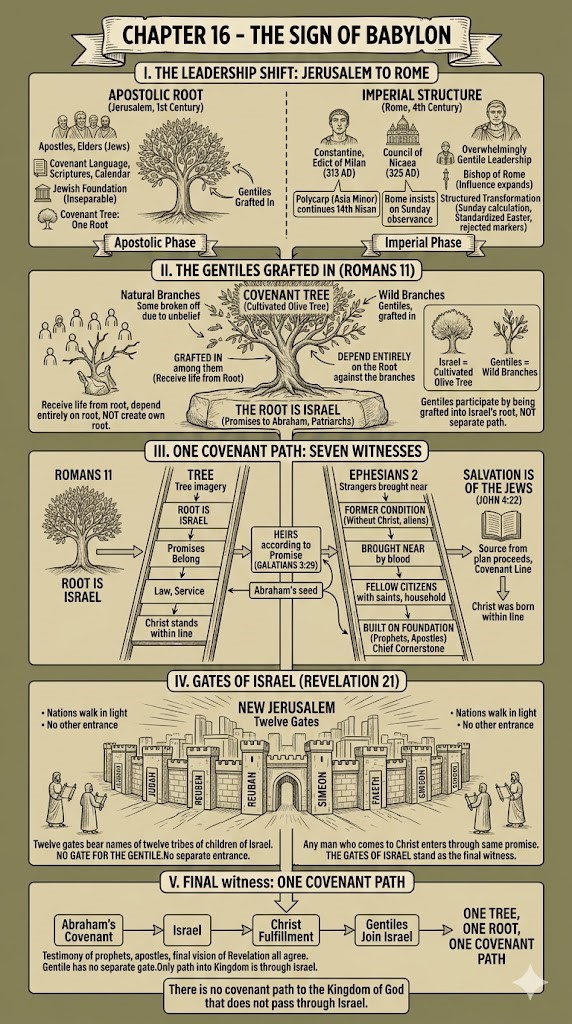
Chapter 16 The Sign of Babylon
Chapter — From Apostolic Root to Imperial Structure
By the time of Constantine, the visible structure of the church centered in Rome had changed dramatically from the congregations established in the apostolic age.
In the first century, the leadership of the church was inseparable from its Jewish foundation. The apostles were Jews. The earliest elders were Jews. The covenant language, the Scriptures, the calendar, and the theological framework were rooted in Israel.
Gentiles were grafted in.
They were not planted as a new root.
By the early second century, tensions between Jewish and Gentile believers had already surfaced. Paul warned Gentile believers in Rome not to boast against the root, reminding them that they did not support the root — the root supported them (Romans 11).
As time progressed, the Jewish presence in the Roman church diminished. The destruction of Jerusalem in 70 AD, followed by the Bar Kokhba revolt in 132–135 AD, further scattered Jewish communities and intensified Roman suspicion toward anything visibly Jewish.
In this climate, the church in Rome increasingly distanced itself from Jewish identity markers.
By the time we reach the late second and third centuries, the leadership structure in Rome is overwhelmingly Gentile.
The Quartodeciman controversy illustrates this shift clearly. Churches in Asia Minor, connected historically to leaders such as Polycarp and Polycrates, continued to observe Passover on the 14th of Nisan, as they stated they had received from earlier tradition. Rome, however, insisted on a Sunday observance tied to the resurrection.
This dispute did not arise because Scripture had newly changed. It arose because practice had diverged.
Polycarp is gone.
Polycrates speaks for Asia Minor.
After that, the historical record grows thinner.
We know less about the continuity of the Asia Minor congregations after the late second century. The Roman church, however, grows in prominence and influence.
Then comes Constantine.
With Constantine’s conversion and the Edict of Milan (313 AD), Christianity moves from persecuted minority to imperial favor. The Council of Nicaea (325 AD) formalizes Sunday resurrection celebration and distances the calculation of Easter from the Jewish calendar.
At this stage, the shift is no longer merely theological.
It becomes political and imperial.
The calendar is standardized.
The distinction from Judaism is reinforced.
The Roman bishop’s influence expands. The question is whether the structure visible in Rome by the time of Constantine reflects the same covenant framework established in the first century.
By the fourth century:
- The Sabbath is widely marginalized.
- Passover on the 14th is suppressed in favor of a Sunday calculation.
- Jewish identity markers are rejected explicitly in conciliar language.
This is no longer a minor divergence.
It is a structural transformation.
By Constantine’s era, the church centered in Rome no longer visibly resembles the Jewish-rooted assemblies of the apostolic age.
The root has faded from view.
And that raises the central question of this chapter:
When the visible root disappears, what sustains the branches?
The Root and the Gentiles Grafted In
The apostle Paul the Apostle explains the relationship between Israel and the Gentiles using the image of a tree. The passage appears in Epistle to the Romans, chapter 11.
Paul writes:
“If the root be holy, so are the branches.”
— Romans 11:16
He then explains that some of the natural branches were broken off and that Gentiles were grafted into the tree:
“And if some of the branches be broken off, and thou, being a wild olive tree, wert grafted in among them….”
— Romans 11:17
The structure Paul presents is clear:
- There is one root.
- The Gentiles do not create a new tree.
- They are grafted into the existing root.
The Root Is Israel
Paul’s entire argument assumes the covenant structure already established in the Old Testament.
God’s covenant promises were given to Israel through the line of the patriarchs, beginning with Abraham and continuing through the people of Israel.
Paul states earlier in Romans:
“Who are Israelites; to whom pertaineth the adoption, and the glory, and the covenants….”
— Romans 9:4
This establishes the root of the tree:
- the covenants
- the promises
- the patriarchal line
All of these belong to Israel.
The Gentiles Are Added to the Tree
Paul does not describe the Gentiles replacing Israel.
He describes them being grafted into the existing structure.
The imagery of grafting is important.
In agriculture, a grafted branch:
- receives life from the root
- depends entirely on the root
- does not create its own root
So Paul warns the Gentiles:
“Boast not against the branches… thou bearest not the root, but the root thee.”
— Romans 11:18
This statement establishes a key principle.
The Gentiles do not support the root.
The root supports them.
There Is One Covenant Tree
Paul’s argument eliminates the idea that the Gentiles form a separate covenant structure.
Instead:
- Israel is the cultivated olive tree.
- Gentiles are wild branches grafted into that tree.
The life of the tree comes from the covenant root established through the patriarchs.
The Gentiles therefore participate in the covenant by being grafted into Israel’s root, not by creating an independent path.
The Root Ultimately Leads to Christ
The covenant promises given to Israel lead to the Messiah.
Christ Himself identifies this connection when He says:
“Salvation is of the Jews.”
— John 4:22
And in Revelation He declares:
“I am the root and the offspring of David.”
Here the covenant line and the Messiah meet.
The root that nourishes the tree ultimately points to Christ, who stands within that covenant line.
Conclusion
Paul’s teaching establishes a single covenant structure.
- The root comes through Israel.
- The promises belong to Israel.
- Gentiles are grafted into that root.
The Gentiles therefore do not approach God through a separate path but are brought into the covenant structure already established through Israel and fulfilled in Christ.
The Root Is Israel
Paul’s argument assumes the covenant structure that had already been established in the Scriptures.
Earlier in Romans he identifies the people to whom the covenants belong:
“Who are Israelites; to whom pertaineth the adoption, and the glory, and the covenants, and the giving of the law, and the service of God, and the promises.”
— Romans 9:4
The root of the olive tree therefore rests in the covenant promises given through the patriarchs, beginning with Abraham and continuing through the people of Israel.
From that root came:
- the covenants
- the promises
- the law
- the service of God
All of these form the foundation of the tree Paul is describing.
Gentiles Do Not Create a New Root
Paul warns the Gentiles not to misunderstand their place in the tree.
“Boast not against the branches. But if thou boast, thou bearest not the root, but the root thee.”
— Romans 11:18
This statement establishes a clear principle.
The Gentiles do not support the root.
The root supports them.
The life of the tree does not originate with the grafted branch. The branch lives only because it is connected to the root.
Paul therefore warns:
“Be not highminded, but fear.”
— Romans 11:20
The Gentiles stand by faith, but their place in the covenant structure remains dependent on the root into which they were grafted.
One Covenant Tree
Paul’s teaching leaves no room for two separate covenant structures.
There is not one tree for Israel and another tree for the Gentiles.
There is one olive tree.
Some natural branches were broken off.
Wild branches were grafted in.
But the root remains the same.
The Gentiles therefore participate in the covenant promises by being grafted into the tree that already existed.
The Root Leads to the Messiah
The covenant promises given to Israel ultimately lead to the Messiah.
Christ Himself acknowledges this covenant structure when He tells the Samaritan woman:
“Salvation is of the Jews.”
— John 4:22
And in the book of Book of Revelation, Christ declares:
“I am the root and the offspring of David.”
Here the covenant line and the Messiah meet.
The root that nourishes the tree ultimately leads to Christ, who stands within that covenant line.
The Warning to the Gentiles
Paul closes this section with a warning.
If God did not spare the natural branches when they fell into unbelief, neither will He spare the grafted branches if they abandon the faith.
“For if God spared not the natural branches, take heed lest he also spare not thee.”
— Romans 11:21
This warning reinforces the structure Paul has described.
The Gentiles do not stand above the root.
They stand only because they have been grafted into it.
Conclusion
Paul’s teaching establishes a single covenant structure.
- The root is the covenant given to Israel.
- The tree grows from that root.
- The Gentiles are grafted into that tree.
The Gentiles therefore do not approach God through a separate path. They enter the covenant by being grafted into the root that God established through Israel and fulfilled in Christ.
“And So All Israel Shall Be Saved”
After explaining the olive tree and the grafting of the Gentiles, the apostle Paul the Apostle brings his argument to its conclusion in the Epistle to the Romans, chapter 11.
Paul writes:
“Blindness in part is happened to Israel, until the fulness of the Gentiles be come in.
And so all Israel shall be saved.”
— Romans 11:25–26
This statement completes the structure he began earlier in the chapter.
Paul has already shown:
- some branches of Israel were broken off
- Gentiles were grafted into the tree
- the root of the tree remains the covenant given to Israel
Now he explains that the blindness affecting part of Israel is not permanent.
The Blindness Is Partial
Paul does not say Israel was completely rejected.
Instead he says:
“Blindness in part is happened to Israel.”
This means the breaking off of branches was partial, not total.
The tree itself was never destroyed.
The root remained alive.
The covenant structure still stands.
The Fullness of the Gentiles
Paul then introduces another part of the process.
“Until the fulness of the Gentiles be come in.”
The Gentiles are being grafted into the olive tree during this period.
Their inclusion does not replace Israel.
Instead it takes place within the same covenant structure.
The Gentiles enter the promises by being grafted into the tree whose root already existed.
The Restoration of Israel
Paul then states the conclusion:
“And so all Israel shall be saved.”
This statement refers to the restoration of the branches that were broken off.
Earlier Paul had already explained this possibility.
“God is able to graft them in again.”
— Romans 11:23
The natural branches can return to the tree if they do not continue in unbelief.
This shows that the breaking off was never intended to destroy Israel but to open the door for both Jew and Gentile to share in the same covenant promises.
The Covenant Promise
Paul then connects this restoration directly to the covenant promises given long before.
“For this is my covenant unto them, when I shall take away their sins.”
— Romans 11:27
The covenant remains the foundation of the entire structure.
It is the same covenant root from which the olive tree grows.
The Gentiles do not replace Israel, and Israel is not permanently rejected. Both are brought into the same covenant through the work of the Messiah.
Conclusion
Paul’s argument throughout Romans 11 establishes a single covenant tree.
- The root comes through the covenant given to Israel.
- Some natural branches were broken off because of unbelief.
- Gentiles were grafted into the tree.
- The natural branches can be grafted in again.
The structure remains one tree, nourished by one root.
Both Jew and Gentile receive life from that root, which ultimately leads to the Messiah.
Strangers From the Covenants of Promise
The apostle Paul the Apostle explains the former condition of the Gentiles in the Epistle to the Ephesians.
He writes:
“Wherefore remember, that ye being in time past Gentiles in the flesh…
That at that time ye were without Christ, being aliens from the commonwealth of Israel, and strangers from the covenants of promise, having no hope, and without God in the world.”
— Ephesians 2:11–12
Paul describes the Gentiles before they were brought into the covenant structure.
They were:
- without Christ
- aliens from the commonwealth of Israel
- strangers from the covenants of promise
- without hope
- without God in the world
This statement establishes the condition of the Gentiles before their inclusion.
They were outside the covenant promises that had been given to Israel.
Brought Near Through Christ
Paul then explains what changed.
“But now in Christ Jesus ye who sometimes were far off are made nigh by the blood of Christ.”
— Ephesians 2:13
The Gentiles who were once far off were brought near.
The phrase “made nigh” does not describe the creation of a new covenant separate from Israel. Instead it describes the Gentiles being brought near to the covenant promises that already existed.
This language matches the image Paul used in Romans.
The Gentiles are brought near to the same root from which the olive tree grows.
Fellow Citizens With the Saints
Paul continues:
“Now therefore ye are no more strangers and foreigners, but fellow citizens with the saints, and of the household of God.”
— Ephesians 2:19
The Gentiles are no longer strangers to the covenants.
They have become:
- fellow citizens
- members of the household of God
This language shows inclusion rather than replacement.
The Gentiles do not establish a separate covenant structure. They are brought into the existing household of God.
Built Upon the Same Foundation
Paul completes the explanation by describing the foundation of this household.
“And are built upon the foundation of the apostles and prophets, Jesus Christ himself being the chief corner stone.”
— Ephesians 2:20
The prophets represent the covenant promises given to Israel.
The apostles testify to their fulfillment in Christ.
Both rest upon the same foundation.
The Gentiles therefore share in the promises not by forming a separate path, but by being brought into the covenant structure that God established from the beginning.
Conclusion
Paul’s teaching in Ephesians confirms the structure described in Romans.
The Gentiles were once strangers to the covenants of promise.
Through Christ they are brought near and become fellow citizens with the saints.
They are grafted into the same covenant root and become part of the same household of God.
There is therefore one covenant structure through which both Jew and Gentile receive the promises of God.
Heirs According to the Promise
The apostle Paul the Apostle connects the Gentiles directly to the covenant promises given to Abraham in the Epistle to the Galatians.
Paul writes:
“And if ye be Christ’s, then are ye Abraham’s seed, and heirs according to the promise.”
— Galatians 3:29
This statement completes the structure already described in Romans and Ephesians.
Paul shows that those who belong to Christ become heirs of the same promise given to Abraham.
The Promise Was Given to Abraham
The covenant promise did not begin with the Gentiles.
It was given to Abraham long before the nations were brought into the covenant.
Earlier in Galatians Paul explains:
“Now to Abraham and his seed were the promises made.”
— Galatians 3:16
The covenant therefore originates with Abraham and continues through the people of Israel who descended from him.
This is the root of the covenant tree.
The Promise Leads to Christ
Paul then explains that the promise given to Abraham ultimately points to Christ.
The seed through whom the promise is fulfilled is the Messiah.
Through Christ the covenant promise becomes available to those who believe.
Gentiles Become Heirs Through Christ
Paul’s conclusion is direct.
Those who belong to Christ become Abraham’s seed and heirs of the promise.
This does not establish a separate covenant for the Gentiles.
Instead it brings the Gentiles into the same promise that was given to Abraham.
Through Christ they share in the inheritance of that covenant.
The Covenant Structure
Taken together, Paul’s writings form a consistent structure.
- The covenant promises originate with Abraham.
- Those promises continue through Israel.
- Christ stands within that covenant line.
- Gentiles who belong to Christ become heirs of the same promise.
There is therefore one covenant root from which the promises of God flow.
Conclusion
Paul’s teaching across Romans, Ephesians, and Galatians establishes a single covenant structure.
The promise begins with Abraham, continues through Israel, and is fulfilled in Christ.
Those who belong to Christ become heirs of that promise and share in the covenant blessings given from the beginning.
“Salvation Is of the Jews”
The words of Jesus Christ confirm the covenant structure already explained by Paul the Apostle. In the Gospel of John, Christ speaks to the Samaritan woman and makes a direct statement about the origin of salvation.
“Ye worship ye know not what: we know what we worship: for salvation is of the Jews.”
— John 4:22
This statement identifies the source from which the plan of salvation proceeds.
Christ does not say salvation originates from many nations.
He states that salvation is of the Jews.
The Covenant Line
The reason for this statement lies in the covenant structure established in the Scriptures.
God’s covenant promises were given through:
- Abraham
- the people of Israel
- the line of King David
From this covenant line came the Messiah.
Christ Himself was born within that covenant line, fulfilling the promises given through the patriarchs.
The Root of Salvation
When Christ says salvation is of the Jews, He is identifying the root from which salvation flows.
The promises, the covenants, and the Messiah all come through that covenant line.
This agrees with what Paul later explains:
- the covenants belong to Israel
- the root supports the branches
- Gentiles are grafted into the covenant tree
The Gentiles Brought Near
The statement does not exclude the Gentiles from salvation.
Instead it shows the path through which salvation comes.
Gentiles are brought near to the covenant promises through Christ and are grafted into the same covenant root.
They share in the promise given to Abraham and fulfilled in the Messiah.
Conclusion
Christ’s words confirm the covenant structure revealed throughout the Scriptures.
Salvation originates from the covenant promises given through Israel.
Through Christ the Gentiles are brought near and become heirs of the same promise.
There remains one root, one covenant structure, and one path through which the promises of God are fulfilled.
The Covenants Belong to Israel
The apostle Paul the Apostle makes a direct statement about Israel in the Epistle to the Romans, chapter 9.
Paul writes:
“Who are Israelites; to whom pertaineth the adoption, and the glory, and the covenants, and the giving of the law, and the service of God, and the promises.”
— Romans 9:4
This passage lists the things that God entrusted to Israel.
According to Paul, the Israelites were given:
- the adoption
- the glory
- the covenants
- the giving of the law
- the service of God
- the promises
These elements form the foundation of the covenant structure described throughout Scripture.
The Covenant Foundation
Paul’s statement shows that the covenant promises did not originate with the Gentiles.
They were given to Israel.
The law, the promises, and the service of God were all established within the covenant relationship between God and Israel.
From this covenant foundation came the structure through which the Messiah would appear.
The Messiah Comes Through Israel
Paul continues in the next verse:
“Of whom as concerning the flesh Christ came, who is over all, God blessed for ever. Amen.”
— Romans 9:5
The Messiah came through Israel.
This confirms what Christ Himself said:
“Salvation is of the Jews.” — John 4:22
The covenant promises, the law, and the Messiah all emerge from the same covenant line.
The Gentiles Share in the Promise
Paul’s earlier explanation in Romans 11 shows how the Gentiles are brought into this structure.
They are grafted into the olive tree whose root lies in the covenant promises given to Israel.
Through Christ they share in the inheritance of those promises.
Conclusion
Romans 9 establishes the origin of the covenant promises.
The adoption, the covenants, the law, and the promises were given to Israel.
From that covenant line came the Messiah.
Through Christ the Gentiles are brought near and become heirs of the same promise.
There remains one covenant root from which the promises of God flow.
Act 3 — The Gates of Israel
Paul’s conclusion is unavoidable.
If the Gentiles are grafted into the root, then the root itself cannot be replaced.
The root remains Israel.
The covenants were given to Israel.
The promises were given to Israel.
The law was given to Israel.
The Gentile does not receive a separate path.
He is brought near and placed into the same covenant structure.
Paul states this plainly:
“If ye be Christ’s, then are ye Abraham’s seed, and heirs according to the promise.”
— Galatians 3:29
The Gentile who comes to Christ does not become part of a new nation.
He becomes part of the same promise given to Abraham.
The New Testament confirms this structure again in the final vision of the Kingdom.
When John describes the New Jerusalem, he does not describe gates for the nations of the world.
He describes twelve gates.
And each gate bears a name.
“And had a wall great and high, and had twelve gates, and at the gates twelve angels, and names written thereon, which are the names of the twelve tribes of the children of Israel.”
— Revelation 21:12
There is no gate for the Gentile.
There is no thirteenth gate.
There is no separate entrance.
The only path into the Kingdom is through the gates of Israel.
This is the same structure Paul described.
Gentiles are not given a separate covenant.
They are grafted into the existing one.
They become part of Abraham’s seed.
They become citizens within the commonwealth of Israel.
This was never a racial system.
It was always a covenant system.
Any man who comes to Christ enters through the same promise.
The gates of Israel stand as the final witness to that truth.
There is only one covenant path.
And that path runs through Israel.
Final Witness — One Covenant Path
The testimony of Scripture is complete.
From the covenant given to Abraham, through the prophets, through the teaching of Christ, and through the writings of Paul, the structure never changes.
God established one covenant nation.
Israel received the covenants.
Israel received the law.
Israel received the promises.
When the Gentiles were called, God did not create a second covenant or a second people.
He grafted them into the same root.
The Gentile does not replace Israel.
The Gentile joins Israel.
This truth stands at the very end of the Bible as the final witness.
When the Kingdom of God is revealed, the city of God has twelve gates.
Not gates of the nations.
Not gates of the Gentiles.
The gates bear the names of the twelve tribes of Israel.
There is no other entrance.
There is no other covenant.
There is no other path.
Every man who enters the Kingdom of God will enter through the promises first given to Abraham and carried through the tribes of Israel.
The testimony of the prophets, the apostles, and the final vision of Revelation all agree.
The Gentile has no separate gate.
The only path into the Kingdom is through Israel.
Final Line
The Scripture leaves no other conclusion:
There is no covenant path to the Kingdom of God that does not pass through Israel.
Chapter 17- Babylon The Final Deception
“The covenant path runs through Israel, the next question must be asked: who has authority to define the covenant itself?”
The Renaming of the Days
The Bible does not name the days of the week.
In Scripture the days are numbered: the first day, the second day, the third day, and so forth. Only the seventh day is given a title—the Sabbath.
The names used today do not come from the Bible. They come from the pagan world, where the days were dedicated to heavenly bodies and pagan gods. Sunday was known as the day of the sun, Monday the day of the moon, and the remaining days were tied to the gods of Rome and the Germanic tribes.
When Constantine issued his decree in AD 321 establishing the empire’s day of rest, he did not refer to the Sabbath of Scripture, nor did he use the Christian phrase “the Lord’s Day.” Instead, he used the pagan title already common in the Roman world: “the venerable day of the Sun.”
This decision reveals the nature of the change. The day being elevated was not named after Christ but after the pagan sun god honored throughout the Roman Empire.
The Day of the Sun
When Constantine established the empire’s weekly day of rest in AD 321, he did not appeal to the Sabbath of Scripture, nor did he refer to the Christian expression “the Lord’s Day.” Instead, his decree used the title already honored throughout the Roman Empire: “the venerable day of the Sun.”
This phrase was not a Christian title but a reference to the imperial cult of Sol Invictus, the Unconquered Sun, which had become one of Rome’s dominant religious symbols. Coins from Constantine’s own reign still carried the image of the sun god and the inscription honoring Sol Invictus as the emperor’s companion.
The name itself therefore reveals the source of the change. The day elevated by imperial law was not named after Christ, but after the pagan sun deity revered throughout the Roman world.
Why the Day of the Sun Was Chosen
By the time of Constantine the Roman world already recognized the planetary week, in which the first day was known as dies solis, the day of the sun. Solar symbolism had become deeply embedded in imperial religion through the cult of Sol Invictus, and other movements such as Mithraism also used strong solar imagery.
When Constantine established the empire’s weekly day of rest in AD 321, he did not appeal to the Sabbath of Scripture or use the Christian phrase “the Lord’s Day.” Instead he adopted the familiar Roman title “the venerable day of the Sun.” The language reflected the religious environment of the empire and reveals that the day being elevated carried a name rooted in the solar traditions of Rome.
Justin Martyr wrote in the mid-2nd century (around AD 150).
He describes Christians gathering on the “day called Sunday.”
His explanation is important because he connects the day with the sun, using the common Roman term.
A well-known passage states:
“On the day called Sunday, all who live in cities or in the country gather together… because it is the first day on which God made the world and Jesus Christ our Savior rose from the dead.”
Two important things appear in this statement:
- The day is called Sunday (the Roman name).
- The explanation still ties it to creation and resurrection, not a biblical command.
This shows the Roman naming system was already in use.
Tertullian (around AD 200) actually acknowledges the connection outsiders made between Christians and the sun.
He wrote that pagans sometimes accused Christians of being sun-worshipers.
He says:
“Others suppose that the sun is our god… because it is a well-known fact that we pray toward the east or make Sunday a day of festivity.”
This statement is revealing because:
- Pagans noticed the Sunday observance
- They associated it with solar worship
Tertullian was defending Christianity, but his comment shows the perception that existed in the Roman world.
The final witness comes from the emperor himself.
In AD 321, Constantine issued the famous decree establishing Sunday as the imperial rest day.
The wording reads:
“On the venerable day of the Sun let the magistrates and people residing in cities rest.”
This is historically significant because:
- The decree uses the Roman name day of the Sun
- It does not say Sabbath
- It does not say Lord’s Day
It uses the solar title already common in Roman culture.
What These Three Witnesses Show
When placed together, they reveal a clear historical pattern.
- The Roman world already called the first day “the day of the Sun.”
- Early Christian writers acknowledged the name Sunday.
- Constantine later made that same day the legal day of rest for the empire.
So the terminology being used in the empire was not derived from Scripture.
It came from the Roman planetary week and its solar terminology.
The historical record shows that the first day of the week carried the Roman name “the day of the Sun” long before it became the empire’s official day of rest. Early Christian writers acknowledged the term already in use, and pagans even associated the day with solar symbolism. When Constantine established the empire’s weekly rest day in AD 321, he used the same Roman title: “the venerable day of the Sun.” The name itself reveals the cultural framework of the change. The day elevated by imperial law carried a title rooted in the solar traditions of Rome, not in the numbering of days found in Scripture.
Long before the Roman Empire, ancient Mesopotamian cultures honored solar deities.
In Babylon the sun god was Shamash, a deity associated with light, justice, and authority. Many ancient cultures viewed the sun as a symbol of divine power because it governed the cycle of day and night.
Solar symbolism appears across many ancient civilizations:
- Mesopotamia (Shamash)
- Egypt (Ra)
- Persia (Mithra)
- Greece and Rome (Helios / Sol)
These traditions were not identical religions, but they shared a common idea: the sun represented divine authority and cosmic order.
The Roman Planetary Week
By the time of the Roman Empire a seven-day cycle tied to celestial bodies had become widely used.
Each day corresponded to a heavenly body:
| Roman Name | Meaning |
| Dies Solis | Day of the Sun |
| Dies Lunae | Day of the Moon |
| Dies Martis | Day of Mars |
| Dies Mercurii | Day of Mercury |
| Dies Jovis | Day of Jupiter |
| Dies Veneris | Day of Venus |
| Dies Saturni | Day of Saturn |
This planetary week became the foundation of the modern naming system used throughout Europe.
From Roman Names to Modern English
When Germanic languages adopted the Roman week, they translated many of the gods into their own mythological figures.
That is why English uses names such as:
| English | Origin |
| Sunday | Sun day |
| Monday | Moon day |
| Tuesday | Tiw (Tyr) |
| Wednesday | Woden (Odin) |
| Thursday | Thor |
| Friday | Freya |
| Saturday | Saturn |
This naming system developed through cultural transmission, not through biblical instruction.
How This Connects to Constantine
When Constantine issued his decree in AD 321 establishing a weekly rest day, he used the already familiar Roman name:
“the venerable day of the Sun.”
The phrase reflected the existing Roman planetary week and the strong solar symbolism present in imperial culture.
It did not originate from the biblical way of numbering days.
The Cultural Naming of the Days
The Bible numbers the days of the week rather than naming them. In Scripture the days are simply described as the first day, the second day, and so forth, while the seventh day alone receives a title—the Sabbath.
The naming system used today developed through ancient cultures that associated the days with celestial bodies and divine figures. In the Roman world the first day of the week was called dies solis, the day of the sun, followed by the day of the moon, Mars, Mercury, Jupiter, Venus, and Saturn.
When Constantine established the empire’s weekly rest day in AD 321, he used the familiar Roman expression “the venerable day of the Sun.” The wording reflected the cultural naming system of the empire rather than the biblical method of numbering days found in Scripture.
Final Summary
The evidence follows a clear line.
First, the Bible does not name the days of the week. Scripture numbers the days, and only the seventh day is given a title—the Sabbath.
Second, the names used today come from the cultural systems of the ancient world. The Roman week assigned each day to a celestial body, calling the first day dies solis, the day of the sun.
Third, when Constantine established the empire’s weekly day of rest in AD 321, he did not appeal to the biblical Sabbath or use the Christian phrase “the Lord’s Day.” Instead, his decree used the familiar Roman title: the venerable day of the Sun.
The historical record therefore shows that the modern name Sunday did not arise from the numbering of days in Scripture. It reflects the naming system of the Roman world that Constantine later elevated into imperial law.
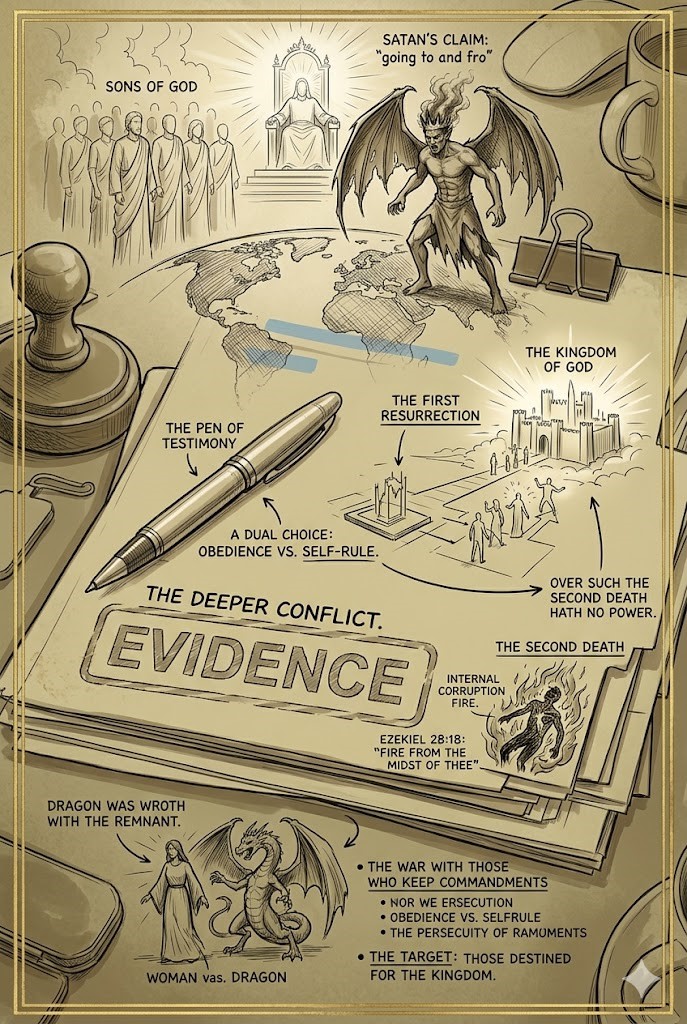
Chapter 18- The Conflict Over the First Resurrection
The Pattern That Emerges
At this stage the question of motive no longer determines the outcome.
History rarely allows certainty about the intentions of those who acted centuries ago. What can be examined, however, is the pattern created by the decisions themselves.
Throughout this book a structure has been followed step by step: the numbering of days in Scripture, the cultural naming of days in the Roman world, and the imperial decree that elevated the “day of the Sun” into law.
Whatever the intentions behind these actions may have been, the result forms a recognizable pattern.
The language, the symbols, and the structure align not with the biblical pattern but with the religious framework of the ancient world.
In Scripture the days are numbered.
In the Roman system they are named after celestial powers.
When imperial authority intervened, the name chosen was the one already tied to the solar traditions of the empire.
At that point the motive becomes secondary.
The pattern itself becomes the witness.
And that pattern mirrors the same religious structure that earlier civilizations had built around celestial symbolism and sacred days.
Satan’s Claim Over the Earth
The book of Book of Job provides one of the clearest glimpses in Scripture into the interaction between God and Satan.
Job 1:6
“Now there was a day when the sons of God came to present themselves before the LORD, and Satan came also among them.”
Job 1:7
“And the LORD said unto Satan, Whence comest thou? Then Satan answered the LORD, and said, From going to and fro in the earth, and from walking up and down in it.”
This moment reveals an important reality about the spiritual order. The sons of God present themselves before the Lord, and Satan appears among them.
The text does not say he was invited. It simply records that he came among them and stood before God.
When God asks where he has come from, Satan answers:
“From going to and fro in the earth, and from walking up and down in it.”
The phrase is more than a description of movement. In the language of the ancient world, walking through a land could signify authority or control over that territory.
Satan’s response therefore carries an implication: he presents himself as one who moves freely through the earth as its ruler.
This idea appears in other passages of Scripture. The New Testament later refers to Satan as:
“the prince of this world” (John 12:31)
and
“the god of this world” (2 Corinthians 4:4).
Taken together, these passages show a consistent picture. Satan presents himself before God as one who exercises influence over the earth.
The book of Job records this exchange at the beginning of the narrative, setting the stage for the conflict that follows.
The Mindset Revealed
The exchange in the Book of Job reveals more than a simple report about Satan’s movements. It exposes the attitude with which he presents himself before God.
Job 1:7
“From going to and fro in the earth, and from walking up and down in it.”
In the language of Scripture, walking through a land often signifies authority over it. Satan therefore answers as one who claims freedom of movement and influence throughout the earth.
Other passages confirm this same picture.
Christ later refers to Satan as:
“the prince of this world.” — John 12:31
And the apostle Paul writes that he is:
“the god of this world.” — 2 Corinthians 4:4
These statements reveal the position Satan claims within the present world system.
The attitude behind that claim is described even more clearly elsewhere in Scripture.
Through the prophet Isaiah, the pride of Satan is described in these words:
“I will ascend into heaven, I will exalt my throne above the stars of God…
I will be like the most High.” — Isaiah 14:13–14
The pattern is consistent. Satan does not merely operate within the world; he seeks to elevate his authority and influence.
The book of Job therefore opens with a striking scene. In the presence of God and the heavenly host, Satan presents himself as one who moves through the earth as its ruler.
This moment reveals the deeper conflict that runs throughout Scripture—the struggle over authority and dominion.
A Competing Authority
Many readers picture Satan’s rebellion as a simple attempt to overthrow God by force. Scripture presents something more revealing.
The Bible shows that Satan first influenced other angels, drawing them away from their original loyalty.
The book of Revelation describes this moment symbolically:
Revelation 12:4
“And his tail drew the third part of the stars of heaven, and did cast them to the earth.”
In biblical language, the “stars” in this passage represent angels. The image describes a large number of angels being drawn into Satan’s rebellion.
Other passages confirm that angels joined this rebellion:
2 Peter 2:4
“God spared not the angels that sinned…”
This indicates that Satan did not stand alone. A group of angels followed him.
When we return to the scene recorded in the Book of Job, Satan appears among the sons of God in the heavenly assembly.
Job 1:6
“The sons of God came to present themselves before the LORD, and Satan came also among them.”
His presence in that assembly reveals that the conflict had already begun. Satan comes before God while presenting himself as one who moves freely through the earth.
Job 1:7
“From going to and fro in the earth, and from walking up and down in it.”
The statement reflects the position Satan claims within the present world system.
Scripture consistently describes this position:
- “the prince of this world” (John 12:31)
- “the god of this world” (2 Corinthians 4:4)
The picture that emerges is not merely one of open rebellion but of a rival authority seeking influence over creation.
From the beginning of the biblical narrative, two paths appear before mankind: the authority of God and the influence of another system operating within the world.
The Judgment of Satan
Before examining the later myths surrounding heaven and hell, Scripture itself describes the fate of Satan.
Through the prophet Ezekiel, God speaks of the fall of the covering cherub:
Ezekiel 28:16
“By the multitude of thy merchandise they have filled the midst of thee with violence, and thou hast sinned: therefore I will cast thee as profane out of the mountain of God: and I will destroy thee, O covering cherub, from the midst of the stones of fire.”
Ezekiel 28:17
“Thine heart was lifted up because of thy beauty, thou hast corrupted thy wisdom by reason of thy brightness: I will cast thee to the ground…”
Ezekiel 28:18
“Thou hast defiled thy sanctuaries by the multitude of thine iniquities, by the iniquity of thy traffick; therefore will I bring forth a fire from the midst of thee, it shall devour thee…”
These passages describe the corruption of Satan’s position and the judgment that follows.
One phrase appears repeatedly: “from the midst of thee.”
The fire of judgment is described as coming from within Satan himself.
The imagery does not describe an external realm where Satan rules and torments others. Instead, it portrays a being whose own corruption brings about his destruction.
The passage therefore presents a different picture from the later pagan image of hell in which Satan rules over a realm of eternal torment.
In the biblical description, Satan does not preside over punishment. The judgment proceeds from the corruption within him.
God declares that the fire will come from the midst of thee, consuming the one who allowed pride and iniquity to grow within.
The emphasis of the text is not on endless torment administered by Satan, but on the destruction that results from the corruption he embraced.
A Short Version
Long before the rise of Christianity, the Greek and Roman world already held beliefs about an afterlife. Their traditions described an underworld where souls continued after death. Some were said to dwell in peaceful regions such as the Elysian fields, while others were punished in places like Tartarus. These ideas assumed that the soul was naturally immortal and continued living after the body died.
The biblical teaching follows a different framework. Instead of an immortal soul continuing immediately after death, the Scriptures repeatedly speak of a future resurrection in which God restores life.
Belief in heaven and hell existed in early Christian theology, but the detailed medieval system describing the afterlife developed gradually over many centuries. By the time of the Council of Florence in 1439, the Catholic Church formally defined a structured doctrine describing heaven, hell, and purgatory and the fate of souls after death.
Tartarus and the Judgment of the Angels
Many later traditions describe a place where human souls are eternally tormented in fire. When the Scriptures themselves are examined carefully, that picture becomes difficult to establish directly from the biblical text.
One of the few passages that describes a specific place of confinement connected with Satan and rebellious angels appears in the writings of the apostle Peter.
2 Peter 2:4
“For if God spared not the angels that sinned, but cast them down to Tartarus, and delivered them into chains of darkness, to be reserved unto judgment.”
The Greek word used here is Tartarus, a term that referred in the ancient world to a deep place of confinement.
In this passage the location is not connected with the punishment of mankind. Instead it is associated with the angels that sinned. The text states that these angels were delivered into chains of darkness and are reserved unto judgment. This indicates that their final judgment lies in the future rather than being carried out immediately. The passage therefore presents Tartarus not as a kingdom ruled by Satan, but as a place of restraint prepared for rebellious angels. This description differs significantly from the later imagery in which Satan rules a realm of eternal torment. In the biblical picture, Satan does not preside over punishment. Instead he and the angels who followed him are themselves awaiting judgment.
A Mystery That Remains
One of the striking features of the biblical record is that it sometimes reveals events without explaining every detail.
The passage describing Tartarus presents such a case.
2 Peter 2:4
“For if God spared not the angels that sinned, but cast them down to Tartarus, and delivered them into chains of darkness, to be reserved unto judgment.”
The text describes a place of confinement for the angels that followed Satan in rebellion.
However, it also makes something else clear: this is not their final judgment.
They are said to be “reserved unto judgment.”
This means the confinement described here is temporary, awaiting a future judgment that Scripture does not fully describe.
The passage therefore raises an important question. If Tartarus is a place of restraint rather than final punishment, then what ultimately becomes of Satan and the angels that followed him?
On this point the Bible does not give a detailed explanation. It reveals the existence of a place of confinement and states that judgment is still to come, but the full outcome of that judgment is not described in detail.
This leaves a mystery within the text. The fate of Satan and the fallen angels is clearly under God’s authority, yet the precise form of their final judgment remains largely unexplained.
The Scriptures reveal enough to show that Satan does not rule a kingdom of punishment. Instead he and the angels who followed him stand under the authority of God, awaiting judgment yet to come.
The Temptation of Self-Rule
Having examined the rebellion of Satan and the conflict within the spiritual realm, the biblical narrative returns to mankind.
The first temptation recorded in Scripture reveals the same underlying principle.
In the account of Eve in Book of Genesis, the serpent does not invite Eve to worship him. Instead, the temptation centers on something else.
“Ye shall be as gods, knowing good and evil.” — Genesis 3:5
The appeal was not submission to Satan but the promise of self-rule—the idea that mankind could determine good and evil independently of God.
From the beginning, the conflict presented to mankind was therefore a choice between two authorities: the rule of God or the path of deciding for oneself.
This pattern continues throughout Scripture.
When the gospel later spread among the nations, the apostle Paul issued a warning to the Gentile believers. Writing to the church in Epistle to the Romans, he explained that they had been brought into an existing covenant structure.
Israel was the root.
The Gentiles were grafted into that root.
Paul therefore warned them not to separate themselves from the foundation that had been established.
“Boast not against the branches… thou bearest not the root, but the root thee.” — Romans 11:18
This warning carried great importance. The Gentile believers were not forming a new covenant apart from Israel. They had been brought into the promises already given through the root.
For this reason Paul devoted an entire section of his letter to explaining the relationship between the Gentiles and Israel.
The warning was simple but crucial: the Gentiles must not abandon the root from which they received life.
The First Resurrection and the Conflict That Precedes It
To understand why Satan directs his attacks the way he does, the reader must first understand the importance of the resurrection.
The Scriptures describe more than one resurrection, but one of them holds a special significance.
In the vision recorded in the Book of Revelation, John writes:
“Blessed and holy is he that hath part in the first resurrection: on such the second death hath no power.”
— Revelation 20:6
This statement reveals something extraordinary. Those who take part in the first resurrection enter a condition where the second death has no authority over them.
Once a person reaches this resurrection, the struggle is finished. They become part of the Kingdom of God, and the power that once opposed them can no longer destroy them.
Because of this, the conflict must occur before that resurrection takes place.
The Scriptures show that Satan understands this reality.
His effort is therefore directed toward preventing those called by God from reaching that point.
This pattern becomes visible in the vision recorded earlier in Revelation.
After being cast out of heaven, Satan turns his attention toward the woman.
“And when the dragon saw that he was cast unto the earth, he persecuted the woman…”
— Revelation 12:13
The narrative then continues:
“And the dragon was wroth with the woman, and went to make war with the remnant of her seed, which keep the commandments of God, and have the testimony of Jesus Christ.”
— Revelation 12:17
The target described here is not the world in general. The focus falls upon those who keep the commandments of God and hold the testimony of Jesus Christ.
These are the people who stand within the covenant.
The reason becomes clear when the promise of the first resurrection is understood.
Those who reach that resurrection enter the Kingdom of God in a way that places them beyond the reach of the second death.
For this reason, the conflict appears most intense against those who are called into that covenant.
The struggle recorded in Scripture is therefore not merely a general opposition to mankind. It is a focused conflict surrounding those who are destined for the Kingdom of God.
The Conflict Behind the Story
The conflict described throughout Scripture is often misunderstood. The central struggle in the biblical narrative is not primarily between Satan and mankind.
The conflict is between God and Satan.
Mankind stands within that conflict, but the roles are very different.
To God, mankind is the object of His purpose. The Scriptures repeatedly describe humanity as those whom God intends to bring into His family.
To Satan, mankind becomes a means through which that purpose can be opposed.
This conflict appears throughout the biblical record. From the temptation in Eden to the persecutions described in the New Testament, the struggle centers on those who belong to God.
After the victory of Christ, the position of Satan becomes increasingly limited.
Jesus Himself declared:
“Now shall the prince of this world be cast out.” — John 12:31
The book of Revelation later describes Satan as one who knows that his time is short.
“Woe to the inhabiters of the earth… for the devil is come down unto you, having great wrath, because he knoweth that he hath but a short time.” — Revelation 12:12
These passages show a being whose influence continues but whose ultimate defeat has already been determined.
This explains why the conflict intensifies against those who belong to God.
If those called by God reach the promise described in the Scriptures—the first resurrection—then the struggle is finished for them.
“Blessed and holy is he that hath part in the first resurrection: on such the second death hath no power.” — Revelation 20:6
For this reason the conflict recorded in Scripture often focuses on those within the covenant rather than the world in general.
The dragon is described as making war with those who keep the commandments of God and hold the testimony of Jesus Christ.
The struggle therefore centers on those whom God is preparing for His Kingdom in the first resurrection.
The conflict recorded throughout Scripture therefore centers on those whom God is preparing for His Kingdom. From the beginning Satan has opposed the purpose of God, and that purpose includes bringing mankind into His family. Those who reach the promise described in the first resurrection stand beyond the reach of the second death. For this reason the struggle described in the Bible often falls most heavily upon those who keep the commandments of God and hold the testimony of Jesus Christ. The conflict is not random, nor is it directed equally at all mankind. It is focused upon the covenant people whom God is preparing for His Kingdom.
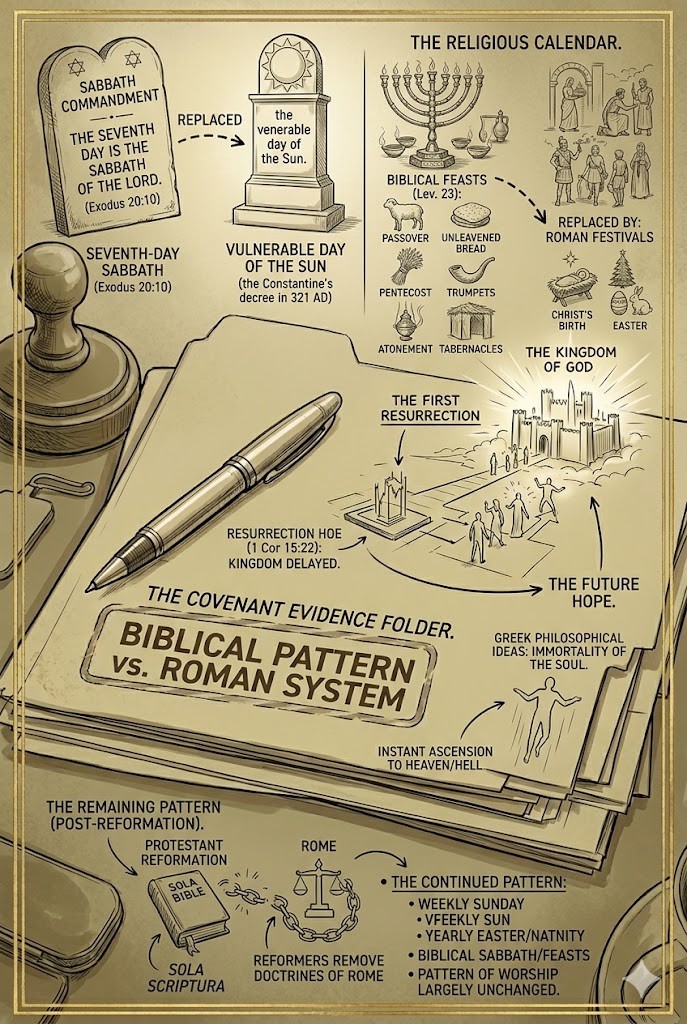
Chapter 19- The Pattern of the System
The Pattern of the System
When the Scriptures are examined from the beginning to the end, a pattern begins to emerge.
The conflict recorded in the Bible is not random. It follows a structure that appears repeatedly throughout history.
From the rebellion of Satan to the temptation of Eve, the same principle appears again and again: the desire to replace the rule of God with another system.
In Eden the temptation was not simply disobedience. The promise offered to mankind was the ability to determine good and evil for oneself.
“Ye shall be as gods.” — Genesis 3:5
This idea introduced the principle of self-rule.
From that moment forward the history of mankind shows the development of systems built upon that foundation.
The Scriptures show that Satan presents himself as the ruler of this world.
When he appeared before God in the book of Job, he described his movement “to and fro in the earth, and walking up and down in it.”
Christ later referred to him as the prince of this world.
Yet at the same time the Bible reveals another structure moving through history.
God established a covenant with mankind. Through Abraham that covenant passed into Israel, and through Israel the promises continued.
When the gospel reached the Gentiles, the apostle Paul warned them not to separate themselves from the root that supported them.
“Thou bearest not the root, but the root thee.” — Romans 11:18
This warning was not a small matter. It addressed the very pattern that had appeared since the beginning.
Whenever mankind attempts to establish its own authority apart from the structure God established, the same result follows.
A system forms that reflects the principles introduced in the beginning.
The Scriptures reveal that the conflict between God and Satan is ultimately reflected in the systems that govern human society.
One system proceeds from the authority of God.
The other grows from the desire of mankind to rule itself.
When these systems are examined through the record of Scripture and history, the pattern becomes clea
Rome and the Rise of a Different System
When the focus turns to Rome, the same pattern appears again.
The Roman world was deeply shaped by its religious traditions. Roman society had long honored celestial powers, including the worship of the sun.
Within that world the message of Christ spread rapidly across the empire. The name of Christ became known throughout the Roman world, and many people accepted the gospel.
At the same time, the cultural environment surrounding the church remained overwhelmingly pagan.
As the original apostolic generation passed from the scene, the influence of those early leaders diminished. Over time the church existed increasingly within the structures of the Roman world.
In that environment the pressure to conform to the surrounding culture became stronger.
One of the clearest examples appears in the change of the weekly day of worship.
The Scriptures consistently identify the seventh day as the Sabbath. The commandment itself states:
“The seventh day is the sabbath of the LORD thy God.” — Exodus 20:10
Yet within the Roman world the first day of the week was widely known as the day of the Sun.
When the Roman emperor Constantine the Great issued his decree in AD 321, he used the familiar Roman expression:
“the venerable day of the Sun.”
This language reflected the terminology already used in Roman culture.
The change therefore illustrates the larger pattern that appears throughout history: when the structures surrounding God’s covenant are reshaped by the systems of the world, the result often reflects the culture from which those systems arise.
The Meaning of the First Day in Scripture
Within the Bible itself, the first day carries a different meaning.
In the creation account recorded in Book of Genesis, the first day marks the appearance of light.
“And God said, Let there be light: and there was light.” — Genesis 1:3
Throughout Scripture light becomes a symbol of truth revealed by God.
In the Old Covenant the law brought that light to the world.
In the New Covenant Christ Himself is described as the light.
“I am the light of the world.” — John 8:12
The biblical meaning of the first day therefore centers on the revelation of light rather than the replacement of the Sabbath established in the commandments.
Attempts to Justify the Change
Deception often attempts to appear as truth. For this reason, changes in religious practice are frequently supported by appealing to Scripture.
Two passages are often cited as evidence for a change in the day of worship.
The first appears in Acts of the Apostles:
“And upon the first day of the week, when the disciples came together to break bread, Paul preached unto them…” — Acts 20:7
This passage describes a gathering of believers during Paul’s travels. The text records a meeting but does not state that the apostle changed the Sabbath or established a new weekly day of worship.
For this reason many scholars understand the passage simply as a record of a particular meeting rather than a command establishing a new observance.
Another passage often mentioned appears in First Epistle to the Corinthians:
“Upon the first day of the week let every one of you lay by him in store…” — 1 Corinthians 16:2
In this instruction Paul is organizing a collection to assist believers in need. The passage speaks about setting aside resources for a contribution rather than describing a formal day of worship.
Neither passage records a command from Christ or the apostles changing the Sabbath established in the commandments.
The change that later appeared in the Roman world therefore did not arise from a clear directive in the biblical text. Instead it developed within a different cultural environment where the first day of the week was already associated with the day of the Sun.
This illustrates the larger pattern that has appeared throughout the book: when human systems reshape religious practice apart from the structure established in Scripture, the result often reflects the surrounding culture rather than the original command.
Constantine and the Imperial System
The change that took place in the Roman world did not originate with Christ or the apostles.
The historical record shows that the Roman emperor Constantine the Great played a central role in shaping the religious structure of the empire.
Constantine was not a theologian. He was a military and political leader responsible for governing a vast empire made up of many nations and cultures.
Like all empires before it, Rome faced the challenge of holding together diverse peoples who spoke different languages and followed different traditions.
Throughout the Roman world many religious systems already existed. Different regions honored different gods, yet many of these traditions shared similar ideas that had spread through the ancient world.
When Christianity spread throughout the empire, the name of Christ became widely known and carried influence among large numbers of people.
During Constantine’s reign Christianity moved from being a persecuted faith to becoming closely connected with the authority of the Roman state.
Constantine issued laws that affected the religious life of the empire. One of the most well-known decrees established a weekly day of rest on what the Roman world already called the day of the Sun.
At the same time the emperor supported councils and institutions that helped organize the Christian church within the structure of the empire.
Through these developments the Roman state and the church became closely linked. Political authority governed the empire, while religious institutions played an increasing role in shaping the beliefs and practices of the population.
This arrangement helped create a system in which religious authority and imperial power operated alongside one another within the Roman world.
From Passover to the Sun
The change within the Roman system did not stop with the Sabbath. It also affected the meaning of the Passover and the remembrance of Christ’s death.
The Scriptures place the focus of the covenant on the death of Christ, the true Passover sacrifice.
Yet within the later system the emphasis gradually shifted toward the resurrection day, which came to be associated with the first day of the week.
Passages such as those found in Acts of the Apostles and First Epistle to the Corinthians were sometimes used in attempts to support this shift, even though those passages describe gatherings or collections rather than establishing a new day of worship.
The Gospel account itself describes the moment the resurrection was discovered.
In Gospel of John, it is written:
“The first day of the week cometh Mary Magdalene early, when it was yet dark, unto the sepulchre.” — John 20:1
The text does not describe the sun rising as an object of worship. It simply records the moment when the empty tomb was discovered before sun raise.
At the same time the Scriptures contain direct warnings against the worship of the sun.
Through the prophet Ezekiel God condemns this practice:
“And, behold, at the door of the temple of the LORD… about five and twenty men… with their backs toward the temple of the LORD, and their faces toward the east; and they worshipped the sun toward the east.” — Ezekiel 8:16
This passage shows that the worship of the rising sun was already condemned within the biblical record.
The contrast is therefore clear. The covenant established in Scripture centers on the Passover sacrifice of Christ, while the worship of the sun is explicitly rejected.
The Simplicity of the Ordinance
The change did not end with the Sabbath or with the meaning attached to the first day. It also affected the memorial that Christ Himself established.
On the night before His death, Jesus instituted a simple observance with His disciples. The Gospel accounts record that He took bread and wine and gave them to the disciples as symbols of His body and His blood.
In the account recorded in Gospel of Luke, it is written:
“This do in remembrance of me.” — Luke 22:19
During that same evening another act took place that revealed the spirit in which the ordinance was to be kept. Jesus washed the feet of His disciples as an example of humility and service.
The Gospel of Gospel of John records His instruction:
“If I then, your Lord and Master, have washed your feet; ye also ought to wash one another’s feet.” — John 13:14
The ordinance established by Christ therefore consisted of three elements:
- the bread
- the wine
- the washing of feet
Together they formed a memorial of His sacrifice and a lesson in humility.
Over time, however, the structure of Christian worship in the Roman world developed differently. The observance became part of a formal sacramental system in which the bread and wine were incorporated into a ritual known as the Eucharist or Communion.
The contrast again illustrates the pattern that appears repeatedly in history. The original instruction recorded in Scripture was simple and direct, while later religious systems often developed more elaborate structures around those practices.
The Addition of Festivals Not Found in Scripture
The development of the system did not stop with changes connected to the Sabbath or the memorial of Christ’s death.
Additional religious observances also appeared over time.
One example is the celebration of the birth of Christ.
The Scriptures record the birth of Jesus, but they do not give a date for that event, nor do they command believers to observe it as a festival.
For that reason the New Testament does not establish a yearly celebration of Christ’s birth.
Centuries later, however, a date was assigned for the celebration of the Nativity. In the Roman world this date became associated with the winter festival that occurred around the time of the sun’s return after the winter solstice.
Many cultures in the ancient world held festivals during this season, often using symbols such as evergreen trees, lights, and gift giving.
These customs eventually became associated with the celebration of Christ’s birth.
The result again reflects the larger pattern that has appeared throughout the chapter: religious practices originally rooted in Scripture were often combined with customs already present in the surrounding culture.
The Replacement of the Holy Days
The development of this system did not stop with the Sabbath, the memorial of Christ’s death, or the weekly day of worship.
Over time additional religious festivals appeared that were not established in the Scriptures.
Celebrations such as the birth of Christ, the festival now known as Easter, and other seasonal observances became part of the religious calendar of the Roman world.
Yet the Bible already contained a calendar given to Israel that outlined the plan of God.
In Book of Leviticus the Lord established appointed times that revealed the stages of His plan.
These included:
- Passover
- the Feast of Unleavened Bread
- Pentecost
- the Feast of Trumpets
- the Day of Atonement
- the Feast of Tabernacles
Each of these festivals carried meaning connected with God’s purpose for mankind.
Passover pointed to the sacrifice of Christ.
Pentecost marked the giving of the Spirit.
The fall festivals described later stages of God’s plan.
When the religious calendar of the Roman world developed, these biblical holy days gradually disappeared from the life of many churches.
In their place a different cycle of observances became common.
The result again reflects the pattern that has appeared throughout the chapter: the structure given in Scripture was replaced by a system shaped by the traditions of the surrounding culture.
Changes to the Structure of the Plan
The changes that developed within the Roman religious system extended beyond the weekly day of worship and the yearly festivals.
They also affected the understanding of the future hope described in Scripture.
The Bible consistently places the hope of mankind in the resurrection.
In the writings of the apostle Paul, the resurrection is described as the central promise of the gospel.
“For as in Adam all die, even so in Christ shall all be made alive.” — 1 Corinthians 15:22
The Scriptures describe a future moment when God raises the dead and brings mankind into His Kingdom.
Yet in the centuries that followed, many Christian traditions adopted a different framework influenced by Greek philosophical ideas about the immortality of the soul. In that framework the focus moved toward the soul immediately entering heaven or hell at death rather than awaiting the resurrection described in the biblical text.
This shift altered how many people understood the plan of God for mankind.
Other developments also appeared within the religious system of the Roman world.
Mary, the mother of Jesus, began to receive increasing veneration in Christian devotion. At the same time the church recognized numerous saints whose lives were honored and remembered.
These practices reflected the religious culture of the Roman world, where devotion to revered figures had long been common.
The result was a religious structure that differed in many ways from the simple framework found in the Scriptures.
The Protestant Reformation and the Remaining Pattern
Centuries later another major change took place within the Christian world.
The movement now known as the Protestant Reformation separated from the authority of the Roman church and rejected many of its teachings and institutions.
Many of the reformers sought to return to the authority of Scripture rather than the authority of church tradition.
In doing so they removed a number of doctrines and practices that had developed within the Roman system.
Yet the reformers did not completely return to the structure described in the biblical covenant.
Several elements that had developed in the earlier system remained in place.
The weekly observance of Sunday continued rather than the seventh-day Sabbath described in the commandments.
The yearly cycle of festivals that had developed within the Roman world—such as Easter and the celebration of Christ’s birth—remained part of the religious calendar.
The biblical holy days described in Scripture were not generally restored.
Because of this, the religious structure that emerged after the Reformation still reflected many elements that had developed within the earlier system.
The reformers removed much of the authority of Rome, but the pattern of worship that had developed over centuries largely remained unchanged.
The Scriptures provide clear signs of the covenant: the Sabbath, the Passover, and the holy days established by God. Wherever those signs are preserved according to the authority of Scripture, the structure of the covenant remains visible. The responsibility then falls upon every reader to examine these things carefully and measure them against the record of Scripture.
The Pattern Revealed
When the record of Scripture and the course of history are examined together, the pattern becomes clear. From the beginning mankind has faced a choice between the authority established by God and systems created through human rule. Throughout the ages that pattern has appeared again and again, shaping religions, empires, and institutions. Yet the Scriptures also preserve clear signs of the covenant God established with His people—the Sabbath, the Passover, and the appointed times that reveal His plan for mankind. These signs remain as markers within the biblical record. The responsibility therefore falls upon every reader to examine these things carefully and measure them against the Scriptures themselves. Wherever the structure of the covenant remains, the pattern given by God can still be found.
Many people believe the Bible is too confusing to understand. Yet the Scriptures themselves present a very different picture.
Throughout the Bible God repeatedly calls His people to understand and to act upon what they see. The message is not hidden from those who are willing to examine the Scriptures carefully.
The book of Book of Revelation contains a direct warning:
“Come out of her, my people, that ye be not partakers of her sins.” — Revelation 18:4
This call assumes that the difference between the systems of the world and the structure established by God can be recognized.
When the Scriptures are examined patiently—precept upon precept—the pattern becomes visible. The covenant signs, the appointed times, and the structure of God’s plan remain clearly recorded in the biblical text.
God does not leave His people in darkness. The responsibility now rests with the reader to examine these things carefully and follow the light that the Scriptures provide.