


Booklet 02: The New Moon a command to Observe
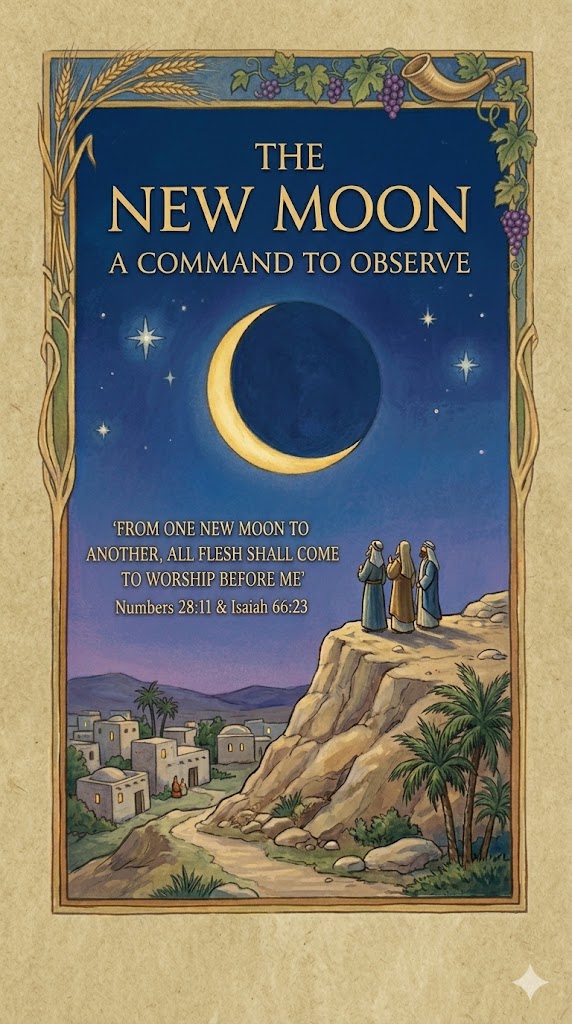
The New Moon a command to Observe
Introduction
The New Moons are treated as a small or unimportant matter by the churches today. Herbert W. Armstrong wrote that the Church does not observe the New Moons because they are not understood. But this is not what the Bible shows. The New Moon is not presented as an unclear or optional matter, but as a commanded part of God’s appointed times. It is tied directly to worship and recognition before God, and it appears in the structure of His system beyond the Old Covenant.
Proof — Command
➤ Numbers 28:11
“And in the beginnings of your months ye shall offer…”
This proves:
- It is commanded
- It is tied to worship
Proof — Ongoing (Future)
➤ Isaiah 66:23
“From one new moon to another… shall all flesh come to worship before me…”
This proves:
- It continues into future worship
- It is not limited to the Old Covenant system
The New Moon is not limited to the Old Covenant, but continues into the future Kingdom, where all flesh will come to worship from one New Moon to another (Isaiah 66:23).
Since the New Moons are largely unobserved by the churches today, and it has been stated that they are not understood, this booklet will examine the New Moon directly from Scripture. The question will not be answered by tradition or assumption, but by what is written.
The New Moons are largely unobserved by the churches today, and it has been stated that they are not understood. Yet the Bible presents the New Moon as part of God’s appointed structure. This booklet will examine the New Moon directly from Scripture, testing each element step by step to determine what is commanded, how it was observed, and what carries forward.
Chapter 1
To begin this booklet, we will take a short step back. While this work is focused on the New Moons, these things do not stand alone, but are part of a larger structure that works together.
Many modern churches do not keep what the Bible commands. The seventh-day Sabbath, the Passover, and the Holy Days are not widely observed, and the New Moons are rarely considered at all.
The question is not what is practiced, but what is written. The Bible presents these things plainly. The Sabbath is first established at creation, where God rested on the seventh day and blessed it (Genesis 2:2–3). This establishes both the timing and the reason for the day. No other day is described in this way.
The Sabbath is first established at creation. The text states that God ended His work on the seventh day, rested on that day, and then blessed and sanctified it (Genesis 2:2–3). The reason given in the text is directly tied to the rest: “because that in it he had rested from all his work.” No other day did God rest so the day cannot be changed. God set the day by His own actions of resting on the day and blessing he day because of the rest.
Genesis 2:2–3
“And on the seventh day God ended his work… and he rested…
And God blessed the seventh day, and sanctified it: because that in it he had rested…”
The other passage often referenced is found in 1 Corinthians. This section does not describe a worship service, but instructions for setting aside a collection for the poor. Each person is told to lay something aside on the first day of the week so that there would be no gathering needed when Paul arrived (1 Corinthians 16:1–2).
The text describes preparation, not a commanded assembly or a change in the day of worship.
There is no passage in Scripture that states the day God rested on was changed. The seventh day is identified at creation as the day God rested, and the blessing of that day is directly tied to that rest. Changing the day would remove the reason given in the text for why the day was set apart. The text does not support such a change.
Alongside this, the New Testament shows Christ and the apostles keeping the Sabbath. This is not presented as a disputed matter in the text, but as a continuing practice. For example, Christ is shown keeping the Sabbath (Luke 4:16), and Paul is shown reasoning in the synagogue on the Sabbath with both Jews and Gentiles (Acts 17:2; Acts 18:4).
There is no passage in Scripture that records a change from the seventh day to the first day.
The shift to widespread first-day observance appears later in history. By the fourth century, under the rule of Constantine I, a civil decree was issued in AD 321 referring to “the venerable day of the sun” as a day of rest. This language reflects the terminology already used in the Roman world, where the days of the week were associated with celestial bodies. The term “Sunday” itself comes from this same naming system, connected to the sun (Latin: dies Solis).
These developments occur outside of the biblical text and are not presented as commands from Christ or the apostles.
➤ Luke 4:16
“And he came to Nazareth… and, as his custom was, he went into the synagogue on the sabbath day…”
➤ Acts 17:2
“And Paul, as his manner was, went in unto them…”
The day was not name in Christ name and could have been the Catholic rename the day the “The Lord day” Caesar name the day after the Roman pagan god which had been worship on Sunday for hundreds of year reaching back before the Babylon empire “the day of the sun” (dies Solis), associated with the Roman sun god Sol.
Sol (Sol Invictus = “Unconquered Sun”)
This is not presented from tradition or assumption, but drawn directly from the text of Scripture and confirmed where applicable by history. The instruction is to hear what is written and to respond accordingly.
As it is written in Revelation 3:22:
“He that hath an ear, let him hear what the Spirit saith unto the churches.”
The Holy days
The Protestant churches teach that the Holy Days are no longer required under the New Covenant. This belief is not presented without Scripture, but is based on certain passages that are interpreted to mean the days have passed.
One of the main passages used is Colossians 2:16–17, where it speaks of holy days as a shadow of things to come. Other passages include Galatians 4:9–10, Romans 14:5, and Hebrews 10:1. These are used to support the conclusion that the observance of days is no longer required.
Colossians 2:16–17 states:
“Let no man therefore judge you… in respect of an holyday… or of the sabbath days: which are a shadow of things to come…”
This passage is often used to claim that the observance of these days is no longer required. However, the text itself does not state that these days have been removed or replaced. Instead, it addresses judgment—“let no man therefore judge you”—in connection with these observances.
The list includes holy days, new moons, and sabbath days—the same structure found throughout the Old Testament calendar. The passage does not separate them or redefine them, but refers to them together.
The instruction is not to abandon these things, but not to be judged in relation to them. The text addresses the issue of judgment, not the removal of what is being observed.
. ➤ Galatians 4:9–10 “Ye observe days, and months, and times, and years…” her the Protest say this is looking backward. Where they get this interpretation of the verse I do not know. However, this interpretation is ignorant of what the Holy Days represent. The Holy days was set by God in the OC they show the plan of God in it’s full. Going from the Passover to the White throne judgment and the second resurrection. Christ has not return at this time so the plan of God has not been fulfilled at this time. The Bible shows and repeated many times of the Apostle keeping the Holy days including Paul where much of these interpretation come from.
➤ Romans 14:5
“One man esteemeth one day above another: another esteemeth every day alike…”
This passage is often applied to the biblical Holy Days. However, the text does not mention the Sabbath, the New Moons, or any of the appointed times established in Scripture.
The broader context of the chapter addresses personal matters of conscience, including eating and dietary choices (Romans 14:2–3). The discussion centers on individual judgment in disputable matters, not on commandments that are clearly established elsewhere in Scripture.
The passage allows for personal conviction in areas of difference, but it does not redefine or remove days that are specifically commanded.
➤ Hebrews 10:1
“For the law having a shadow of good things to come…”
This passage is often used to conclude that the law, including the appointed times, is no longer relevant. However, the immediate context of Hebrews 10 addresses the sacrificial system, stating that the law could not make those who approached perfect through repeated offerings.
The phrase “shadow of good things to come” points forward, not backward. It identifies something that has not yet been fully brought to completion. The text does not state that the shadow is removed, but that it points to something greater.
The passage focuses on the insufficiency of animal sacrifices, not on the removal of the appointed times themselves. Therefore, it cannot be used on its own to conclude that the biblical calendar has been set aside.
These interpretations do not align with the text as written. The passages themselves do not state that the appointed times have been removed, but are often used to support that conclusion. This section is not addressing motive, but how these passages are being applied.
What is often left unaddressed are the examples in the New Testament showing the apostles continuing within the structure of these appointed times. These accounts must be considered alongside the interpretations in order to form a complete understanding.
➤ Acts 20:16
“For Paul had determined to sail by Ephesus… for he hasted… to be at Jerusalem the day of Pentecost.”
👉 Shows:
- Pentecost still recognized
- Timing still matters
➤ Acts 18:21
“I must by all means keep this feast that cometh in Jerusalem…”
👉 Shows:
- Feast observance continues
➤ Acts 17:2
“Paul, as his manner was, went in unto them… three sabbath days reasoned with them…”
👉 Shows:
- Ongoing Sabbath practice
As it is written in Revelation 3:22:
“He that hath an ear, let him hear what the Spirit saith unto the churches.
Passover
The Sabbath and the Holy Days are presented in Scripture as part of the covenant structure given to Israel. This raises a question about who the covenant applies to.
There is a common belief today that a separate covenant exists for Gentiles apart from Israel. However, the New Testament does not present two covenants—one for Israel and another for Gentiles. Instead, it shows Gentiles being brought into what was already established.
The covenant was given to Israel. Through Christ, access is opened so that Gentiles may be brought into that same covenant, not into a separate one. This is described by Paul as being joined to, or grafted into, what already exists.
📖 PROOF FROM PAUL (THIS IS YOUR CORE)
➤ Romans 11:17
“And if some of the branches be broken off, and thou, being a wild olive tree, wert grafted in among them…”
👉 Shows:
- Gentiles are grafted in
- Not a separate tree
➤ Ephesians 2:12–13
“At that time ye were without Christ, being aliens from the commonwealth of Israel…
But now in Christ Jesus ye who sometimes were far off are made nigh…”
👉 Shows:
- Gentiles were outside
- Then brought near to Israel’s commonwealth
➤ Romans 9:4
“Who are Israelites; to whom pertaineth… the covenants…”
👉 Shows:
- Covenants belong to Israel
“The New Testament does not present two covenants, but shows Gentiles being brought into what was already established.”
The importance of the Passover is often overlooked. While it is not always directly labeled as a “sign” in the same way as other elements, the text closely connects it to the covenant through circumcision.
In the Old Covenant, participation in the Passover was restricted to those who were circumcised. This establishes a direct connection between circumcision—identified as a sign of the covenant—and the Passover itself.
➤ Exodus 12:48
“And when a stranger shall sojourn with thee, and will keep the passover… let all his males be circumcised… and then let him come near and keep it…”
👉 Shows:
- Circumcision required
- Then → Passover allowed
The connection goes further. The text also shows that failure to keep the Passover results in removal from among the people. This ties participation in the Passover directly to remaining within the covenant community.
➤ Numbers 9:13
“But the man that is clean… and forbeareth to keep the passover, even the same soul shall be cut off…”
👉 Shows:
- Not keeping Passover → cut off
- This is covenant-level consequence
- The Passover is also connected to the fulfillment of circumcision under the New Covenant. In the New Testament, circumcision is no longer presented as physical, but as inward—of the heart (Romans 2:28–29). This describes a change that is not outward, but internal.
This inward change is connected with life. In the Gospel of John, Christ makes a direct statement:
“Except ye eat the flesh of the Son of man, and drink his blood, ye have no life in you” (John 6:53).
The statement connects life with participation in Christ. It does not describe a general idea, but something specific that must be received.
Christ later establishes the form of this participation at the Passover, where the bread and wine are given as symbols of His body and blood (Luke 22:19–20). This ties the instruction in John to a defined observance.
The connection shows that the Passover remains directly linked to covenant participation, now expressed through the New Covenant in Christ.
📖 Supporting verses (add these)
➤ Romans 2:28–29
“Circumcision is that of the heart…”
➤ John 6:53
“Except ye eat… and drink… ye have no life in you…”
➤ Luke 22:19–20
“This is my body… This cup is the new covenant in my blood…”
The Passover is defined by Christ Himself. It is not left open to interpretation, but is established with a specific time and a defined observance. The elements, the meaning, and the manner are all given directly in the text.
➤ Luke 22:15
“With desire I have desired to eat this passover with you before I suffer.”
👉 Shows:
- Christ is keeping Passover
- It is a specific event in time
➤ Luke 22:7
“Then came the day of unleavened bread, when the passover must be killed.”
👉 Shows:
- There is an appointed day
- Not random or continuous
➤ Luke 22:19–20
“This is my body… This cup is the new covenant in my blood…”
👉 Shows:
- Bread → defined meaning
- Wine → defined meaning
- Not symbolic guesswork—direct instruction
- Added to this is the foot washing
The Passover is not a general practice, but a defined observance set at a specific time by Christ.
Because the time and observance are both defined, they cannot be altered without departing from what is established in the text by Christ Himself.
The Passover and the following night are closely connected in the text, but they are not identical. The Passover is tied to the fourteenth day, while the following night begins the fifteenth. These two are placed next to each other, which has led to them often being treated as one event.
However, the text distinguishes between the killing of the lamb and the night that follows. The lamb is associated with the fourteenth day, and the observance that follows moves into the next day, beginning at sunset according to the biblical reckoning of a day.
➤ Leviticus 23:5
“In the fourteenth day of the first month… is the LORD’s passover.”
👉 Locks:
- Passover = 14th day
➤ Exodus 12:42
“It is a night to be much observed unto the LORD…”
👉 This is:
- The night following
- Associated with deliverance
➤ Leviticus 23:6
“And on the fifteenth day… is the feast of unleavened bread…”
👉 Locks:
- Next day = 15th
The text places the Passover on the fourteenth day and the following observance on the fifteenth, beginning at sunset.
The text distinguishes between the Passover on the fourteenth day and the following night beginning the fifteenth. Because these occur back-to-back, they are often treated as a single observance. However, the structure in the text shows a distinction between the two.
This pattern continues in modern Jewish practice, where the distinction between the fourteenth and the fifteenth is not maintained in the same way the text presents it. This is also observe in the same way by the Jehovah witness church today.
Christ established the Passover observance by separating it from the events that follow. The killing of the lamb was associated with the fourteenth day, while the following night begins the fifteenth and the Days of Unleavened Bread.
Christ brought the disciples together at the beginning of the fourteenth day, at sunset. At that time, He established the observance of the Passover—defining the bread the wine and foot washing setting the day the time and the manner in which it was to be kept.
By doing this, Christ placed the Passover at the start of the fourteenth, distinct from the following night and the Holy Days that begin on the fifteenth.
➤ Timing (start of 14th)
- Luke 22:14–15
👉 Christ sits down before His suffering, at the appointed time - ➤ Definition of observance
- Luke 22:19–20
👉 Bread, wine and foot washing was defined
➤ Separation in the Law
- Leviticus 23:5–6
👉 14th = Passover
👉 15th = Unleavened Bread
This was the fulfillment of the Passover established under the Old Covenant. The sacrifice of the lamb pointed forward to Christ. Through His blood and death, the physical sacrifice was fulfilled, and the meaning of the Passover was brought into its full expression.
➤ 1 Corinthians 5:7
“For even Christ our passover is sacrificed for us:”
👉 This is your key verse
- Christ = Passover
- Sacrifice = fulfilled in Him
➤ Hebrews 10:1
“The law having a shadow of good things to come…”
👉 Shows:
- Old Covenant sacrifices = shadow
- Christ = reality / fulfillment
➤ Hebrews 9:12
“…by his own blood he entered in once… having obtained eternal redemption…”
👉 Confirms: His blood replaces repeated sacrifices The Passover lamb under the Old Covenant pointed forward to Christ, whose sacrifice fulfilled what the physical lamb represented.
It is important to understand the meaning of the Passover and the Sabbath. Both are directly connected to the covenant God made with Israel.
The Passover was established at the time Israel was brought out of Egypt. It marked the final plague, when the blood of the lamb was placed on the houses of the children of Israel. This blood was given as a sign, and those who followed the instruction were spared.
The Passover therefore identified those who obeyed God’s command and were brought out under His deliverance. It became part of the foundation leading into the covenant later established at Mount Sinai.
📖 PROOF — THE SIGN
➤ Exodus 12:13
“And the blood shall be to you for a sign upon the houses…”
👉 Locks:
- Blood = sign
- Connected to obedience
📖 PROOF — DELIVERANCE
➤ Exodus 12:27
“…when he smote the Egyptians, and delivered our houses.”
👉 Shows:
- Passover = deliverance event
➤ Exodus 19:5
“If ye will obey my voice… then ye shall be a peculiar treasure unto me…”
👉 Shows:
- Covenant tied to obedience
- Comes after deliverance
The Passover marked those who obeyed God’s instruction and were brought out under His deliverance, forming the foundation for the covenant that followed.
The Passover was established before the covenant was given at Mount Sinai. The Sabbath was also established before Sinai.
In the wilderness, before the covenant was given, God provided manna for Israel. The manna was given each day, but it would not remain until the next day. However, on the sixth day, a double portion was given, and it was preserved for the following day.
This was the only time the manna remained without spoiling. This established the pattern of the Sabbath before the covenant was formally given at Sinai.
📖 PROOF — MANNA & SABBATH
➤ Exodus 16:4
“I will rain bread from heaven… that I may prove them…”
👉 Before Sinai (Exodus 19)
➤ Exodus 16:22–24
Sixth day → double portion
It did not spoil
➤ Exodus 16:26
“The seventh day… there shall be none.”
👉 Sabbath already operating
📖 PROOF — PASSOVER BEFORE SINAI
➤ Exodus 12
👉 Passover established in Egypt
➤ Exodus 19
👉 Sinai covenant comes later
Both the Passover and the Sabbath were established before the covenant at Sinai, showing they were not introduced at Sinai but already in place.
There was also another sign given under the covenant God made with Abraham. This sign was circumcision. Every male child was to be circumcised, and this was established as a sign of the covenant.
This covenant was made with Abraham long before the covenant given at Mount Sinai. Circumcision therefore stands as an earlier covenant sign, preceding the later covenant established with Israel.
📖 PROOF — COVENANT WITH ABRAHAM
➤ Genesis 17:10–11
“This is my covenant… Every man child among you shall be circumcised… and it shall be a token of the covenant…”
👉 Locks:
- Circumcision = sign (token) of the covenant
- Given to Abraham
📖 BEFORE SINAI
- Abraham → Genesis 17
- Sinai → Exodus 19–20
👉 Clear order:
- Abraham covenant comes first
Circumcision was established as a sign of the covenant with Abraham, long before the covenant given at Mount Sinai.
Circumcision was given as a sign of the covenant with Abraham, and only those who were circumcised could partake of the Passover. The Passover was not optional—if a person refused to keep it when required, they were cut off from among the people. This shows that the Passover was a required part of covenant participation sign
➤ Numbers 9:13
“But the man that is clean… and forbeareth to keep the passover, even the same soul shall be cut off from among his people…
The Passover was not merely symbolic—it was required. Those who refused it were cut off, showing it was an essential part of covenant life.
The Passover began with a sign—the blood placed on the houses. This sign identified those who obeyed God’s command and were spared. The Passover was then established as an ongoing observance, required of those within the covenant. In this way, the Passover carries forward the function of identifying God’s people, even though it is not directly called a sign in the same manner as circumcision or the Sabbath.
Circumcision is directly called a sign of the covenant. The Passover is not directly called a sign, but it is inseparably tied to the covenant sign of circumcision, as only those within the covenant could partake of it, and refusal to keep it resulted in being cut off. This establishes the Passover as a required covenant observance.
In the New Covenant, the outward sign of circumcision is fulfilled inwardly. Scripture describes this as a circumcision of the heart, associated with the work of the Spirit.
Christ then connects life to partaking of Him. In His teaching, He states that unless one eats His flesh and drinks His blood, there is no life in them. Later, at the Passover, He defines this participation through the bread and the cup.
This establishes a connection between the inward work described as circumcision of the heart and the participation defined at the Passover, bringing the meaning forward from the Old Covenant into the New.
📖 PROOF — CIRCUMCISION OF THE HEART
➤ Romans 2:28–29
“…circumcision is that of the heart, in the spirit…”
👉 Shows:
- Shift from physical → inward
➤ Colossians 2:11
“In whom also ye are circumcised with the circumcision made without hands…”
👉 Confirms:
- Not physical, but inward/spiritual
📖 PROOF — LIFE CONNECTED TO PARTAKING
➤ John 6:53
“Except ye eat the flesh of the Son of man, and drink his blood, ye have no life in you.”
👉 Establishes:
- Life ↔ partaking of Christ
📖 PROOF — PASSOVER DEFINED BY CHRIST
➤ Luke 22:19–20
Bread and cup defined
👉 This is where:
- Christ gives the form of participation
The Passover began as a sign event in the Old Covenant, identifying those who obeyed God’s command. It was then established as a required observance within the covenant, restricted to those under the covenant and enforced by removal if refused.
In the New Covenant, circumcision is fulfilled inwardly, and life is connected to participation in Christ. Christ defines that participation through the Passover observance of the bread and the cup.
This establishes a continuous structure from the Old Covenant to the New, where the Passover remains directly connected to covenant identity and participation, even though it is not explicitly called a sign in the same manner as circumcision or the Sabbath.
Holy Days
The Holy Days are not identified in Scripture as a sign of the covenant people, but they are established as God’s appointed times. These appointed times reveal the structure and progression of God’s plan, showing what the covenant accomplishes rather than identifying who is within it.
While the Sabbath and circumcision are directly identified as signs of the covenant with Passover link to the signs, the Holy Days are given as appointed times that outline the work and fulfillment of God’s plan. They do not function to identify the covenant people, but to reveal the structure of the covenant itself.
Chapter 3- The Confusion
To understand where the confusion began, we must take a brief look at how the term “early church” is used.
Historians often use this phrase to describe the period that follows the apostles. However, this creates a blending of two different things. The church established by the apostles is what is recorded in Scripture this is the early church. What developed after the apostles is a historical record, not the same authority as the text.
Over time, the center of influence shifted. The church in Jerusalem, which had been led by Jewish leaders those closest to the original teaching, was disrupted during the Roman period. Following the events surrounding the Bar Kokhba revolt (132–135 AD), Jerusalem was restructured under Roman control, and all Jew was removed, the population changed, and the city itself was renamed.
These changes affected leadership, practice, and continuity. What remained in later historical records reflects this transition.
The “early church” of Scripture and what followed it are not the same thing.
When that distinction is not made, confusion follows.
Rome
A similar disruption took place in Rome earlier.
During the first century, conflict arose among the Jewish population in Rome. Historical records note disturbances connected to disputes within the Jewish community. As a result, Jews were expelled from the city under the authority of the Roman government.
This removal affected the early congregation in Rome, which had included Jewish leadership. With their absence, Gentile believers continued and naturally took on a greater role in leadership and practice.
When Jewish believers later returned, tension existed between the two groups. This situation is reflected in the writings of Paul, where he addresses both Jewish and Gentile believers within the same congregation.
Paul gives a direct warning to the Gentiles:
➤ Romans 11:17–18
“Thou, being a wild olive tree, wert graffed in among them… boast not against the branches…”
The point is clear. The Gentiles were brought into an existing covenant structure—they did not replace it or become a separate foundation.
This warning shows that a shift was already taking place, and that without maintaining that understanding, conflict and confusion would follow.
At this point, we must be careful in how we present the historical record.
History does not always provide confirmed facts in the same way Scripture does. Much of what is preserved from this period comes through testimony, and historians themselves distinguish between levels of certainty.
With that in mind, there is a well-known account involving a man named Polycarp, who is described in historical sources as a student of the apostle John. He served as a leading figure among the churches in Asia Minor in the second century.
According to these accounts, Polycarp traveled to Rome and met with Anicetus, the bishop there, regarding the observance of Passover.
The difference was clear. Polycarp maintained the practice of observing Passover on the 14th day, consistent with what had been received earlier. The Roman position, however, emphasized the first day of the week in connection with the resurrection.
The historical record is limited, and the details of the discussion are not fully preserved. However, it is generally recorded that the two parted on respectful terms, even though the disagreement remained unresolved.
This account, while not Scripture, provides testimony that differing practices were already present by this time.
This is where much of the confusion begins.
When the historical record is examined, what is often called the “early church” is not a single, unified body with one consistent practice. Instead, there are clear differences between regions—particularly between Rome and the churches of Asia Minor.
Testimony from the second century shows this difference. Polycarp, who is described as a student of the apostle John, maintained the observance of Passover on the 14th day, consistent with what had been received earlier. In contrast, the church in Rome held to a different emphasis, associating observance with the first day of the week.
This disagreement is recorded in the meeting between Polycarp and Anicetus. While the full details are limited, the difference in practice is clear.
From Scripture, the focus of the Passover is the death of Christ, not the day of the resurrection. The observance established by Christ centers on His body and blood, given at the appointed time.
Over time, changes in practice developed in Rome. The 14th-day observance was not maintained, and the first day of the week became more prominent. The seventh-day Sabbath was also not consistently preserved in later Roman practice.
In addition, other observances developed that are not defined in the biblical text. For example, celebrations such as Christmas are not established by command in Scripture, and the date itself does not come from the biblical record. Similarly, the spring celebration later called Easter reflects a development in terminology and practice not found in the original Passover instructions.
These changes reflect a shift away from the structure found in Scripture. This is not established by assumption, but by comparing what is written with what developed later in history.
These later developments also correspond with practices that were already present in the Roman world.
For example, the celebration later known as Christmas falls at the time of existing midwinter festivals connected with the return of light. The observance called Easter reflects terminology and seasonal themes that were already associated with springtime fertility and renewal. Easter also a lines with the worship of Sunday morning sunrise worship condemned in the Bible. The use of Sunday as a primary day of worship aligns with the long-standing significance of the “day of the sun” in Roman culture.
These event of the removal of Passover, the seventh day sabbath and the Holy Days in the Bible show that the practices that developed later correspond to existing pagan cultural patterns rather than to commands found in the biblical text.
When compared directly with Scripture, the difference becomes clear. The Bible defines specific times and observances, while these later practices are not established from the Bible but all have pagan origins. History can confirm what was written without question.
When studying the Bible—especially doctrines that relate to salvation—it is necessary to look for patterns of deception. This is not a question of judging motive, but of identifying where what is practiced does not match what is written.
For a change in practice to stand, it must be supported by the text. In the case of Sunday observance, passages such as those in Acts and 1 Corinthians are often used. However, when examined in context, these passages do not establish a replacement for the 14th-day Passover or the seventh-day Sabbath.
Beyond this, deception is often found not only in what is said, but in what is left out. The Passover is clearly defined in Scripture. It is not presented as a general or weekly observance, but as a specific, appointed time.
Paul reinforces this:
➤ 1 Corinthians 11:26–27
“As often as ye eat this bread, and drink this cup… whosoever shall eat… unworthily, shall be guilty…”
Paul does not redefine the Passover—he confirms its meaning and warns of the seriousness of its observance. This is not a casual practice, but one tied directly to judgment when handled improperly.
A similar issue appears in how certain verses are used to set aside the Holy Days.
➤ Colossians 2:16–17
“Let no man therefore judge you… in respect of an holyday… or of the sabbath days: Which are a shadow of things to come…”
This verse is often used to claim that these observances are no longer required, interpreting the passage as looking backward. However, this conclusion does not come from the text itself, but from how the verse is applied.
The passage does not say the Holy Days have ended—it states they are a shadow of things to come, pointing forward, not backward.
What is left out is the consistent example in Scripture showing the apostles continuing in these practices. The same writings used to argue against the Holy Days and the sabbath also show them being observed.
When a single verse is used to overturn a pattern established throughout Scripture, the problem is not with the text, but with the interpretation.
When these things are placed side by side, the difference becomes clear. The practices recorded in Scripture and those that developed later are not the same.
With that distinction established, we can now turn to a subject that is often overlooked, yet directly commanded—the New Moons.
Rev 3:22 He that hath an ear, let him hear what the Spirit saith unto the churches.
Chapter 4 – The New Moons
This booklet is about the New Moons, so why has so much been established before reaching this point?
The reason is simple: these things are not separate—they work together.
Some churches keep the seventh-day Sabbath but do not observe the Passover as it is defined in Scripture. Others observe the Passover but do not keep the seventh-day Sabbath. Most do not keep the Holy Days.
There are a few that keep the Sabbath, the Passover, and the Holy Days together. However, even among these, the New Moons are often not observed.
This shows that while parts of the structure are present in different places, the full pattern is rarely seen together.
This shows that while parts of the structure exist, the full pattern is rarely held together.
NEW MOONS ARE COMMANDED
The New Moons are not a tradition or a minor detail—they are commanded in the Bible.
📖 COMMAND IN THE LAW
➤ Numbers 10:10
“In the day of your gladness… and in the beginnings of your months, ye shall blow with the trumpets…”
✔️ “Beginnings of your months” = New Moons
✔️ Not optional → commanded observance
📖 OFFERINGS REQUIRED
➤ Numbers 28:11
“In the beginnings of your months ye shall offer…”
✔️ Specific sacrifices required
✔️ Set timing → recurring command
➤ 1 Chronicles 23:31
“…in the sabbaths, in the new moons, and on the set feasts…”
✔️ Listed together:
- Sabbath
- New Moons
- Holy Days
👉 Same system
📖 CONTINUAL OBSERVANCE
➤ 2 Chronicles 2:4
“…on the sabbaths, and on the new moons, and on the solemn feasts…”
✔️ Ongoing pattern
✔️ Not isolated or temporary
The New Moons are established in Scripture as part of the commanded system of worship. They are placed alongside the Sabbath and the Holy Days, showing they are not separate or optional, but part of the same structure.
The New Moons are often not observed, and one reason given is that they are not fully understood.
However, lack of understanding does not remove what is commanded. The Bible establishes the New Moons as part of the same system as the Sabbath and the Holy Days.
Before understanding how the New Moons are observed, we must first define what the New Moon is.
This is where much confusion begins, because many do not understand what marks the beginning of a month. Some believe the full moon marks the start, but the opposite is true.
The New Moon begins when the moon is not visible in the sky. This marks the start of a new month. From that point, the moon begins to grow in light until it reaches the full moon.
This provides a clear and observable pattern. For example, if Passover is kept on the 14th day of the month, it will occur at or near the full moon. This shows that the full moon is not the beginning, but the middle of the cycle.
The cycle itself confirms the count. The New Moon marks the beginning, and the full moon confirms the midpoint.
Rotation
To understand the New Moons, we must first ask: how did God establish time?
The Bible shows that time is set through the heavenly bodies.
➤ Genesis 1:14
“…let them be for signs, and for seasons, and for days, and years…”
The day and the year are determined by the earth’s relationship with the sun. A full cycle of the earth’s orbit establishes the year.
The month, however, is determined by the cycle of the moon around the earth. The moon moves through its phases in approximately 29½ days, marking the beginning and progression of each month.
This creates an important difference. A solar year is about 365 days, while twelve lunar months total approximately 354 days. This results in a gap of about 11 days each year.
This difference is not an error—it is part of the system. The sun establishes the year and the days, and the moon establishes the months. Together, they form the structure of time that the Bible uses
HOW THE NEW MOON WAS KNOWN
Before explaining the difference between the solar and lunar cycles, we must first ask: how did the people know when the New Moon began?
It is often assumed that this was determined only by observation. While observation is one way to recognize the cycle, the biblical record shows that the timing of the New Moon was also known in advance.
➤ 1 Samuel 20:5
“Behold, tomorrow is the new moon…”
This statement shows that the New Moon was anticipated ahead of time. It was not discovered after the fact, but expected on a known day.
➤ 1 Samuel 20:18
“Tomorrow is the new moon, and thou shalt be missed…”
Again, the timing is known in advance. This reflects a structured system, not an uncertain observation.
The New Moons were part of an ordered calendar. They were appointed times, just as the Sabbaths and Holy Days were appointed times.
This shows that the New Moon was not left to guesswork, but was part of a known and repeatable cycle.
THE 11-DAY DIFFERENCE
This brings up an important question: how does the Bible account for the difference between the solar year and the lunar months?
As shown, a solar year is approximately 365 days, while twelve lunar months total about 354 days. This creates a difference of about 11 days each year.
If this difference were not corrected, the appointed times would move out of their proper seasons.
The Bible shows that the timing of the year is tied to the seasons, specifically to the harvest cycle.
➤ Exodus 13:4
“This day came ye out in the month Abib.”
➤ Exodus 23:15
keep the feast of unleavened bread… in the time appointed of the month Abib…”
The word Abib refers to the stage of the barley harvest, showing that the calendar is tied to the agricultural season.
Because of this, the year must remain aligned with the harvest cycle. When the difference between the solar year and the lunar months becomes too great, an additional month is added to bring the calendar back into alignment.
This results in a 13th month when needed, ensuring that the appointed times remain in their proper season.
“If this difference were not corrected, the appointed times would move out of their proper seasons.”
WHY THE ROMAN CALENDAR DOES NOT FIT
This also shows why a solar-only calendar cannot be used to determine the appointed times in the Bible.
The commonly used calendar today is based on the solar year. It fixes the length of months and keeps the year aligned only with the sun.
In Scripture, however, time is not set by the sun alone. While the day and the year are tied to the sun, the months are determined by the cycle of the moon.
Because of this, the biblical calendar does not function the same way as a solar-only system.
For example, if Passover were set on the same date each year in a solar calendar, it would never move. However, in a system based on lunar months, the cycle naturally shifts by about 11 days each year unless it is corrected.
This is why an adjustment is required. The additional month restores alignment so that the appointed times remain in their proper season.
The difference is not small—it affects the timing of the commanded observances. A fixed solar calendar cannot account for this structure, while the biblical system requires both the sun and the moon working together.
“The biblical system requires both the sun and the moon working together.”
HOW THE ADJUSTMENT IS HANDLED
In earlier times, the condition of the barley harvest was used to confirm the timing of the year. If the barley was not yet at the proper stage, the year would be delayed so that the appointed times remained in their proper season.
This shows that the calendar was not fixed to a set number of days alone, but was tied to the seasonal cycle.
As already shown, the New Moons were known in advance, indicating that the system followed a consistent and repeatable pattern. Because the difference between the solar year and the lunar months is regular, the adjustment itself follows a pattern as well.
In practice, this results in the addition of an extra month at set intervals to maintain alignment with the seasons. A commonly used method places seven additional months within a nineteen-year cycle, keeping the calendar in order.
This does not change the structure given in Scripture, but reflects a way of maintaining that structure so that the appointed times remain in their proper season.
ON USING AI
At this point, something should be made clear. The understanding presented here did not come from personal intelligence or study alone.
The information that brings this into focus can be difficult to gather and organize. It requires bringing together multiple parts into one clear structure. What would normally take significant time and effort can now be made accessible through tools such as artificial intelligence.
This does not replace the need to test what is shown against the text. It simply allows the information to be brought together more quickly and clearly.
The point is not to present something complex, but to show that when the structure is laid out plainly, it is simple enough to be understood.
The Bible consistently shows that understanding is not reserved for the learned, but is given to those who are willing to receive it. When the information is presented clearly, even a child can follow it.
“It simply allows the information to be brought together more quickly and clearly.”
UNDERSTANDING VS OBSERVANCE
As can be seen, the structure itself is not difficult to understand.
This brings us back to a common statement—that the New Moons are not observed because they are not understood.
What has been shown here makes something clear: the system itself is not complex. Once it is laid out, it can be followed step by step.
The issue, then, is not with understanding how the calendar works, but with how the New Moons are to be observed.
This is where the difficulty arises. The Bible establishes the New Moons as commanded, but it does not describe their observance in the same level of detail as the Sabbath or the Passover.
The Sabbath is clearly defined as a day of rest. The Passover is defined by a specific time and observance. The Holy Days are given with clear instructions.
With the New Moons, however, the instruction is not laid out in the same way. There are examples and indications in the text, but not a single detailed command describing exactly how the day is to be kept.
This is where the focus must shift—from questioning whether the New Moons should be kept, to understanding what the Bible does show about their observance.
If the New Moons were intended to have the same detailed format as the Sabbath or the Passover, that instruction would be clearly laid out in the text.
At the same time, if they were not meant to be observed, they would not be commanded alongside the Sabbath and the Holy Days.
This places the New Moons in a unique position. They are established and commanded, yet not defined with the same level of detailed instruction.
The biblical record does, however, provide examples of how they were recognized. These examples show gatherings, meals, and acknowledgment of the day.
From this, a pattern can be seen—not a rigid structure, but a consistent recognition of the time.
The New Moon, therefore, reflects a time of gathering and acknowledgment among God’s people. It is not defined by strict ceremonial detail, but by recognition of the appointed time.
What stands out most is the sense of fellowship—both among the people and in relation to God—centered around a time that He established.
WHAT WAS DONE ON THE NEW MOON
This does not mean the New Moon was without meaning or structure.
The biblical record shows that it was recognized as a time of worship and acknowledgment. Offerings were given, and the day was marked as part of the established system.
➤ Numbers 10:10
“…in the beginnings of your months… ye shall blow with the trumpets…”
➤ Numbers 28:11
“…in the beginnings of your months ye shall offer…”
These commands show that the New Moon was actively recognized before God.
The record also shows gatherings associated with the day.
➤ 1 Samuel 20
✔️ A meal is connected with the New Moon
✔️ People are expected to be present
In addition, there are indications that it was a time when people sought instruction.
➤ 2 Kings 4:23
“…Wherefore wilt thou go to him today? it is neither new moon, nor sabbath.”
This shows that both the Sabbath and the New Moon were recognized times for gathering and seeking guidance.
At the same time, the Bible does not define the New Moon as a full day of rest in the same way as the Sabbath.
Taken together, these elements show a clear pattern: the New Moon was a time of recognition, offering, gathering, and acknowledgment before God, without the same detailed structure given to other appointed times.
“a time of recognition, offering, gathering, and acknowledgment before God”
NEW MOONS IN THE KINGDOM
The final point to understand about the New Moons is their lasting importance.
The Bible shows that this is not a temporary command, but something that continues beyond the present age.
➤ Isaiah 66:23
“And it shall come to pass, that from one new moon to another, and from one sabbath to another, shall all flesh come to worship before me, saith the Lord.”
This shows that the New Moons continue into the future, even into the time when all flesh comes before God.
The New Moon is placed alongside the Sabbath, showing it remains part of the established pattern of worship.
This confirms that the New Moons are not limited to the past, but are part of the continuing structure God has set.
What has been presented in this booklet is the structure God has established.
The Sabbath, the Passover, the Holy Days, and the New Moons are not separate ideas—they form a complete pattern.
The Bible shows that the covenant was given to Israel. The New Covenant does not replace this, but brings others into it.
Grace is not presented in Scripture as something separate from this structure. It is given within it. What God offers, He offers according to His terms, not ours.
Throughout the Bible, what is given by God is connected to what He has established. The appointed times are part of that structure.
This has been laid out so that it can be seen directly from the text.
The responsibility does not rest with the one presenting it, but with the one hearing it.
“He that hath an ear, let him hear what the Spirit saith unto the church
“What God offers, He offers according to His terms, not ours.”